
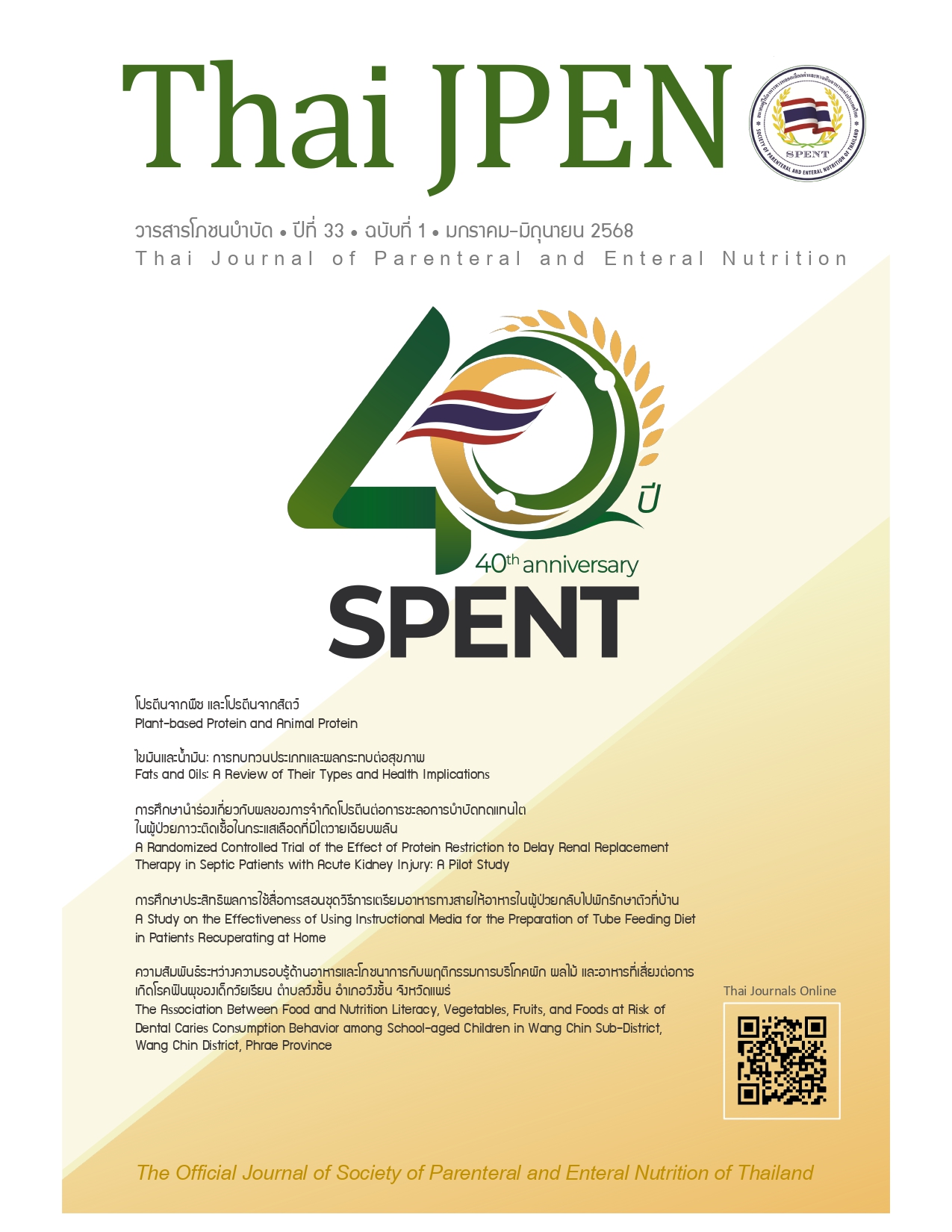
A Randomized Controlled Trial of The Effect of Protein Restriction to Delay Renal Replacement Therapy in Septic Patients with Acute Kidney Injury: A Pilot Study
Keywords:
acute kidney injury, critical illness, sepsis, renal replacement therapy, protein intake, catabolismAbstract
Background: Acute kidney injury (AKI) is a common complication in septic patients. A nutritional guideline for AKI is to increase protein intake to less negative nitrogen balance. However, clinicians are still concerned about increased blood urea nitrogen from high protein intake, causing required renal replacement therapy (RRT). In contrast, limited protein intake may negatively affect critically ill patients. As a result, the issue of protein requirement in AKI still needs to be clarified.
Objective: The authors aimed to investigate the impact of limited protein intake on delayed dialysis time in septic patients with AKI. Materials and Methods: An unblinded, randomized, controlled trial was conducted in septic patients with AKI. The participants were randomized into study group which limited protein intake at 0.9-1.0 g/kg/d or a control group receiving protein at 1.2-1.5 g/kg/d. Both groups received the same nutrition care.
Results: A total of 25 patients underwent randomization. The mean age in the study and control groups were 75.3 ± 18.7 and 75.7 ± 18.5 years old (p = 0.96). Baseline GFR were 77.8 ± 20, 68.5 ± 18.2 ml/min/1.73 m2 (p = 0.23). The Kaplan–Meier estimates of time to dialysis did not differ significantly (p = 0.966). There was no significant difference in 30-day mortality, hospital-acquired and catheter-related bloodstream infection in study and control group at 50% vs. 38.5%, p 0.561, 75% vs. 61.5%, p 0.673, and 16.7% vs. 0%, p 0.22, respectively.
Conclusion: There was no significant difference in time to dialysis between protein intake at 0.9-1 g/kg/d and 1.2-1.5 g/kg/d in septic AKI patients. Therefore, lower protein intake may not help to delay RRT in patients with sepsis and AKI.
References
Fiaccadori E, Parenti E, Maggiore U. Nutritional support in acute kidney injury. J Nephrol 2008;2:645-56.
McCarthy MS, Phipps SC. Special nutrition challenges: current approach to acute kidney injury. Nutr Clin Pract 2014;29:56-62.
Griffin BR, Liu KD, Teixeira JP. Critical Care Nephrology: Core Curriculum 2020. Am J Kidney Dis 2020;75:435-452.
Gervasio JM, Garmon WP, Holowatyj M. Nutrition support in acute kidney injury. Nutr Clin Pract 2011;26:374-81.
Wiesen P, Van Overmeire L, Delanaye P, Dubois B, Preiser JC. Nutrition disorders during acute renal failure and renal replacement therapy. J Parenter Enteral Nutr 2011;35:217-22.
Druml W. Nutritional management of acute renal failure. J Ren Nutr 2005;15:63-70.
Cano NJ, Aparicio M, Brunori G, Carrero JJ, Cianciaruso B, Fiaccadori E, et al. ESPEN Guidelines on Parenteral Nutrition: adult renal failure. Clin Nutr 2009;28:401-14.
Cano N, Fiaccadori E, Tesinsky P, Toigo G, Druml W, Kuhlmann M, et al. ESPEN Guidelines on Enteral Nutrition: Adult renal failure. Clin Nutr 2006;25:295-310.
Kopple JD. Abnormal amino acid and protein metabolism in uremia. Kidney Int 1978;14:340-8.
Yan B, Su X, Xu B, Qiao X, Wang L. Effect of diet protein restriction on progression of chronic kidney disease: A systematic review and meta-analysis. PLoS One 2018;13:e0206134.
Weijs PJ, Stapel SN, de Groot SD, Driessen RH, de Jong E, Girbes AR, et al. Optimal protein and energy nutrition decreases mortality in mechanically ventilated, critically ill patients: a prospective observational cohort study. J Parenter Enteral Nutr 2012;36:60-8.
McClave SA, Taylor BE, Martindale RG, Warren MM, Johnson DR, Braunschweig C, et al. Guidelines for the Provision and Assessment of Nutrition Support Therapy in the Adult Critically Ill Patient: Society of Critical Care Medicine (SCCM) and American Society for Parenteral and Enteral Nutrition (ASPEN). J Parenter Enteral Nutr 2016;40:159-211.
Brown RO, Compher C. ASPEN clinical guidelines: nutrition support in adult acute and chronic renal failure. J Parenter Enteral Nutr 2010;34:366-77.
Fiaccadori E, Sabatino A, Barazzoni R, Carrero JJ, Cupisti A, De Waele E, et al. ESPEN guideline on clinical nutrition in hospitalized patients with acute or chronic kidney disease. Clin Nutr 2021;40:1644-68.
Palevsky PM, Liu KD, Brophy PD, Chawla LS, Parikh CR, Thakar CV, et al. KDOQI US commentary on the 2012 KDIGO clinical practice guideline for acute kidney injury. Am J Kidney Dis 2013;61:649-72.
Singer M, Deutschman CS, Seymour CW, Shankar-Hari M, Annane D, Bauer M, et al. The third international consensus definitions for sepsis and septic shock (Sepsis-3). JAMA 2016;315:801-10.
Matsuzawa Y, Tokunaga K, Kotani K, Keno Y, Kobayashi T, Tarui S. Simple estimation of ideal body weight from body mass index with the lowest morbidity. Diabetes res and clin pract 1990;10:S159-S164.
Mehanna HM, Moledina J, Travis J. Refeeding syndrome: what it is, and how to prevent and treat it. BMJ 2008;336:1495-8.
Knaus WA, Draper EA, Wagner DP, Zimmerman JE. APACHE II: a severity of disease classification system. Crit Care Med 1985;13:818-29.
Lie KC, Lau C-Y, Van Vinh Chau N, West TE, Limmathurotsakul D, for Southeast Asia Infectious Disease Clinical Research N. Utility of SOFA score, management and outcomes of sepsis in Southeast Asia: a multinational multicenter prospective observational study. J Intensive Care 2018;6:9.
Demirjian S, Chertow GM, Zhang JH, O’Connor TZ, Vitale J, Paganini EP, et al. Model to predict mortality in critically ill adults with acute kidney injury. Clin J Am Soc Nephrol 2011;6:2114-20.
Singer P. High-dose amino acid infusion preserves diuresis and improves nitrogen balance in nonoliguric acute renal failure. Wien klin Wochenschr 2007;119:218-22.
Zusman O, Theilla M, Cohen J, Kagan I, Bendavid I, Singer P. Resting energy expenditure, calorie and protein consumption in critically ill patients: a retrospective cohort study. Crit Care 2016;20:367.
Sabatino A, Theilla M, Hellerman M, Singer P, Maggiore U, Barbagallo M, et al. Energy and protein in critically Ill patients with AKI: A prospective, multicenter observational study using indirect calorimetry and protein catabolic rate. Nutrients 2017;9:802.
Downloads
Published
How to Cite
Issue
Section
License
Copyright (c) 2025 Thai JPEN วารสารโภชนบำบัด

This work is licensed under a Creative Commons Attribution-NonCommercial-NoDerivatives 4.0 International License.
The content and information in the articles published in Thai JPEN วารสารโภชนบำบัด, are the opinions and responsibility of the authors directly. The editorial team is not obliged to agree or take any responsibility.
All articles, content, figures, etc. that have been published in Thai JPEN วารสารโภชนบำบัด are the copyright of Thai JPEN วารสารโภชนบำบัด. If any person or organization require distribution of all or any part of them, please send the request for the written permission from Thai JPEN วารสารโภชนบำบัด only.

