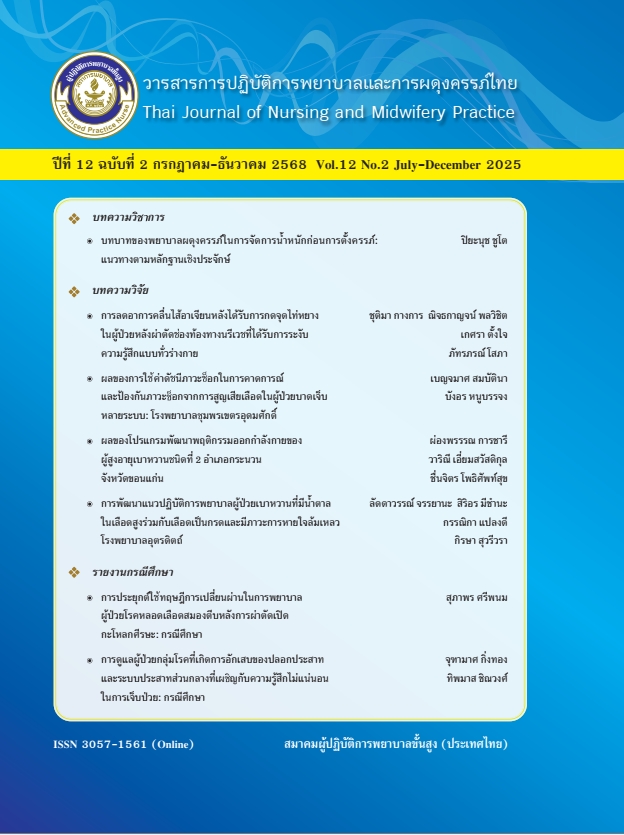
The role of nurse and midwifery in preconception weight management: An evidence-based approach
Article Sidebar
Main Article Content
Abstract
Abstract: Weight management for women in the preconception period is an important, though often overlooked, aspect of healthcare that significantly impacts the health of both mother and fetus. The worldwide prevalence of overweight and obesity in women of childbearing age is increasing, positioning nurses and midwives in a key role to screen, counsel, and support women in achieving a healthy weight before pregnancy. Evidence shows that a woman's pre-pregnancy weight affects fertility and increases maternal health risks and long-term health risks for the child through complex mechanisms involving hormonal control, metabolic function, and epigenetic programming. Effective care for this group consists of comprehensive health and risk behavior assessment, motivational counseling, and the promotion of health behavioral changes, comprising nutritional management, physical activity management, and sleep and stress management, and the promotion of a proper diet, moderate exercise, and sleep and stress management, aiming for a 5-10% reduction in current body weight to increase the likelihood of conception. This article compiles evidence-based guidelines for nurses and midwives to apply in the care of women of reproductive age for effective preconception weight management.
Downloads
Article Details

This work is licensed under a Creative Commons Attribution-NonCommercial-NoDerivatives 4.0 International License.
References
Aekplakorn W, Puckcharern H, Satheannoppakao W. The 6th Thai national health examination survey, 2019-2020. Faculty of Medicine Ramathibodi Hospital, Mahidol University. 2564. Available from: http://hdl.handle.net/11228/5425
Gonzalez MB, Robker RL, Rose RD. Obesity and oocyte quality: significant implications for ART and emerging mechanistic insights. Biol Reprod. 2022; 106(2): 338-50. Available from: https://austinpublishinggroup.com/endocrinologydiabetes/fulltext/ajed-v10-id1103.php
Rejani CT, Bhuvarahamurthy V. Adipokines in obesity: a neuroendocrine perspective on female reproductive health. Austin J ndocrinol Diabetes. 2023; 10(2): 1103.
Cavaliere G, Cimmino F, Trinchese G, et al. From obesity-induced low-grade inflammation to lipotoxicity and mitochondrial ysfunction: altered multi-crosstalk between adipose tissue and metabolically active organs. Antioxidants (Basel). 2023; 12(6): 1172. doi: https://doi.org/10.3390/antiox12061172.
Ding H, Zhang J, Zhang F, et al. Resistance to the insulin and elevated level of androgen: A major cause of polycystic ovary syndrome. Front Endocrinol (Lausanne). 2021; 12: 741764. doi: https://doi.org/10.3389/fendo.2021.741764.
Qu X, Donnelly R. Sex hormone-binding globulin (SHBG) as an early biomarker and therapeutic target in polycystic ovary syndrome. Int J Mol Sci. 2020; 21(21): 8191. doi: https://doi.org/10.3390/ijms21218191.
Broughton DE, Moley KH. Obesity and female infertility: potential mediators of obesity’s impact. Fertil Steril. 2017; 107(4): 840-7. doi: https://doi.org/10.1016/j.fertnstert.2017.01.017.
Song J, Xiang S, Pang C, et al. Metabolomic alternations of follicular fluid of obese women undergoing in-vitro fertilization treatment. Sci Rep. 2020; 10(1): 5968. doi: https://doi.org/10. 1038/s41598-020-62975-z.
Michalopoulou M, Jebb SA, Hobson A, et al. The effect of weight loss before in vitro fertilization on reproductive outcomes in women with obesity: A systematic review and meta-analysis. Ann Intern Med. 2025; 178(9): 1298-313. doi: https://doi.org/10.7326/ANNALS-24-01025.
Benedetto C, Borella F, Divakar H, et al. FIGO Preconception Checklist: Preconception care for mother and baby. Int J Gynecol Obstet. 2024; 165(1): 1-8. doi: https://doi.org/10.1002/ijgo.15446.
Zaçe D, Orfino A, Mariaviteritti A, et al. A comprehensive assessment of preconception health needs and interventions regarding women of childbearing age: a systematic review. J Prev Med Hyg. 2022; 63(1): E174-99. doi: https://doi.org/10.151 67/2421-4248/jpmh2022.63.1.2391.
National Institute for Health and Care Excellence. Overweight and obesity management (NICE guideline NG246). 2025. Available from: https://www.nice.org.uk/guidance/ng246
Caldwell AE, Gorczyca AM, Bradford AP, et al. Effectiveness of preconception weight loss interventions on fertility in women: a systematic review and meta-analysis. Fertil Steril. 2024; 122(2): 326-40. doi: https://doi.org/10.1016/j.fertnstert.2024.02.038.
Baker VL. Health promotion across the lifespan. In: Phillippi J, Kantrowitz-Gordon I, editors. Varney’s midwifery. 7th ed. Burlington, MA: Jones & Bartlett Learning; 2021. p. 127-53.
Barger MK. Nutrition. In: Phillippi J, KantrowitzGordon I, editors. Varney’s midwifery. 7th ed. Burlington, MA: Jones & Bartlett Learning; 2021. p. 396-438.
Wallace MK, Jones MA, Whitaker K, et al. Patterns of physical activity and sedentary behavior before and during pregnancy and cardiometabolic outcomes. Midwifery. 2022; 114: 103452. doi: https://doi.org/10.1016/j.midw.2022.103452.
Moholdt T, Hawley JA. Maternal lifestyle interventions: targeting preconception health. Trends Endocrinol Metab. 2020; 31(8): 561-9. doi: https://doi.org/10.1016/j.tem.2020.03.002.
Mazza E, Troiano E, Ferro Y, et al. Obesity, dietary patterns, and hormonal balance modulation: genderspecific impacts. Nutrients. 2024; 16(11): 1629. doi: https://doi.org/10.3390/nu16111629.
