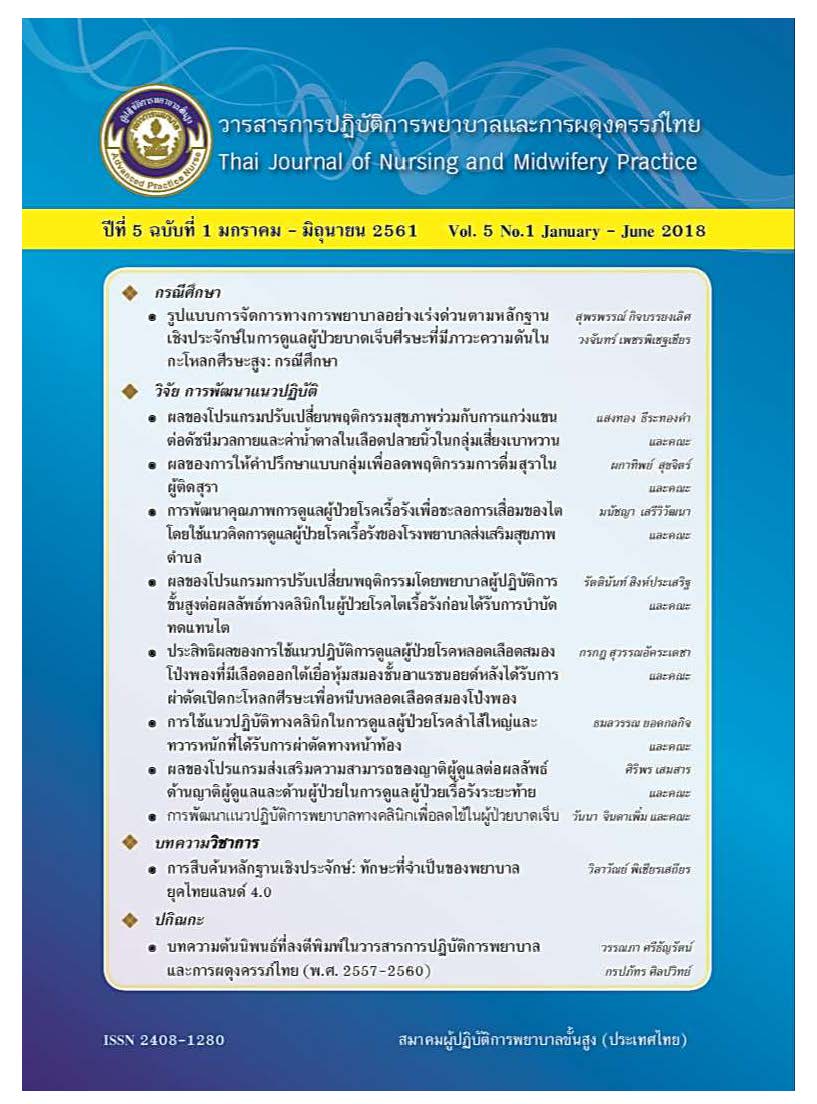
ผลของโปรแกรมปรับเปลี่ยนพฤติกรรมสุขภาพร่วมกับการแกว่งแขน ต่อดัชนีมวลกายและค่าน้ำตาลในเลือดปลายนิ้วในกลุ่มเสี่ยงเบาหวาน
Article Sidebar
Main Article Content
บทคัดย่อ
การวิจัยกึ่งทดลองมีวัตถุประสงค์เพื่อศึกษาผลของโปรแกรมปรับเปลี่ยนพฤติกรรมสุขภาพร่วมกับการแกว่งแขนต่อดัชนีมวลกายและค่าน้ำตาลในเลือดปลายนิ้วของกลุ่มเสี่ยงเบาหวาน เลือกกลุ่มตัวอย่างตามเกณฑ์คัดเข้า จำนวน 30 คน ได้รับโปรแกรมปรับเปลี่ยนพฤติกรรมสุขภาพร่วมกับการแกว่งแขนเป็นระยะเวลา 8 สัปดาห์ เก็บข้อมูลก่อนและหลังการเข้าร่วมโปรแกรมโดยวัดดัชนีมวลกาย และค่าน้ำตาลในเลือดปลายนิ้วหลังอดอาหาร วิเคราะห์ข้อมูลด้วยสถิติบรรยาย และ paired t-test ผลการศึกษาพบว่าภายหลังเข้าร่วมโปรแกรมปรับเปลี่ยนพฤติกรรมสุขภาพร่วมกับการแกว่งแขน กลุ่มตัวอย่างมีดัชนีมวลกาย และค่าน้ำตาลในเลือดปลายนิ้วลดลงอย่างมีนัยสำคัญทางสถิติเมื่อเทียบกับก่อนได้รับโปรแกรม (p < .05, และ .01 ตามลำดับ) ดังนั้นจึงควรประยุกต์ใช้โปรแกรมปรับเปลี่ยนพฤติกรรมสุขภาพร่วมกับการแกว่งแขน เพื่อป้องกันการเกิดโรคเบาหวานให้กับกลุ่มเสี่ยงเบาหวาน
Downloads
Article Details
เอกสารอ้างอิง
2. Aekplakorn W, editor. Report of the fifth Thai National Health Survey by physical examination 2014. Nonthaburi: Health System Research Institute; 2016. (In Thai)
3. Apasuwannakul N, Himmun-ngan R, Khiawkhoaw N. Prevalence of diabetes mellitus and impaired glucose tolerance among relatives of DM cases in Chor-Hor Community Medical Center, Nakhonratchasima Province in 2004. Disease Control J 2005; 31: 164-74. (In Thai)
4. Aekplakorn W, editor. Report of the Fifth Thai National Health Survey by physical examination 2014. Nonthaburi: Health System Research Institute; 2016. (In Thai)
5. Bock G, Dalla MC, Campioni M, Chittilapilly E, Basu R, Toffolo G, et al. Pathogenesis of pre-diabetes: Mechanisms of fasting and postprandial hyperglycemia in people with impaired fasting glucose and/ or impaired glucose tolerance. Diabetes 2006; 55(12): 3536-49.
6. Smith R. Targeting people with pre-diabetes: Lifestyle interventions should also be aimed at people with pre-diabetes. BMJ 2002;3: 403-4.
7. American College of Endocrinology & American Association of Clinical Endocrinologists. Diagnosis and management of prediabetes in the continuum of hyperglycemia- when do the risks of diabetes begin? A consensus statement from the American College of Endocrinology and the American Association of Clinical Endocrinologists. Endocrine Practice 2008; 14 (7): 933-46.
8. American Diabetes Association. Stress 2014 [cited 2018 Jan 12]; Available from: http://www.diabetes.org/living-with diabetes/complications/stress.html).
9. American Diabetes Association. 5. Prevention or delay of type 2 diabetes. Diabetes Care 2017; 40 (Suppl 1): S44-7.
10. Bureau of Non Communicable Disease. Developing communication for risk prevention and diabetes control. Bangkok: No printing company, 2009. (In Thai)
11. American Diabetes Association. Standards of Medical Care In Diabetes-2012. Diabetes Care 2012; 35 Suppl 1: S11-63.
12. Wongsricha W, Kongtaln O. Application of self-efficacy program for changing health behaviors in diabetes high risk group at Nakae Community Hospital, Nakhonpanom Province. Graduate Research Conference 2012. Khon Kaen University (In Thai)
13. Ounprom S, Oba N, Vichitkaew N. Effects of health educational program on health promotion behaviors among pre-diabetes adults. Journal of Nursing Science Naresuan University 2007; 1(1): 100-11. (In Thai)
14. Critchley CR, Hardie EA, Moore SM. Examining the psychological pathways to behavior change in a group-based lifestyle program to prevent type 2 diabetes. Diabetes Care 2012; 35: 699-705.
15. Intarawichian S. Participatory sustainable changing health behavior in pre-diabetes group, Kasetwisai District: Roi-et Province. Office of Disease Prevention and Control 6, Khon Kaen 2012;19: 65-75. (In Thai)
16. Kulzer B, Hermanns N, Gorges D, et al. Prevention of diabetes self-management program (predias): Effects on weight, metabolic risk factors, and behavioral outcomes. Diabetes Care 2009; 32:1143-6.
17. Siriwattanapornkul T, Oba N, Intarakumhang N, Rachasima S. Factors related to blood glucose level among patients with diabetes mellitus type II. Journal of Nursing Science Naresuan University 2007; 1(2): 57-67. (In Thai)
18. Chongchareon W, Kahawong W, Apichato A, Sangchandr, O, Chukumneard P, Boonsin K, et al. A self-care promotion model for controlling blood sugar. Songklanagarind Medical Journal 2008; 26(1): 72-84. (in Thai)
19. Delahanty LM, Grant RW, Wittenberg E, Bosch JL, Wexler DJ, Cagliero E, et al. Association of diabetes-related emotional distress with diabetes treatment in primary care patients with type 2 diabetes. Diabetic Medicine 2007; 24(1): 48-54.
20. Moreau A, Aroles V, Souweine G, Flori M, Erpeldinger S, Figon S, et al. Patient versus general practitioner perception of problems with treatment adherence in type 2 diabetes: From adherence to concordance. European Journal of General Practice 2009; 15(3): 147-153.
21. American Diabetes Association. Blood glucose control and exercise. 2016 [cited 2016 March 4]. Available from http://www.diabetes.org/food-and-fitness/fitness/get-started-safely/blood-glucose- control-and-exercise.html?referrer
22. Bandura A. Self-efficacy: The exercise of control. New York: W.H. Freeman and Company; 1997.
23. Faul F, Erdfelder E, Lang AG, et al. G*Power 3: A flexible statistical power analysis program for the social, behavioral, and biomedical sciences. Behav Res Meth 2007; 39: 175-91.
24. Aekplakorn W, Cheepudomwit S, Bunnag P, et al. A risk score for predicting incident diabetes in the Thai population. Diabetes Care 2006; 29:1872-7.
25. Leelayuwat N, Tunkumnerdthai O, Donsom M, Punyaek N, Manimanakorn A, Kukongviriyapan U, et al. An alternative exercise and its beneficial effects on glycaemic control and oxidative stress in subjects with type 2 diabetes. Diabetes Res Clin Pract 2008; 82: 5-8.
26. Tunkamnerdthai O, Auvichayapat P, Donsom M, Leelayuwat N. Improvement of pulmonary function with arm sl P, Asawachaisuwikrom W, Junprasert S. Effects of self-regulation program on arm swing exercise behavior and blood sugar of diabetes patients in community. Journal of Faculty of Nursing Burapha University 2012; 20(4): 21-32. (In Thai)
27. Kittipeerachol P, Asawachaisuwikrom W, Junprasert S. Effects of self-regulation program on arm swing exercise behavior and blood sugar of diabetes patients in community. Journal of Faculty of Nursing Burapha University 2012; 20(4): 21-32. (In Thai)
28. Terathongkum S. Arm swing exercise for diabetes control. Thai Journal of Nursing and Midwifery Practice 2017; 4(1): 36-44. (In Thai)
