
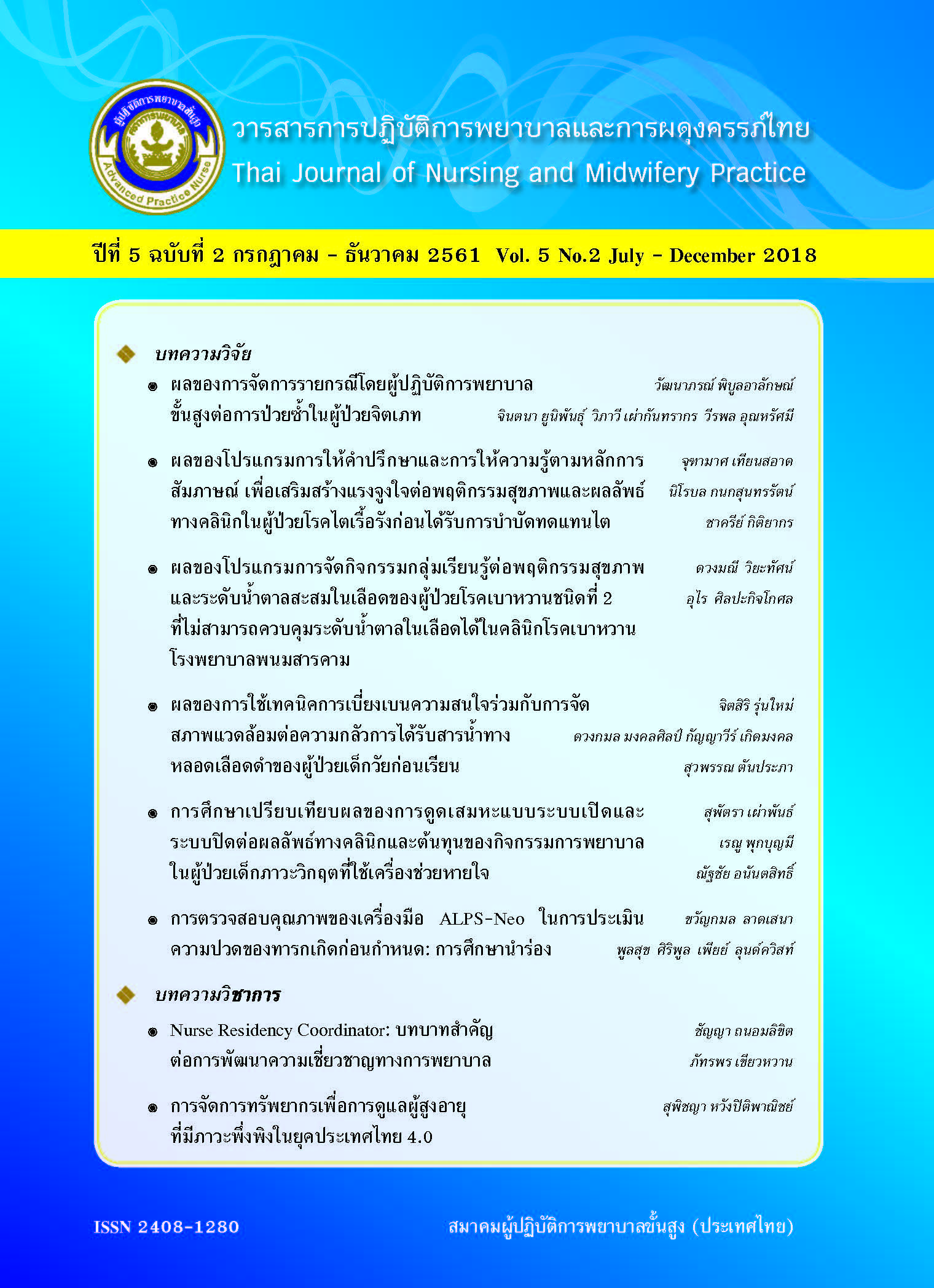
การศึกษาเปรียบเทียบผลของการดูดเสมหะแบบระบบเปิดและระบบปิดต่อผลลัพธ์ทางคลินิก และต้นทุนของกิจกรรมการพยาบาลในผู้ป่วยเด็กภาวะวิกฤตที่ใช้เครื่องช่วยหายใจ
Article Sidebar
Main Article Content
บทคัดย่อ
การวิจัยกึ่งทดลองศึกษาแบบข้ามสลับ เพื่อเปรียบเทียบผลของการดูดเสมหะแบบระบบเปิด และระบบปิดต่อผลลัพธ์ทางคลินิก และต้นทุนของกิจกรรมการพยาบาลที่ใช้ในการดูดเสมหะในผู้ป่วยเด็กภาวะวิกฤตที่ใช้เครื่องช่วยหายใจ กลุ่มตัวอย่าง คือ ผู้ป่วยเด็กจำนวน 23 ราย ที่เข้ารับการรักษาในหอผู้ป่วยกุมารเวชบำบัดวิกฤต ระหว่างเดือนมิถุนายน 2560 ถึงเดือนสิงหาคม 2560 เกณฑ์การคัดเข้า คือ ผู้ป่วยเด็กภาวะวิกฤตอายุ 1 เดือนถึง 18 ปี ได้รับการใส่ท่อหลอดลมคอและใช้เครื่องช่วยหายใจ และไม่ได้รับการรักษาด้วยยาหย่อนกล้ามเนื้อ ทำการสุ่มแบบกลุ่มย่อยโดยเรียงลำดับวิธีการดูดเสมหะทั้งแบบระบบเปิดและระบบปิดด้วยคอมพิวเตอร์ กลุ่มตัวอย่างนี้ได้รับการดูดเสมหะทั้งหมด 92 ครั้ง ระยะเวลาของการดูดเสมหะแต่ละครั้งห่างกันอย่างน้อย 3 ชั่วโมง วิเคราะห์ข้อมูลด้วยสถิติบรรยาย Wilcoxon signed-rank test และ paired t-test ผลการวิจัยพบว่าการดูดเสมหะแบบระบบปิดมีค่ามัธยฐานการเปลี่ยนแปลงอัตราการเต้นของหัวใจ การเปลี่ยนแปลงความดันเลือดแดงเฉลี่ย และการเปลี่ยนแปลงระดับความรู้สึกตัวน้อยกว่า การดูดเสมหะแบบระบบเปิดอย่างมีนัยสำคัญทางสถิติ (p < .05) ค่าเฉลี่ยต้นทุนของกิจกรรมการพยาบาลที่ใช้ในการดูดเสมหะแบบระบบปิดน้อยกว่าการดูดเสมหะแบบระบบเปิดอย่างมีนัยสำคัญทางสถิติ (p < .05) ผลการวิจัยนี้แสดงให้เห็นว่าการดูดเสมหะแบบระบบปิดมีความปลอดภัย และเกิดความคุ้มค่าคุ้มทุนในการรักษาพยาบาลในผู้ป่วยเด็กภาวะวิกฤตที่ใช้เครื่องช่วยหายใจ
Downloads
Article Details
เอกสารอ้างอิง
2. Pookboonmee R. Humanistic nursing approach in pediatric critical care. In: Vaicheeta S, Chaisupmongkollarp T, Pookboonmee R, editors. Advance pediatric critical care nursing. Bangkok; D-One books; 2008. P.36-45. (In Thai)
3. Pediatric intensive care unit of Ramathibodi Hospital. Statistics of pediatric intensive care unit; 2017. (In Thai)
4. Jarog D. Endotracheal tube: suctioning and care. In: Verger JT, Lebet RM, editors. AACN procedure manual for pediatric acute and critical care. St. Louis (London): Saunders Elsevier; 2008. P.5-16.
5. Couchman BA, Wetzig SM, Coyer FM, Wheeler MK. Nursing care of the mechanically ventilated patient: what does the evidence say? part one. Intensive Critical Care Nusing. 2007; 23(1): 4-14.
6. Chulay M, Seckel MA. Suctioning: endotracheal or tracheostomy tube. In: Wiegand DM, editors. AACN procedure manual for critical care. 6th ed. St. Louis (London): Saunders Elsevier; 2011. P.5-16.
7. Fisk, A. C. The effects of endotracheal suctioning in the pediatric population: An integrative review. Dimens Crit Care Nurs. 2018; 37(1), 44-56.
8. AARC Clinical Practice Guidelines. Endotracheal suctioning of mechanically ventilated patients with artificial airways 2010. Respir Care. 2010; 55(6): 758-64.
9. Bassi GL. Airway secretions and suctioning. In: Tobin MJ, editors. Principles and practice of mechanical ventilation. 3th ed. New York, NY: The McGraw-Hill Companies; 2013
10. Faraji A, Khatony A, Moradi G, Abdi A, Rezaei M. Open and closed endotracheal suctioning and arterial blood gas values: A single-blind crossover randomized clinical trial. Crit Care Res Pract. 2015: 1-7
11. Jantra M. Role of continuous infusion of sedation and anagesics in pediatric ICU. In: Staworn D, Eksin C, Samransamruajkit R, editors. Pediatric critical care: The essentials. Bangkok; Beyond enterprise; 2015. P. 214-220. (In Thai)
12. Gelinas C, Tousignant-Laflamme Y, Tanguay A, Bourgault P. Exploring the validity of the bispectral index, the critical-care pain observation tool and vital signs for the detection of pain in sedated and mechanically ventilated critically ill adults: a pilot study. Intensive Crit Care Nurs. 2011; 27(1): 46-52.
13. Sonmez Duzkaya, D., & Kuguoglu, S. Assessment of pain during endotracheal suction in the pediatric intensive care unit. Pain Manag Nurs. 2015; 16(1), 11-19.
14. Coleman RM, Tousignant-Laflamme Y, Ouellet P, Parenteau-Goudreault E, Cogan J, Bourgault P. The use of the bispectral index in the detection of pain in mechanically ventilated adults in the intensive care unit: a review of the literature. Pain Res Manag. 2015;20(1):e33-7
15. Faritous Z, Barzanji A, Azarfarin R, et al. Comparison of Bispectral index monitoring with the critical-care pain observation tool in the pain assessment of intubated adult patients after cardiac surgery. Anesth Pain Med. 2016; 6(4):e38334.
16. Vaicheeta S. Nursing management in pediatric with mechanical ventilation. In: Vaicheeta S, Chaisupmongkollarp T, Pookboonmee R, editors. Advance pediatric critical care nursing. Bangkok; D-One books; 2008. P.135-154. (In Thai)
17. Evans, J., Syddall, S., Butt, W., & Kinney, S. Comparison of open and closed suction on safety, efficacy and nursing time in a paediatric intensive care unit. Aust Crit Care. 2014; 27(2), 70-74; quiz 75-76.
18. Johnson KL, Kearney PA, Johnson SB, Niblett JB, MacMillan NL, McClain RE. Closed versus open endotracheal suctioning: costs and physiologic consequences. Crit Care Med. 1994; 22(4): 658-66.
19. Seyyed Mazhari M., Pishgou’ei A. H., Zareian A., & Habibi H. Effect of open and closed endotracheal suction systems on heart rhythm and artery blood oxygen level in intensive care patients. Iran J Crit Care Nurs. 2010; 2(4), 1-2.
20. Evans, J., Syddall, S., Butt, W., & Kinney, S. Comparison of open and closed suction on safety, efficacy and nursing time in a paediatric intensive care unit. Aust Crit Care. 2014; 27(2), 70-74; quiz 75-76.
21. Ozden D, Gorgulu RS. Effects of open and closed suction systems on the haemodynamic parameters in cardiac surgery patients. Nurs Critl Care. 2015; 20(3): 118-25.
22. Ugras, G. A., & Aksoy, G. The effects of open and closed endotracheal suctioning on intracranial pressure and cerebral perfusion pressure: A crossover, single blind clinical trial. J Neurosci Nurs. 2012; 44(6), E1-E8.
23. Dastdadeh, R., Ebadi, A., & Vahedian-Azimi, A. Comparison of the effect of open and closed endotracheal suctioning methods on pain and agitation in medical ICU patients: A clinical trial. Anesth Pain Med. 2016; 6(5), e38337.
24. Acikgoz A, Yildiz S. Effects of open and closed suctioning systems on pain in newborns treated with mechanical ventilation. Pain Manag Nurs. 2015; 16(5): 653-63.
25. Afshari A, Safari M, Oshvandi K, Soltanian AR. The effect of the open and closed system suctions on cardiopulmonary parameters: time and costs in patients under mechanical ventilation. Nurs Midwifery Stud. 2014, 3(2): 1-6.
