
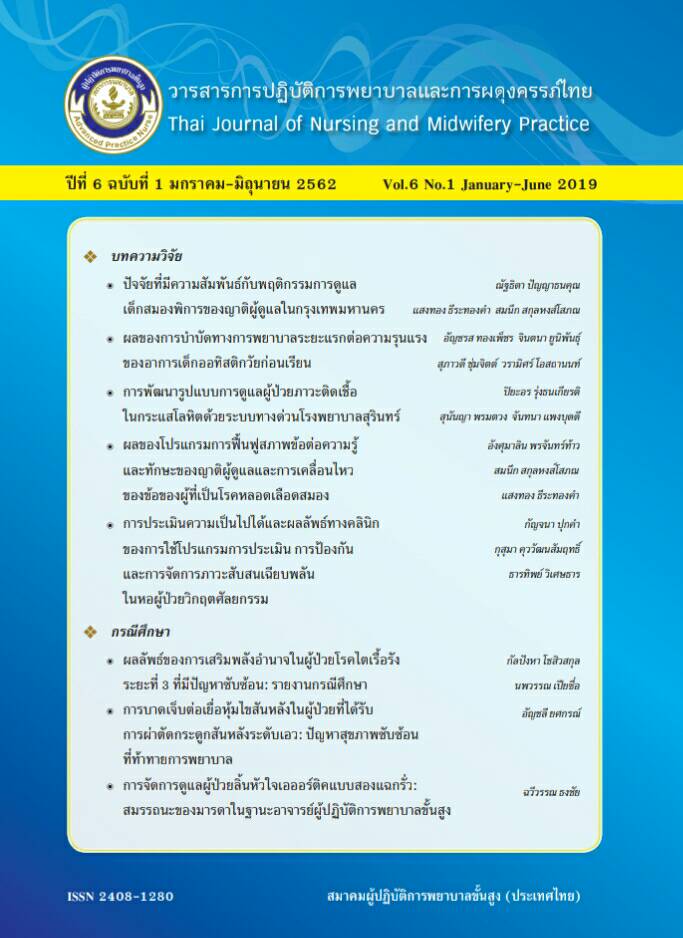
ปัจจัยที่มีความสัมพันธ์กับพฤติกรรมการดูแลเด็กสมองพิการของญาติผู้ดูแลในกรุงเทพมหานคร
Article Sidebar
Main Article Content
บทคัดย่อ
บทคัดย่อ : การศึกษาเชิงสหสัมพันธ์มีวัตถุประสงค์ เพื่อศึกษาปัจจัยที่มีความสัมพันธ์กับ พฤติกรรมการดูแลเด็กสมองพิการของญาติผู้ดูแล ตัวอย่างคือญาติผู้ดูแลเด็กสมองพิการ ในเขตกรุงเทพมหานคร จำนวน 75 คน ใช้กรอบแนวคิดของแบนดูรา เก็บข้อมูลด้วยการ สัมภาษณ์แบบมีโครงสร้าง โดยใช้ 7 แบบสอบถาม ได้แก่ ปัจจัยส่วนบุคคลของเด็กสมอง พิการและของญาติผู้ดูแล ความรู้เกี่ยวกับสมองพิการและการดูแล ความเชื่อเกี่ยวกับการ ฟื้นฟูสมรรถภาพ การรับรู้สมรรถนะแห่งตนในการดูแล การสนับสนุนทางสังคม และ พฤติกรรมการดูแลเด็กสมองพิการของญาติผู้ดูแล วิเคราะห์ข้อมูลด้วยสถิติบรรยาย สถิติ สหสัมพันธ์แบบเพียร์สัน แบบสเปียร์แมน และไคสแควร์ ผลการศึกษาพบว่า คะแนนเฉลี่ยพฤติกรรมการดูแลเด็กสมองพิการโดยรวมอยู่ในระดับดี (X= 124.12, SD = 10.55) การรับรู้สมรรถนะแห่งตนในการดูแลมีความสัมพันธ์ทางบวกกับพฤติกรรมการดูแลเด็กสมองพิการของญาติผู้ดูแลอย่างมีนัยสำคัญทางสถิติ (r = .371, p <.05) ผลการศึกษามีข้อเสนอแนะว่า พยาบาลวิชาชีพควรส่งเสริมสมรรถนะแห่งตนในการดูแลให้กับญาติผู้ดูแล เพื่อให้เกิดความมั่นใจในการเผชิญและแก้ไขปัญหา ส่งผลให้เด็กสมองพิการได้รับการดูแลที่ดี มีคุณภาพ และก่อให้เกิดความผาสุกกับเด็กสมองพิการและครอบครัว
Downloads
Article Details
เอกสารอ้างอิง
2. Braun KVN, Christensen D, Doernberg N, Schieve L, Rice C, Wiggins L, et al. Trends in the prevalence of autism spectrum disorder, cerebral palsy, hearing loss, intellectual disability, and vision impairment, metropolitan Atlanta, 1991–2010. PloS One 2015; 10(4): e0124120.
3. Kakooza-Mwesige A, Andrews C, Peterson S, Wabwire Mangen F, Eliasson AC, & Forssberg H. Prevalence of cerebral palsy in Uganda: A population-based study. Lancet Glob Health 2017; 5(12): 1275 - 82.
4. Lang TC, Fuentes-Afflick E, Gilbert WM, Newman TB, Xing G, Wu YW. Cerebral palsy among Asian ethnic subgroups. Ped J 2012; 129(4): 992-8.
5. Ruiz Ruiz E, Ramalle-Gomara E, Quiñones C, Andrés JM, Posada M. Trends in cerebral palsy infant mortality from 1981 to 2011 in Spain. J Neurol Disord Stroke 2014; 2(1): 1-4.
6. Yilmaz H, Erkin G, Nalbant L. Depression and anxiety levels in mothers of children with cerebral palsy: A controlled study. Eur J Phys Rehabil Med 2013; 49(6): 823-7.
7. Parkes J, Caravale B, Marcelli M, Franco F, Colver A. Parenting stress and children with cerebral palsy: A European cross-sectional survey. Dev Med Child Neurol 2011; 53(9): 815-21.
8. Siritaratiwat W, Thomas I. Gross motor function classification system expanded and revised (Thai version). 2007 [28 January 2018]. [1-5].Available from:https://canchild.ca/system/tenon/assets/attachments/000/000/081/original/GMFCS-ER_Translation-Thai.pdf. (In Thai)
9. Chiarello LA, Palisano RJ, Maggs JM, Orlin MN, Almasri N, Kang LJ, et al. Family priorities for activity and participation of children and youth with cerebral palsy. Phys Ther 2010; 90(9): 1254-64.
10. Orlin MN, Palisano RJ, Chiarello LA, Kang LJ, Polansky M, Almasri N, et al. Participation in home, extracurricular, and community activities among children and young people with cerebral palsy. Dev Med Child Neurol 2010; 52(2): 160-6.
11. Hayles E, Harvey D, Plummer D, Jones A. Parents' experiences of health care for their children with cerebral palsy. Qual Health Res 2015; 25(8): 1139-54.
12. Ahmed S, El-Dein SB, Shenuda M, Mohamed A. Home care offered by family caregivers to preschool children, suffering from hemiplegic cerebral palsy. J Biol 2015; 5(4): 65-72.
13. Malheiros SR, Monteiro CB, da Silva TD, Torriani-Pasin C, de Andrade M, Valenti VE, et al. Functional capacity and assistance from the caregiver during daily activities in Brazilian children with cerebral palsy. Int Arch Med 2013; 6(1): 1.
14. Tungpaibool P. Factors predicting maternal behaviors in caring for children with cerebral palsy [Dissertation]. Bangkok: Mahidol University; 2008.
15. Ribeiro MF, Vandenberghe L, Prudente CO, Vila VD, Porto CC. Cerebral Palsy: how the child's age and severity of impairment affect the mother's stress and coping strategies. Cien Saude Colet 2016; 21(10): 3203-12.
16. Molinaro A, Fedrizzi E, Calza S, Pagliano E, Jessica G, Fazzi E, Group GS. Family-centred care for children and young people with cerebral palsy: Results from an Italian multicenter observational study. Child Care Health Dev 2017; 43(4): 588-97.
17. Sardana R, Singh U, Sumalatha KB. Family life of caregivers: A descriptive study of disruption of family activities, leisures and interaction of caregivers of children with cerebral palsy. Al Ameen J. Med. Sci 2016; 9(3): 154-61.
18. Eyong KI, Ekanem EE, Asindi AA. Challenges of care givers of children with cerebral palsy in a developing country. Int J Contemp Pediatr 2017; 4(4): 1128-31.
19. Steadman J. (2015). The experience of caring for a child with cerebral palsy in rural communities of the Western Cape [Dissertation]. South Africa: Stellenbosch Univ;2015.
20. Bandura A. Social cognitive theory. 6th ed. Greenwich: JAI Press; 1989.
21. Faul F, Erdfelder E, Lang AG, Buchner A. G*Power 3: a flexible statistical power analysis program for the social, behavioral, and biomedical sciences. Behav Res Methods 2007;39(2):175-91.
22. Sornarkas A, Deoisres W, Wacharasin C. Factors influencing family caregivers’ rehabilitation behavior
for stroke patients. JHSR 2015; 9(2): 29-4. (In Thai)
23. Pada J, Kunrawong N, Promwang P, Puchan B . Effect of family program on the parent perceived self-efficacy, family caring behaviors and development of intellectual and developmental disabilities persons. Bangkok; Rajanukul Institute;2015. (In Thai)
24. Inthachom R, Angsupaisal M, Lekphan P. Attiitude and knowledge of cerebral palsy main caregivers. Buddhachinaraj Med J 2014; 28(3): 239-24. (In Thai)
25. Hanucharurnkul S. Social support, self-care and quality of life in cancer patient receiving radiotherapy in Thailand [Dissertation]. United States: Wayne State University; 1988.
