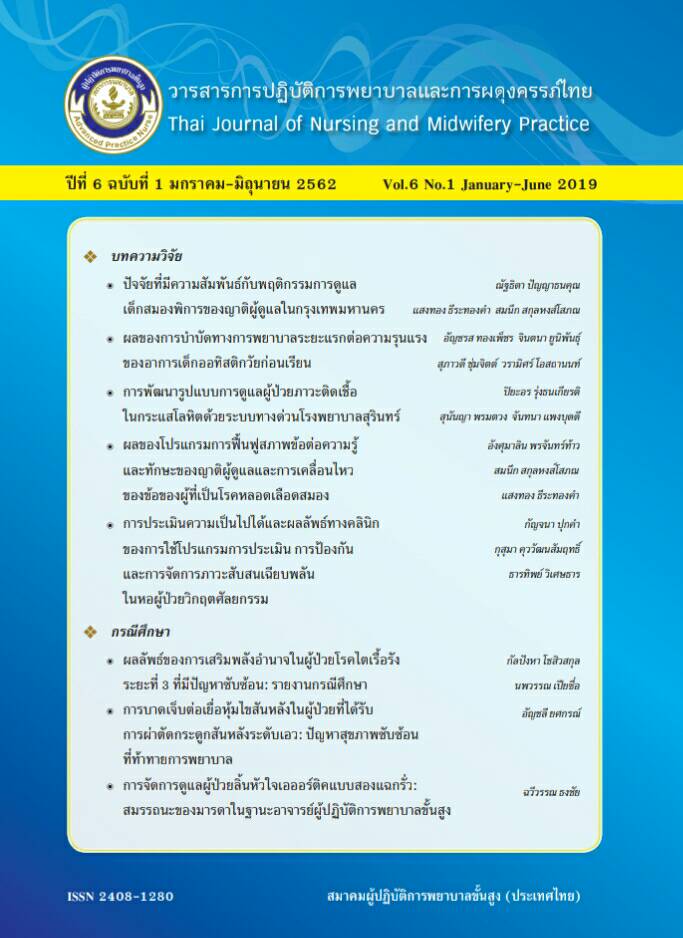
ผลของโปรแกรมการฟื้นฟูสภาพข้อต่อความรู้และทักษะของญาติผู้ดูแลและการเคลื่อนไหวของข้อ ของผู้ที่เป็นโรคหลอดเลือดสมอง
Article Sidebar
Main Article Content
บทคัดย่อ
บทคัดย่อ: การวิจัยแบบกึ่งทดลองมีวัตถุประสงค์เพื่อศึกษาผลของโปรแกรมการฟื้นฟูสภาพ ข้อในผู้ที่เป็นโรคหลอดเลือดสมองโดยญาติผู้ดูแล กลุ่มตัวอย่างคือผู้ที่เป็นโรคหลอดเลือดสมอง และญาติผู้ดูแล อาศัยอยู่ในชุมชนเขตกรุงเทพมหานคร ถูกเลือกแบบเจาะจงตามเกณฑ์คัดเข้า จำนวน 44 คน แบ่งออกเป็นกลุ่มทดลอง 22 คน ได้รับโปรแกรมการฟื้นฟูสภาพข้อบนพื้นฐาน ทฤษฎีการรับรู้สมรรถนะแห่งตนของแบนดูราเป็นเวลา 8 สัปดาห์ และกลุ่มควบคุม 22 คนได้รับการพยาบาลตามปกติ เก็บข้อมูลโดยใช้แบบสอบถามส่วนบุคคล แบบประเมินความรู้และทักษะ การฟื้นฟูสภาพข้อ แบบประเมินความสามารถการปฏิบัติกิจวัตรประจำวัน และวัดองศาการเคลื่อนไหวของข้อ วิเคราะห์ข้อมูลโดยใช้สถิติบรรยาย และสถิติอ้างอิง ได้แก่ paired t- test, Independent t-test, Wilcoxon Signed-Ranks test และ Mann-Whitney U test ผลการศึกษาพบว่า ภายหลังได้รับโปรแกรมการฟื้นฟูสภาพข้อ ญาติผู้ดูแลกลุ่มทดลองมีความรู้และทักษะการฟื้นฟูสภาพข้อสูงกว่าก่อนได้รับโปรแกรม (t = -4.29, p < .001; t = -6.61, p < .001) และสูงกว่ากลุ่มควบคุมอย่างมีนัยสำคัญคัญทางสถิติ (t = -3.35, p < .01; t = -4.42, p < .001) คะแนนเฉลี่ยความสามารถในการปฏิบัติกิจวัตรประจำวันของกลุ่มทดลองสูงกว่าก่อนได้รับโปรแกรมและเช่นเดียวกับกลุ่มควบคุม แต่ไม่พบมีความแตกต่างกันอย่างมีนัยสำคัญทางสถิติ (z = -1.39, p > .05; z = -0.05, p > .05) ค่าเฉลี่ยองศาการเคลื่อนไหวของข้อไหล่ด้านการกางออก และการงอของกลุ่มทดลองสูงกว่าก่อนได้รับโปรแกรมอย่างมีนัยสำคัญทางสถิติ (z = -2.98, p < .01; z = -3.11, p < .01) แต่ในข้ออื่น ๆ และในกลุ่มควบคุมไม่พบมีความแตกต่างกันอย่างมีนัยสำคัญทางสถิติ (p > .05) ผลการวิจัยมีข้อเสนอว่า ควรสอนโปรแกรมการฟื้นฟูสภาพข้อแก่ญาติผู้ดูแล เพื่อเพิ่มความรู้และทักษะการฟื้นฟูสภาพข้อ เพื่อเพิ่มองศาการเคลื่อนไหวของข้อในผู้ที่เป็นโรคหลอดเลือดสมอง
Downloads
Article Details
เอกสารอ้างอิง
1. World Stroke Organization: (WSO). Up again after stroke. 2018 [update 2018 Dec 29]. Available from https://www.worldstrokecampaign.org/getinvolved/campaign-toolkit/brochures-2018.html
2. Strategy and Planning Division Ministry of Public Health. Statistical Thailand. 2017 [updated 2018 Dec29]. Available from https://bps.moph.go.th/ new_bps/sites/default/files/health%20 stratistic%202560.pdf (In Thai)
3. Bureau of Non communicable Diseases Ministry of Public Health. Admission rate of Non communicable Diseases. 2016 [updated 2018 Dec29]. Available from https://www.thaincd.com//6102mission/ documents.php?tid=23&gid= 020-1 (In Thai)
4. Bureau of Non communicable Diseases Ministry of Public Health. Issue of world stroke campaign. 2018 [updated 2018 Dec29]. Available from https://ddc. moph.go.th/uploads/files/78a5b91d92a079c1a35867c6347a9299.pdf (In Thai)
5. Thonghong A, Thepsittha K, Jongpiriyaanan P, Gappbirom T. Chronic Diseases Surveillance Report, 2012. Weekly Epidemiological Surveillance Report 2013; 44: 800-8. (In Thai).
6. Dajpratham P, Kuptniratsaikul V, Kovindha A , Srisa-an Kuptniratsaikul P, Dejnuntarat. Prevalence and management of poststroke spasticity in Thai stroke patients: A multicenter study. Journal of the Medical Association of Thailand 2009; 92: 1354-60.
7. Thibaut A, Chatelle C, Ziegler E, Bruno MA, Laureys S, Gosseries O. Spasticity after stroke: physiology, assessment and treatment. Brain Inj 2013;27:1093–105.
8. Zhang M, Davies TC, Xie S. Effectiveness of robot-assisted therapy on ankle rehabilitation-a systematic review. J Neuroeng Rehabil 2013 ;10 :30.
9.Siriwararom, P. Rehabiltation situation of stroke patients at home in Nongboonmak district, Nakhon Ratchasima province [Master Thesis]. Khon Kaen : Khon Kaen University ; 2007. (In Thai).
10. Massakulpun P, Sarinkarinkul T, Rewtong K, Thimayom P, Wichiangpaisan P. (Eds). Clinical practice guidelines for stroke rehabilitation. 2016 [updated 2019 May29]. Available from https:// r8way.moph.go.th/r8wayadmin/page/uploads_ file/20180713155424_2.7คู่มือ%20 แนวทางการฟื้นฟูสมรรถภาพผู้ป่วย.pdf. (In Thai)
11.Karkai, B. Rehabilitation of stroke patients eith hemiplegia at home through community participation [Master Thesis]. Khon Kaen : Khon Kaen University ; 2010. (In Thai).
12. White LC ,Cantu GA, Trevino M. Interventions for caregivers of stroke survivors: An update of the evidence. Clinical Nursing Studies 2015; 3: 87-95.
13. Thanamai N. Effects of holistic approach teaching program on caregivers' caring ability of stroke patients[Master Thesis].Phitsanulok : Naresuan Unversity; 2008. (In Thai).
14. Srijumnong N, Rawiworakul T, Lagampan S, Malathum P. The Effects of a self-efficacy Promotion Program for Family Caregivers of Persons of stroke at Home. Journal of Boromarajonani College of Nursing 2010; 26. (In Thai).
15. Kavepattaranon A, Harnirattisai T, Pregamol R. The effects of a self-efficacy promoting program for care to stroke patients on caregivers during the transition phase from hospital to home. Journal of nursing Science Chulalongkorn University 2013; 25 :93-105. (In Thai).
16. Bandura A. Self-efficacy: toward a unifying theory of behavioral change. Psychological review 1977; 84(2), 191.
17. Pichitporn K, Sudsara S, Sukon P, Theppanitch S. Effects of a home based physical therapy intervention for stroke patients and care givers in Donput community of Saraburi province.Saraburi Hospital Medical Journal 2008;33:55-65. (in Thai)
18.Thai Health Organization. Manual of rehabilitation of stroke patients for family caregivers at home. Bangkok: The Sun Group;2011.
19. Suwantri P. Using the home rehabilitation program for development a quality of life among cerebrovascular disease patients in Chunman hospital, Amnatcharoen province 2012. Graduate Studies Journal 2012;9(44):189-97. (In Thai)
20. Chaiwongnoi A, Jullamate P, Kangchai W. Effects of Swanson’s caring on activities of daily living and well-being of elderly with stroke [Dissertation]. Chon Buri: Burapha University;2013. (In Thai)
21.Teasell R, Mehta S, Pereir A, Mclntyre A, Janzen S, Allen L, et al. Time to rethink long-term rehabilitation management of stroke patients. Top Stroke Rehabil 2012;19:457-62.
22. Pitthayapong S, Thiangtam W, Powwattana A, Leelacharas S, Waters CM. A community based program for family caregivers for post stroke survivors in Thailand. Asian Nurs Res 2017;11 (2):150-7.
