
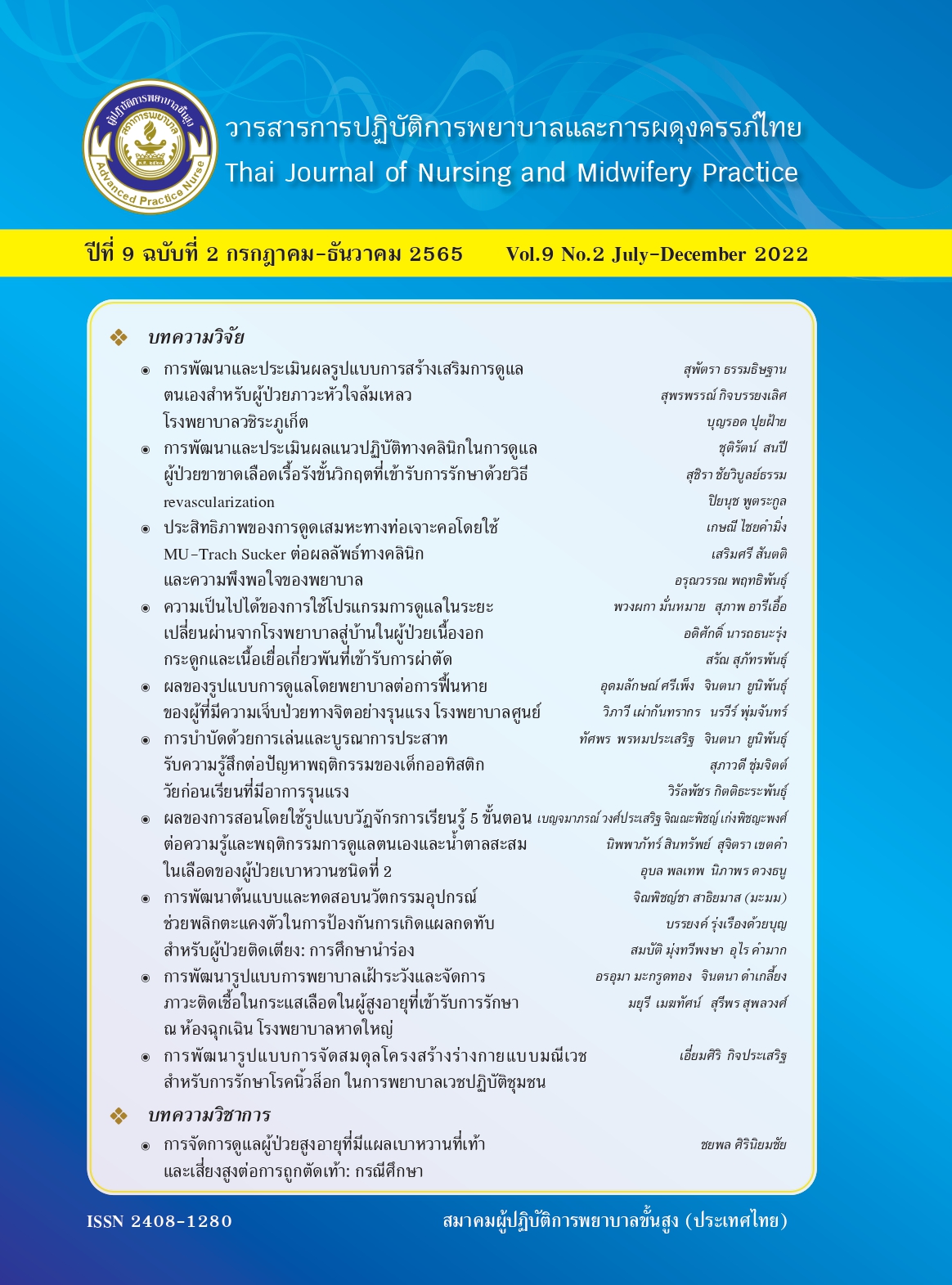
การพัฒนาต้นแบบและทดสอบนวัตกรรมอุปกรณ์ช่วยพลิกตะแคงตัวในการป้องกันการเกิดแผลกดทับสำหรับผู้ป่วยติดเตียง: การศึกษานำร่อง of pressure ulcers for bedridden patients
Article Sidebar
Main Article Content
บทคัดย่อ
การศึกษานำร่องครั้งนี้เป็นการพัฒนาต้นแบบอุปกรณ์ช่วยพลิกตะแคงตัวที่สามารถใช้ควบคู่กับเตียงผู้ป่วยปกติ โดยช่วยลดการเกิดแรงกดทับ แรงเสียดทานและแรงเฉือน อันเป็นสาเหตุสำคัญของการเกิดแผลกดทับ และช่วยอำนวยความสะดวกในการพลิกตะแคงตัวผู้ป่วย มีการดำเนินการร่วมกันโดยทีมสหสาขาวิชาชีพ พัฒนาต้นแบบและทดสอบนวัตกรรม 3 ระยะ เริ่มตั้งแต่การศึกษาบริบทของการดูแลผู้ป่วยติดเตียง และ วิเคราะห์ความต้องการและปัญหาอุปสรรคในการพลิกตะแคงตัว จากนั้นพัฒนาต้นแบบและทดสอบกับผู้ป่วยติดเตียงระยะที่หนึ่ง จำนวน 1 ราย จึงพัฒนาต่อด้วยการนำปัญหาและข้อเสนอแนะไปปรับปรุงเพื่อทดสอบในระยะที่สอง จำนวน 3 ราย และปรับปรุงก่อนนำมาทดสอบในระยะที่ 3 จำนวน 10 ราย ระหว่าง ธันวาคม 2563 – มีนาคม 2564 อุปกรณ์ช่วยพลิกตะแคงตัวนี้มีลักษณะเป็นโครงเหล็กที่ใช้วางครอบไปบนพื้นเตียงปกติแล้วจึงวางเบาะนอนด้านบน การพลิกตะแคงตัวด้านขวาด้วยการยกโครงเหล็กด้านซ้ายขึ้นแล้วตั้งแกนเหล็กค้ำที่ซ่อนอยู่ด้านใต้โครงเตียงให้ตั้งขึ้น ส่วนการพลิกตะแคงตัวด้านซ้ายด้วยการยกโครงเหล็กด้านขวาขึ้นแล้วตั้งแกนเหล็กค้ำที่ซ่อนอยู่ด้านใต้โครงเตียงให้ตั้งขึ้น สถิติที่ใช้ในการวิจัยเป็นสถิติเชิงพรรณนา ผลการวิจัยพบว่า ภายหลังการทดสอบในระยะเวลา 1 สัปดาห์ ทั้งสามระยะทดสอบ ไม่พบการเกิดแผลกดทับ จากผลการศึกษาแสดงให้เห็นว่าอุปกรณ์ช่วยพลิกตะแคงตัวที่สร้างขึ้นนี้เป็นนวัตกรรมต้นแบบที่พัฒนาขึ้น นำโดยพยาบาลผู้ปฏิบัติการพยาบาลขั้นสูงเพื่อส่งเสริมการจัดท่าถูกต้อง ลดและกระจาย
Downloads
Article Details

อนุญาตภายใต้เงื่อนไข Creative Commons Attribution-NonCommercial-NoDerivatives 4.0 International License.
เอกสารอ้างอิง
Mamom J, Daovisan H. Listening to caregivers’ voices: the informal family caregiver burden of caring for chronically ill bedridden elderly patients. Int J Environ Res 2022;19(1):567.
Mamom J, Daovisan H. Telenursing: How do caregivers treat and prevent pressure injury in bedridden patients during the COVID-19 pandemic in Thailand? Using an embedded approach. J Telemed Telecare 2022;16:1-8.
Al Mutairi KB, Hendrie D. Global incidence, and prevalence of pressure injuries in public hospitals: a systematic review. Wound Med 2018;22:23-31.
Amir Y, Lohrmann C, Halfens RJ, Schols JM. Pressure ulcers in four Indonesian hospitals: prevalence, patient characteristics, ulcer characteristics, prevention, and treatment. Int Wound J 2017;14(1):184-93.
Boyko T, Longaker M, Yang GP. Review of the current management of pressure ulcers. Adv Wound Care 2018;7(2):57-67.
Mamom J, Daovisan H. Repositioning mattress: How a lateral tilt position reshapes the prevention of pressure ulcers in bedridden patients. J Med Eng Technol 2022;1:1-12.
Gillespie BM, Latimer S, Walker RM, McInnes E, Moore Z, Eskes AM, Li Z, Schoonhoven L, et al. The quality and clinical applicability of recommendations in pressure injury guidelines: A systematic review of clinical practice guidelines. Int J Nurs Stud 2021;115:1-12.
Hehsan MR. The Concept of repositioning as preventive measure for pressure injury in critical care: An analysis of a verse of 18th from Al-Kahfi. Int J Islam Stud. 2021;21(1):27-31.
Beckford-Ball J. Preventing and managing pressure ulcers in patients receiving palliative care. Nurs Older People. http://doi: 10.7748/nop.2021.e1299
Mamom J, Rungroungdouyboon B, Chuanasa J. Enhancing the quality of long-term patient care by use of the innovative “Electrical Bed-Turning System” for the prevention of pressure injuries: A pilot study. STA 2022;27(1):128-35.
Maungtoug N, Mamom J. Enhancing Quality of Palliative Home Care by Using the Nursing Innovative: A Pilot Study. Journal of Health and Nursing Research 2021;37(3):170–80. (In Thai)
Bernardes RA, Santos-Costa P, Sousa LB, Graveto J, Salgueiro OA, Serambeque B, et al. Innovative devices for bedridden older adults upper and lower limb rehabilitation: Key characteristics and features. Int. Workshop Gerontechnol 2020;1185: 25–35.
Mamom J, Ruchiwit M, Hain D. Strategies of repositioning for effective pressure ulcer prevention in immobilized patients in home-based palliative care: An integrative literature reviews. J Med Assoc Thai 2020;103(4):111-9.
Kottner J, Cuddigan J, Carville K, Balzer K, Berlowitz D, Law S, et al. Prevention and treatment of pressure ulcers/injuries: The protocol for the second update of the international clinical practice guideline 2019. J tissue viability 2019;28(2):51-8.
Mervis JS, Phillips TJ. Pressure ulcers: Pathophysiology, epidemiology, risk factors, and presentation. J Am Acad Dermatol 2019;81(4):881-90.
De Meyer D, Van Hecke A, Verhaeghe S, Beeckman D. Protect–Trial: A cluster RCT to study the effectiveness of a repositioning aid and tailored repositioning to increase repositioning compliance. J Adv Nurs 2019;75(5):1085-98.
National Pressure Ulcer Advisory Panel (NPUAP) announces a change of terminology from pressure ulcer to pressure injury and updates the stages of pressure injury. 2016. Retrieved from http://www.npuap.org.
Bambi AA, Yusuf S, Irwan AM. Use of pillow 30 degree in preventing the pressure injury event. Jurnal Keperawatan 2020;12(3):341-50.
Trautman L, Anderson VL. Retrospective data analysis to support the use of small body movements as an intervention for prevention of pressure ulcer development. 2020. Retrieved from http://sigma.nursingrepository.org/handle/10755/20854
Marfil-Gómez RM, García-Mayor S, Morales-Asencio JM, Gómez-González AJ, Morilla-Herrera JC, Moya-Suárez AB, et al. Pressure levels in the trochanter area according to repositioning at different degrees of inclination in healthy subjects. J Tissue Viability 2020;29(2):125-9.
Moore Z, van Etten M. Repositioning and pressure ulcer prevention in the seated individual. Wounds UK 2011;7(3):34-40.
Beeckman D, Serraes B, Anrys C, Van Tiggelen H, Van Hecke A, Verhaeghe S. A multicentre prospective randomised controlled clinical trial comparing the effectiveness and cost of a static air mattress and alternating air pressure mattress to prevent pressure ulcers in nursing home residents. Int J Nurs Stud 2019;97:105-13.
Nixon J, Nelson EA, Rutherford C, Coleman S, Muir D, Keen J, et al. Pressure ulcer program of research (PURPOSE): using mixed methods (systematic reviews, prospective cohort, case study, consensus, and psychometrics) to identify patient and organizational risk, develop a risk assessment tool and patient-reported outcome Quality of Life and Health Utility measures. 2015. Retrieved from https://doi.org/10.3310/pgfar03060
Shi C, Bonnett LJ, Dumville JC, Cullum N. Nonblanchable erythema for predicting pressure ulcer development: a systematic review with an individual participant data meta‐analysis. Br J Dermatol 2020;182(2):278-86.
