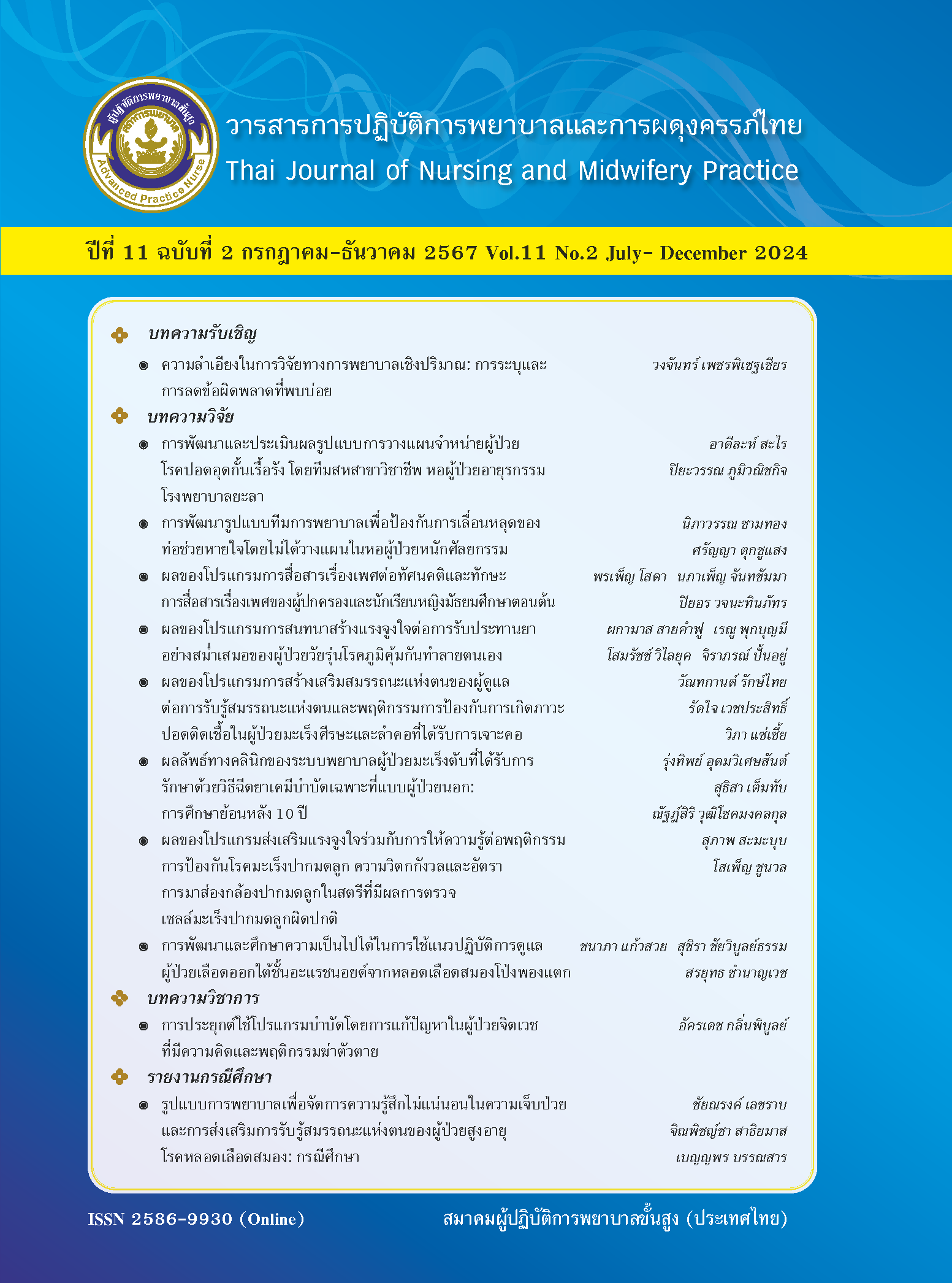
ผลของโปรแกรมการสร้างเสริมสมรรถนะแห่งตนของผู้ดูแลต่อการรับรู้สมรรถนะแห่งตนและพฤติกรรมการป้องกันการเกิดภาวะปอดติดเชื้อในผู้ป่วยมะเร็งศีรษะและลำคอที่ได้รับการเจาะคอ
Article Sidebar
Main Article Content
บทคัดย่อ
บทคัดย่อ: การวิจัยกึ่งทดลองแบบสองกลุ่มวัดซ้ำ เพื่อศึกษาผลของโปรแกรมการสร้างเสริมสมรรถนะแห่งตนของผู้ดูแลต่อการรับรู้สมรรถนะแห่งตนและพฤติกรรมการป้องกันการเกิดภาวะปอดติดเชื้อในผู้ป่วยมะเร็งศีรษะและลำคอที่ได้รับการเจาะคอ กลุ่มตัวอย่างคือผู้ป่วยและผู้ดูแล 20 คู่ ที่เข้ารับการรักษาในหอผู้ป่วยหู คอ จมูก แบ่งเป็นกลุ่มละ 10 คู่เพื่อเข้ากลุ่มทดลองที่ได้รับการดูแลเสริมด้วยโปรแกรมเสริมสมรรถนะแห่งตนฯ และกลุ่มควบคุม ที่ได้รับการดูแลตามปกติเครื่องมือในการทดลอง คือ โปรแกรมการสร้างเสริมสมรรถนะแห่งตนของผู้ดูแลตามแนวคิดการรับรู้สมรรถนะแห่งตนของแบนดูรา เก็บข้อมูลโดยใช้แบบสอบถามการรับรู้สมรรถนะแห่งตน และแบบสังเกตพฤติกรรมของผู้ดูแล เครื่องมือทั้งหมดผ่านการตรวจสอบคุณภาพ มีค่าความตรงเชิงเนื้อหาระหว่าง .97- 1.0 และค่าความเที่ยงระหว่าง .97-.98วิเคราะห์ข้อมูลโดยใช้สถิติเชิงพรรณนา การทดสอบทีอิสระ และวิเคราะห์ความแปรปรวนสองทางแบบวัดซ้ำ เพื่อเปรียบเทียบความแตกต่างจากการติดตามผล 3 ครั้ง คือ หลังเข้าร่วมโปรแกรม 3 วัน 5 วัน และหลังจำหน่าย 14 วัน ผลพบว่า หลังเข้าร่วมโปรแกรม กลุ่มทดลองมีคะแนนการรับรู้สมรรถนะแห่งตนและพฤติกรรมการป้องกันภาวะปอดติดเชื้อสูงกว่ากลุ่มควบคุมอย่างมีนัยสำคัญทางสถิติ (F1,17 = 17.532, p < .001; F1, 17 = 109.188, p < .001) โปรแกรมสามารถใช้เป็นแนวทางสำหรับพยาบาลในการส่งเสริมสมรรถนะแห่งตนของผู้ดูแล เพื่อให้มีความมั่นใจและปฏิบัติการป้องกันภาวะปอดติดเชื้อในผู้ป่วยมะเร็งศีรษะและลำคอที่ได้รับการเจาะคอได้ ทั้งนี้ ควรศึกษาในกลุ่มตัวอย่างที่มีขนาดใหญ่ขึ้นต่อไป
Downloads
Article Details

อนุญาตภายใต้เงื่อนไข Creative Commons Attribution-NonCommercial-NoDerivatives 4.0 International License.
เอกสารอ้างอิง
Bray F, Laversanne M, Sung H, et al. Global cancer statistics 2022: GLOBOCAN estimates of incidence and mortality worldwide for 36 cancers in 185 countries. CA Cancer J Clin. 2024; 74(3): 229-63. doi: 10.3322/caac.21834.
National Cancer Institute. Hospital-based cancer registry 2022. Bangkok: Medical Digital Division, National Cancer Institute [Internet]; 2022.
Chan EL, Rovira A. Head-and-neck cancer in the emergency department: A contemporary review of common presentations and management. J Emerg Trauma Shock. 2024; 17(1): 33-9. doi: 10.4103/jets.jets_40_23.
Reddy PD, Yan F, Nguyen SA, et al. Factors influencing the development of pneumonia in patients with head and neck cancer: A meta-analysis. Otolaryngol Head Neck Surg. 2021; 164(2): 234-43. doi: 10.1177/0194599820938011.
Ko C-A, Fang T-J, Chi C-C, et al. Pneumonia in patients with head and neck cancer: risk factors and prevention strategies. IJHNS. 2020; 4(4): 146-55. doi: 10.6696/IJHNS.202012_4(4).0002.
Pengpist K, Theunnade SK. Effects of promoting perceived self-efficacy program on perceived selfefficacy and behavior of nurses to prevent ventilatorassociated. Journal of Nursing Science & Health. 2017; 40(2): 1-10. Thai.
Huang TT, Peng JM. Role adaptation of family caregivers for ventilator-dependent patients: Transition from respiratory care ward to home. J Clin Nurs. 2010; 19(11-12): 1686-94. doi: 10.1111/j.1365-2702. 2009.03007.x.
Khemshotgun W, Srisanga S, Siripornadunsil S. Discharge planning model development of patients with head and neck cancer at ENT unit, Buriram Hospital. Journal of Nurses’ Association of Thailand, North-Eastern Division. 2012; 30(3): 146-52. Thai.
Medical record section. Patient statistics of Songklanagarind Hospital. Hat Yai, Songkhla; 2020.
Bandura A. Self-efficacy: The exercise of control. New York: W H Freeman; 1997.
Physiopedia. Vital Signs [Internet]. 2024 [cited 2024 October 13]. Available from: https://www.physio-pedia.com/Vital_Signs.
Firmawati E, Songwathana P, Kitrungrote L. A pilot study of self-efficacy enhancing education program on family caregivers’ competencies in caring for patients with mild traumatic brain injury. Songklanagarind J Nurs. 2014; 34: 129-37.
Cohen J. Statistical Power Analysis for the Behavioral Sciences. 2 nd ed. Hillsdale, NJ: Lawrence Erlbaum Associate; 1988.
Sanitlou N, Sartphet W, Naphaarrak Y. Sample size calculation using G*Power program SVITTJ. 2019;5(1):496-507. Thai.
Plichta SB, Kelvin EA. Examining Cross-Tabulations: The Chi-Square and Associated Statistics. Munro’s statistical methods for health care research. 6th ed: Wolters Kluwer Health /Lippincott Williams & Wilkins; 2013. p. 289-319.
Keppel G. Design and analysis: A researcher’s handbook: Prentice-Hall, Inc; 1991.
Kasemsuk K, Ritudom B. Health promotion of middle adulthood development. Regional Health Promotion Center 9 Journal. 2023; 17(1): 368-80. Thai.
Yamma W, Nuttarugs S. The effect of mediation program on emotion quotient of the first year nursing students in Phetchaburi Rajabhat University. JRTAN. 2021; 22(1): 156-65. Thai.
Khoochonthara P. Role of e-Learning with selfdirected learning. TUH Journal online. 2016; 1(1): 53-61. Thai.
Chaibubpha J, Hengudomsub P, Vatanasin D. The effects of motivational enhancement program on smoking cessation of perceived self-efficacy and behaviors among male clients. JFONUBUU. 2018; 26(4): 10-20. Thai.
Jitsakorn C, Jaramillo WI-A, Wiwaraganon P. Perceived self-efficacy and preventive health behaviors with COVID-19 among the older adults in Mueang Lampang District, Lampang Province. TJPHE. 2023; 3(3): 142-58. Thai.
Mayi N, Vachprasit R, Sae-Sia W. The effect of self-efficacy promoting program on perceived selfefficacy and behaviors in prevention of pressure injury among caregivers and incidence of pressure injury in dependent patients. JHNR. 2021; 37(3): 89-104. Thai.
