
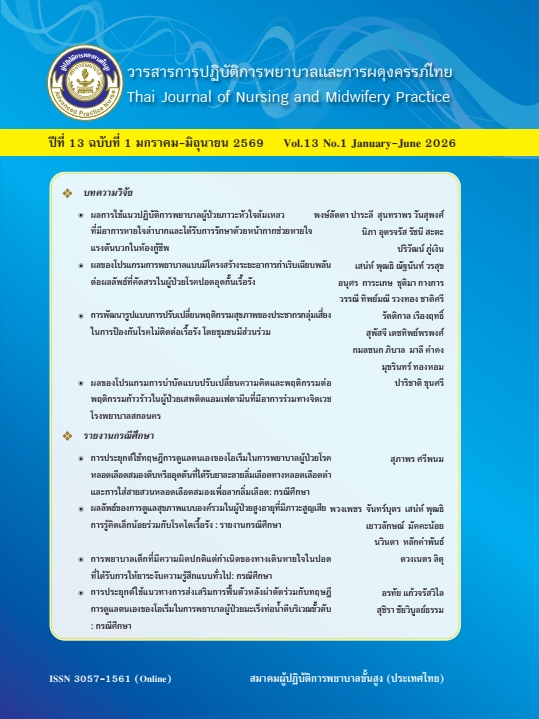
ผลการใช้แนวปฏิบัติการพยาบาลผู้ป่วยภาวะหัวใจล้มเหลวที่่มีอาการหายใจลำบากและได้รับการรักษาด้วยหน้ากากช่วยหายใจแรงดันบวกในห้องกู้ชีพ
Article Sidebar
Main Article Content
บทคัดย่อ
บทคัดย่อ: วัตถุประสงค์: เพื่่อศึกษาผลลัพธ์การพยาบาลผู้ป่วยภาวะหัวใจล้มเหลวที่ได้รับการพยาบาลตามแนวปฏิบัติการพยาบาลผู้ป่วยภาวะหัวใจล้มเหลวที่มีอาการหายใจลำบาก
และได้รับการรักษาด้วยหน้ากากช่วยหายใจแรงดันบวกในห้องกู้ชีพ รููปแบบการวิจัย:วิจัยเชิงปฏิบัติการ วิธีดำเนินการวิจัย: กลุ่่มตัวอย่างเป็นผู้ป่วยภาวะหัวใจล้มเหลวที่มีอาการ
หายใจลำบากและได้รับการรักษาด้วยหน้ากากช่วยหายใจแรงดันบวกในห้องกู้ชีพและได้รับการพยาบาลตามแนวปฏิบัติฯ จำนวน 32 ราย เครื่องมือที่ใช้ในการวิจัย ได้แก่ แบบ
บันทึกข้อมูลของกลุ่มตัวอย่าง แบบบันทึกผลลัพธ์การพยาบาล และแนวปฏิบัติฯ วิเคราะห์ข้อมููลโดยใช้สถิติเชิงพรรณนา การทดสอบแบบจับคู่ที และการทดสอบลำดับที่มีเครื่องหมายของวิลค็อกซัน ผลการศึกษา: กลุ่่มตัวอย่างอายุเฉลี่่ย 66.87±2.42 ปี มีอาการสำคัญนำมาโรงพยาบาล ได้แก่ หายใจลำบาก ร้อยละ 28.13 แน่นหน้าอกและหายใจลำบาก ร้อยละ 21.88 และเหนื่อยเพลีย ร้อยละ 15.63 มีค่าสัญญาณชีพแรกรับและก่อนจำหน่ายออกจากห้องกู้ชีพที่ดีขึ้นอย่างมีนัยสำคัญทางสถิติ ได้แก่ ความดันโลหิตซิสโตลิค อัตราการเต้นของหัวใจ อัตราการหายใจ และค่่าความอิ่่มตัวของออกซิเจนปลายนิ้ว (p < 0.05) มีอัตราความสำเร็จในการรักษาด้วยหน้ากากช่วยหายใจแรงดันบวก ร้อยละ 90.62 และมีคะแนนความทนต่อการรักษาด้วยหน้ากากช่วยหายใจแรงดันบวกเฉลี่่ย 3.65±0.11 คะแนน ข้อเสนอแนะ: การพยาบาลฉุุกเฉินตามแนวปฏิบัติฯ ช่วยส่่งเสริมให้กิจกรรมการพยาบาลเป็นไปในแนวทางเดียวกันภายใต้มาตรฐานวิชาชีพและส่งเสริมผลลัพธ์ทางการพยาบาลด้านสรีรวิทยาและอาการทางคลินิกในผู้ป่วยภาวะหัวใจล้มเหลวที่ห้องกู้ชีพที่ดีขึ้น
Downloads
Article Details

อนุญาตภายใต้เงื่อนไข Creative Commons Attribution-NonCommercial-NoDerivatives 4.0 International License.
เอกสารอ้างอิง
Zanza C, Saglietti F, Tesauro M, et al. Cardiogenic pulmonary edema in emergency medicine. Adv Respir Med. 2023; 91(5): 445-63. doi: 10.3390/arm91050034.
Department of medical services, Ministry of public health. MOPH ED. Triage. Bangkok: Division of medical technical and academic affairs, Department of medical services, Ministry of public health; 2024. Thai.
Martin SS, Aday AW, Almarzooq ZI, et al. 2024 Heart disease and stroke statistics: A report of US and global data from the American Heart Association. Circulation. 2024; 149(8): e347–913. doi: 10.1161/CIR.0000000000001209.
Jiampo P, Tangkittikasem T, Boonyapiphat T, et al. Real-world heart failure burden in Thai patients. Cardiol Ther. 2024; 13(2): 281-97. doi: 10.1007/s40119-024-00355-8.
Medical Records & Statistic Department, Srinagarind Hospital. The statistic of congestive heart failure patients at Srinagarind hospital in 2022-2024. Khon Kaen: Srinagarind Hospital; 2025. Thai.
Masip J. Noninvasive Ventilation in Acute Heart Failure. Curr Heart Fail Rep. 2019; 16(4): 89-97. doi: 10.1007/s11897-019-00429-y.
Elena B, Tommaso P, Gianluca F, et al. The importance of education and training for noninvasive ventilation: suggestions from the literature. Egypt J Intern Med. 2019; 31(4): 435-41. doi: 10.4103/ejim.ejim_45_19.
Pimpun P, Theeranut A, So-ngern A. Development of nursing practice guidelines for promoting patients with successful noninvasive ventilation: A pilot study. J Nurs Sci Health. 2020; 43(1): 109-17. Thai.
Pimpun P. Effects of clinical nursing practice guidelines on selected outcome among patients with noninvasive ventilation [dissertion]. Khon Kaen: Khon Kaen University; 2019. 97p. Thai.
Yaman O, Aygun M, Erten H. Noninvasive ventilation with nursing perspective: Impacts on patient tolerance, short-term adverse effects, and nursing workload. Niger J Clin Pract. 2021; 24(2): 177-85. doi: 10.4103/njcp.njcp_133_20.
Ergan B, Nasilowski J, Winck JC. How should we monitor patients with acute respiratory failure treated with noninvasive ventilation? Eur Respir Rev Off J Eur Respir Soc. 2018; 27(148): 170101-17. doi: 10.1183/16000617.0101-2017.
Juntachum W. Nursing Research: Sampling and Sample Size Determination. Khon Kaen; 2002.
Duan J, Wang S, Liu P, et al. Early prediction of noninvasive ventilation failure in COPD patients: derivation, internal validation, and external validation of a simple risk score. Ann Intensive Care. 2019; 9(1): 108. doi: 10.1186/s13613-019-0585-9.
Soukup SM. The Center for advanced nursing practice evidence-based practice model: promoting the scholarship of practice. Nurs Clin North Am. 2000; 35(2): 301-9.
Di Cristo A, Segreti A, Tetaj N, et al. Hemodynamic effects of positive airway pressure: A cardiologist’s overview. J Cardiovasc Dev Dis. 2025; 12(3): 97-109. doi: 10.3390/jcdd12030097.
Yildiz M, Çelik D, Akoglan F, et al. Structured practices increasing patient compliance to noninvasive mechanical ventilation therapy: Example of best practice. Anatol Curr Med J. 2022; 4(2): 126-32. doi: 10.38053/acmj.1032396.
Paralee P, Sumritrin S, Lartham K, et al. Nursing outcomes of noninvasive positive pressure ventilation therapy in congestive heart failure patient with dyspnea in emergency room. Nurs Sci J Thai. 2023; 41(4): 73-85. Thai.
Liu X, Li H, Wang L, et al. Incidence and risk factors of noninvasive ventilation device-related pressure skin injuries: A retrospective study. Health Sci Rep. 2025; 8(5): e70635. doi: 10.1002/hsr2.70635.
Brill AK, Pickersgill R, Moghal M, et al. Mask pressure effects on the nasal bridge during short-term noninvasive ventilation. ERJ Open Res. 2018; 4(2): 00168-2017. doi: 10.1183/23120541.00168-2017.
Pickham D, Ballew B, Ebong K, et al. Evaluating optimal patient-turning procedures for reducing hospital-acquired pressure ulcers (LS-HAPU): Study protocol for a randomized controlled trial. Trials. 2016; 17(1): 190-7. doi: 10.1186/s13063-016-1313-5.
Batool, Grag. Appropriate use of oxygen delivery devices. Open Anesthesiol J. 2017; 11: 35-8. doi: 10.2174/1874321801711010035.
Donnelly N, Fry M, Elliott R, et al. The role of the ward nurse in recognition and response to clinical deterioration: a scoping review. Contemporary nurse. 2024; 60: 1–30. doi: 10.1080/10376178. 2024.2413125.
Duhalde H, Baath C, Hommel A, et al. Emergency Nurses’ Perceptions of Nursing Care in an Emergency Department: A henomenographic Study. Journal of Emergency Nursing. 2025; 51(5): 840–9. doi: 10.1016/j.jen.2025.03.018.
