Hemodynamic assessment of different septic shock resuscitation strategies: a comparison of volume expansion versus norepinephrine administration, a prospective: Study protocol
Hemodynamic assessment in septic shock (fluid vs NE): A study protocol
DOI:
https://doi.org/10.54205/ccc.v34.280736Keywords:
Sepsis, Septic Shock, EchocardiographyAbstract
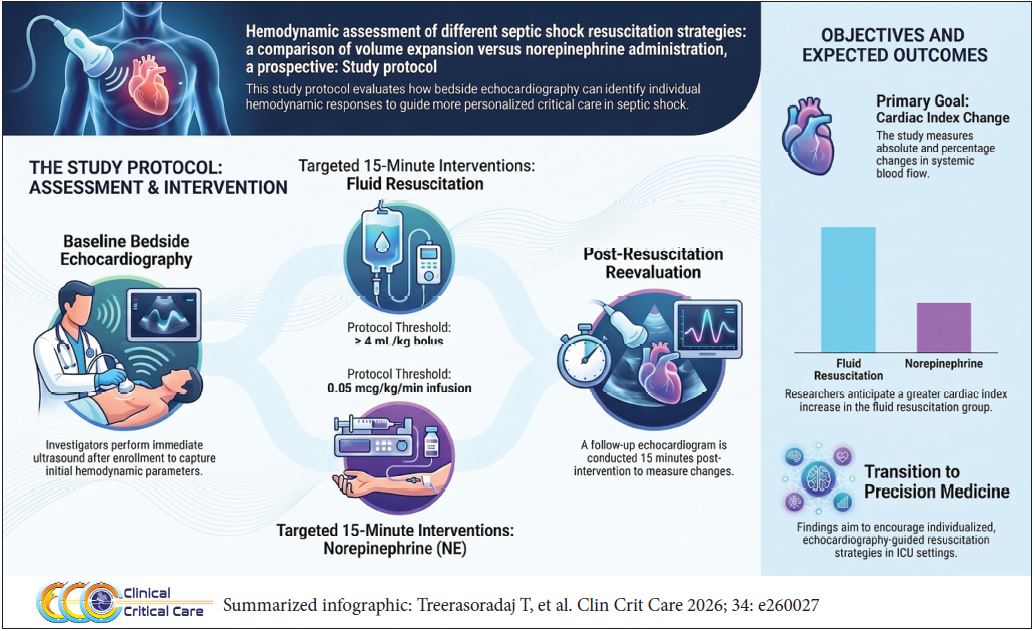
Background: Fluid resuscitation and vasopressors are the mainstays of septic shock management. However, individual hemodynamic responses vary significantly based on baseline cardiac function and preload status. Bedside echocardiography is a valuable tool for assessing these parameters, monitoring fluid responsiveness, and predicting vasopressor efficacy, which can ultimately improve patient outcomes. While recent studies have explored echocardiographic responses to vasopressin, evidence comparing hemodynamic responses to available vasopressors (like norepinephrine) versus fluid therapy in early septic shock remains limited, particularly in Thailand, where vasopressin is unavailable. This bedside echocardiography will help identify hemodynamic responders and guide individualized, precise management.
Objective: To test the hypothesized assumption that hemodynamic response would differ between volume resuscitation and norepinephrine infusion resuscitation, in terms of cardiac index and stroke volume.
Methods: This is a prospective cohort study conducted in the medical and surgical intensive care units of a tertiary care hospital in Thailand. We perform pre- and post-resuscitation echocardiography on patients with septic shock. Resuscitation strategies follow the Surviving Sepsis Campaign 2021 guidelines and are entirely directed by the attending physicians without blinding or randomization. To standardize the assessment, post-resuscitation echocardiography is performed 15 minutes after one of two physician-selected interventions: either fluid resuscitation with an intravenous bolus of isotonic fluid (≥4 mL/kg ideal body weight) or vasopressor resuscitation by norepinephrine with an infusion reaching 0.05 mcg/kg/min. The primary outcome is the change in the echocardiographic cardiac index from baseline to post-resuscitation.
Conclusions: This study aims to evaluate pre- and post-intervention echocardiographic profiles in septic shock patients receiving either fluid boluses or norepinephrine infusion resuscitation.
Ethics and Consideration: This study was approved by Siriraj institutional review board (IRB) on Certificate of approval (COA) no. Si 061/2025 Written informed consent was obtained from all participants or legally authorized representative (LAR) prior to inclusion in the study.
Trial Registration: NCT07438301
Downloads
References
Evans L, Rhodes A, Alhazzani W, Antonelli M, Coopersmith CM, French C, et al. Surviving sepsis campaign: international guidelines for management of sepsis and septic shock 2021. Crit Care Med. 2021;49:e1063-e143. doi:https://doi.org/10.1007/s00134-021-06506-y.
Fernando SM, Tran A, Soliman K, Flynn B, Oommen T, Wenzhe L, et al. Methylene blue in septic shock: a systematic review and meta-analysis. Crit Care Explor. 2024;6:e1110. doi:https://doi.org/10.1097/cce.0000000000001110.
Teja B, Bosch NA, Walkey AJ. How we escalate vasopressor and corticosteroid therapy in patients with septic shock. Chest. 2023;163:567-74. doi:https://doi.org/10.1016/j.chest.2022.09.019.
Desai N, Garry D. Assessing dynamic fluid-responsiveness using transthoracic echocardiography in intensive care. BJA Educ. 2018;18:218-26. doi:https://doi.org/10.1016/j.bjae.2018.03.005.
McLean AS. Echocardiography in shock management. Crit Care. 2016;20:275. doi:https://doi.org/10.1186/s13054-016-1401-7.
Wattanasansomboon S, Tongyoo S. Critical care echocardiography in shock: A comprehensive review. Clinical Critical Care. 2023. http://dx.doi.org/https://doi.org/10.54205/ccc.v31.265335. doi:https://doi.org/10.54205/ccc.v31.265335.
Miller A, Mandeville J. Predicting and measuring fluid responsiveness with echocardiography. Echo Res Pract. 2016;3:G1-G12. doi:https://doi.org/10.1530/erp-16-0008.
Monnet X, Shi R, Teboul JL. Prediction of fluid responsiveness. What's new? Ann Intensive Care. 2022;12:46. doi:https://doi.org/10.1186/s13613-022-01022-8.
Monnet X, Letierce A, Hamzaoui O, Chemla D, Anguel N, Osman D, et al. Arterial pressure allows monitoring the changes in cardiac output induced by volume expansion but not by norepinephrine. Crit Care Med. 2011;39:1394-9. doi:https://doi.org/10.1097/ccm.0b013e31820edcf0.
Alhabashy WS, Shalaby OM, Elgebaly AS, Ghafar MSAE. Echocardiography-guided hemodynamic management of severe sepsis and septic shock in adults. 2021;25:722-32. doi:https://doi.org/10.21203/rs.3.rs-17392/v2.
Dugar S, Siuba MT, Sacha GL, Sato R, Moghekar A, Collier P, et al. Echocardiographic profiles and hemodynamic response after vasopressin initiation in septic shock: A cross-sectional study. J Crit Care. 2023;76:154298. doi:https://doi.org/10.1016/j.jcrc.2023.154298.
Glassford NJ, Eastwood GM, Bellomo R. Physiological changes after fluid bolus therapy in sepsis: a systematic review of contemporary data. Crit Care. 2014;18:696. doi:https://doi.org/10.1186/s13054-014-0696-5.
De la Puente-Diaz de Leon VM, Rivero-Sigarroa E, Domiguez-Cherit G, Ñamendys-Silva SA. Fluid Therapy in severe sepsis and septic shock. Critical Care Medicine. 2013;41:e484-e5. doi:https://doi.org/10.1097/CCM.0b013e31829644fe.
Hamzaoui O, Georger JF, Monnet X, Ksouri H, Maizel J, Richard C, et al. Early administration of norepinephrine increases cardiac preload and cardiac output in septic patients with life-threatening hypotension. Crit Care. 2010;14:R142. doi:https://doi.org/10.1186/cc9207.
De Backer D, Pinsky M. Norepinephrine improves cardiac function during septic shock, but why? British Journal of Anaesthesia. 2018;120:421-4. doi:https://doi.org/10.1016/j.bja.2017.11.069.
Messina A, Palandri C, De Rosa S, Danzi V, Bonaldi E, Montagnini C, et al. Pharmacodynamic analysis of a fluid challenge with 4 ml kg(-1) over 10 or 20 min: a multicenter cross-over randomized clinical trial. J Clin Monit Comput. 2022;36:1193-203. doi:https://doi.org/10.1007/s10877-021-00756-3.
Permpikul C, Tongyoo S, Viarasilpa T, Trainarongsakul T, Chakorn T, Udompanturak S. Early use of norepinephrine in septic shock resuscitation (CENSER). A Randomized Trial. Am J Respir Crit Care Med. 2019;199:1097-105. doi:https://doi.org/10.1164/rccm.201806-1034oc.
Kotani Y, Di Gioia A, Landoni G, Belletti A, Khanna AK. An updated "norepinephrine equivalent" score in intensive care as a marker of shock severity. Crit Care. 2023;27:29. doi:https://doi.org/10.1186/s13054-023-04322-y.
Jozwiak M, Mercado P, Teboul JL, Benmalek A, Gimenez J, Dépret F, et al. What is the lowest change in cardiac output that transthoracic echocardiography can detect? Crit Care. 2019;23:116. doi:https://doi.org/10.1186/s13054-019-2413-x.
Downloads
Published
How to Cite
Issue
Section
License
Copyright (c) 2026 The Thai Society of Critical Care Medicine

This work is licensed under a Creative Commons Attribution-NonCommercial 4.0 International License.