The nurse role in early mobilization in ICU: A Brazilian perspective on recovery-oriented critical care
Nurse role in ICU early mobilization
DOI:
https://doi.org/10.54205/ccc.v34.282232Keywords:
Early mobilization, Intensive care unit, Nursing, Brazil, Critical careAbstract
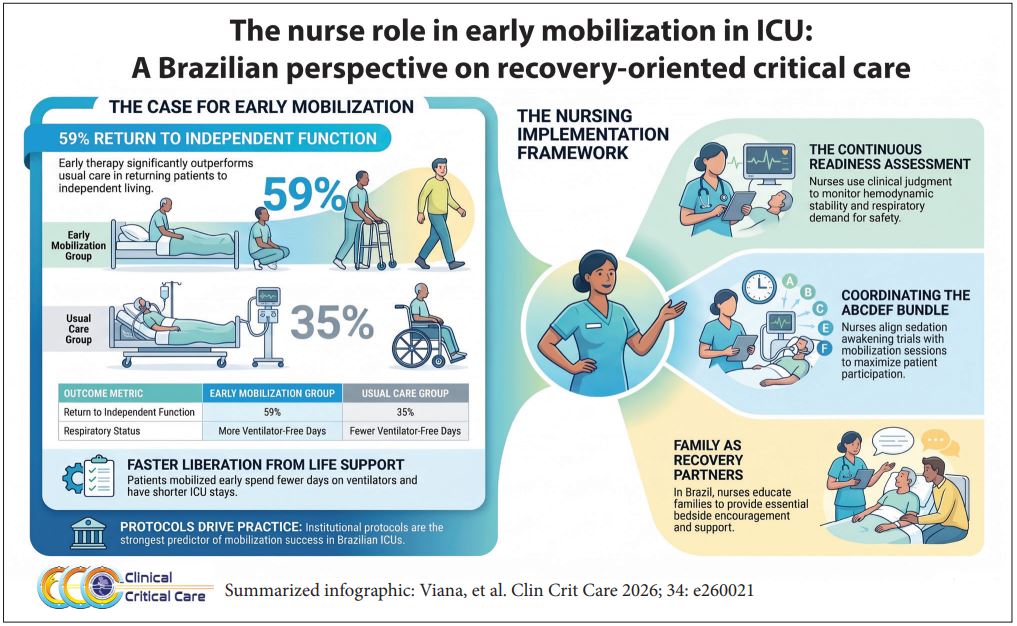
Background: Early mobilization (EM) in the intensive care unit (ICU) is an evidence-based strategy to prevent ICU-acquired weakness and improve functional recovery. Nurses play a central role in its implementation and safety, particularly in resource-variable settings such as Brazil.
Objective: To describe and contextualize the role of nurses in early mobilization in the ICU from a Brazilian perspective.
Methods: Narrative review based on indexed literature and Brazilian clinical guidelines on early mobilization.
Results: Early mobilization is associated with reduced ICU length of stay, more ventilator-free days, and better functional recovery; in a landmark randomized trial, 59% of early-mobilized patients returned to independent function at hospital discharge versus 35% with usual care. Nurses are fundamental in readiness assessment, safety monitoring, team coordination, and patient and family engagement. Key implementation barriers include sedation culture, staffing workload, and the absence of structured institutional protocols.
Conclusion: Nurses are essential for successful EM implementation. Protocol standardization, continuing education, and institutional support are required to expand early mobilization practices across Brazilian ICUs.
Downloads
References
Schweickert WD, Pohlman MC, Pohlman AS, Nigos C, Pawlik AJ, Esbrook CL, et al. Early physical and occupational therapy in mechanically ventilated, critically ill patients: a randomised controlled trial. Lancet. 2009;373(9678):1874-82. doi:10.1016/S0140-6736(09)60658-9
Morris PE, Goad A, Thompson C, Taylor K, Harry B, Passmore L, et al. Early intensive care unit mobility therapy in the treatment of acute respiratory failure. Crit Care Med. 2008;36(8):2238-43. doi:10.1097/CCM.0b013e318180b90e
Aquim EE, Bernardo WM, Buzzini RF, Azeredo NSG, Cunha LS, Damasceno MCP, et al. Brazilian Guidelines for early mobilization in intensive care unit. Rev Bras Ter Intensiva. 2019;31(4):434-443. doi:10.5935/0103-507X.20190084
Xu J, Wang S, Zhang Q, Yao Y, Yu J. Effectiveness of nurse-led early mobility protocols on the outcomes of critical care patients: a systematic review and meta-analysis. Nurs Open. 2025;12(5):e70206. doi:10.1002/nop2.70206
Silva VS, Pinto JG, Martinez BP, Camelier FWR. Mobilization in the Intensive Care Unit: systematic review. Fisioter Pesqui. 2014;21(4):398-404. doi:10.1590/1809-2950/11511921042014
Timenetsky KT, Neto AS, Assuncao MSC, Taniguchi L, Eid RAC, Correa TD, et al. Mobilization practices in the ICU: A nationwide 1-day point-prevalence study in Brazil. PLoS One. 2020;15(4):e0230971. doi:10.1371/journal.pone.0230971
Perme C, Chandrashekar R. Early mobility and walking program for patients in intensive care units: creating a standard of care. Am J Crit Care. 2009;18(3):212-21. doi:10.4037/ajcc2009598
Lenard MH, Cechinel C, Zomer TB, Rodrigues JAM, Binotto MA, Spoladore R. Evidence of the use of the Perme Intensive Care Unit Mobility Score in hospitalized adults: a scoping review. Rev Lat Am Enfermagem. 2025;33:e4542. doi:10.1590/1518-8345.7491.4542
Hodgson CL, Stiller K, Needham DM, Tipping CJ, Harrold M, Baldwin CE, et al. Expert consensus and recommendations on safety criteria for active mobilization of mechanically ventilated critically ill adults. Crit Care. 2014;18(6):658. doi:10.1186/s13054-014-0658-y
Tipping CJ, Bailey MJ, Bellomo R, Berney S, Buhr H, Denehy L, et al. The ICU Mobility Scale has construct and predictive validity and is responsive: a multicenter observational study. Ann Am Thorac Soc. 2016;13(6):887-893. doi:10.1513/AnnalsATS.201510-717OC
TEAM Study Investigators and the ANZICS Clinical Trials Group. Early active mobilization during mechanical ventilation in the ICU. N Engl J Med. 2022;387(19):1747-1758. doi:10.1056/NEJMoa2209083
Ely EW. The ABCDEF bundle: science and philosophy of how ICU liberation serves patients and families. Crit Care Med. 2017;45(2):321-330. doi:10.1097/CCM.0000000000002175
Devlin JW, Skrobik Y, Gélinas C, Needham DM, Slooter AJC, Pandharipande PP, et al. Clinical practice guidelines for the prevention and management of pain, agitation/sedation, delirium, immobility, and sleep disruption in adult patients in the ICU. Crit Care Med. 2018;46(9):e825-e873. doi:10.1097/CCM.0000000000003299
Rosa RG, Falavigna M, da Silva DB, Sganzerla D, Santos MMS, Kochhann R, et al. Effect of flexible family visitation on delirium among patients in the intensive care unit: the ICU Visits randomized clinical trial. JAMA. 2019;322(3):216-228. doi:10.1001/jama.2019.8766
Zhang L, Hu W, Cai Z, Liu J, Wu J, Deng Y, et al. Early mobilization of critically ill patients in the intensive care unit: a systematic review and meta-analysis. PLoS One. 2019;14(10):e0223185. doi:10.1371/journal.pone.0223185
Downloads
Published
How to Cite
Issue
Section
License
Copyright (c) 2026 The Thai Society of Critical Care Medicine

This work is licensed under a Creative Commons Attribution-NonCommercial 4.0 International License.