
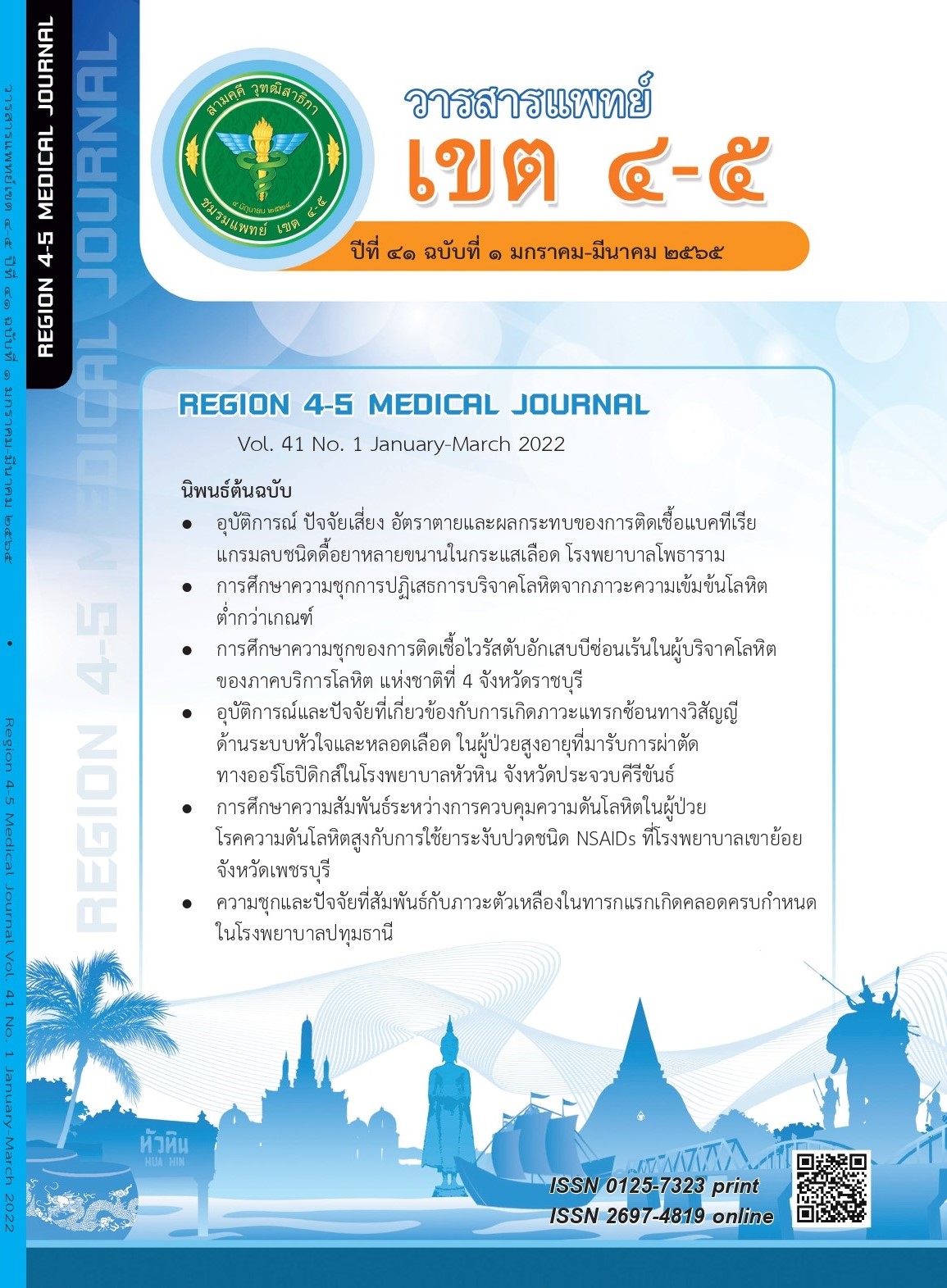
อุบัติการณ์ ปัจจัยเสี่ยง อัตราตายและผลกระทบของการติดเชื้อ แบคทีเรียแกรมลบชนิดดื้อยาหลายขนานในกระแสเลือด โรงพยาบาลโพธาราม
คำสำคัญ:
เชื้อดื้อยาหลายขนาน, แบคทีเรียแกรมลบ, การติดเชื้อในกระแสเลือดบทคัดย่อ
วัตถุประสงค์: ศึกษาอุบัติการณ์การติดเชื้อแบคทีเรียแกรมลบดื้อยาหลายขนานในกระแสเลือด วิเคราะห์หาปัจจัยเสี่ยงต่อการติดเชื้อแบคทีเรียแกรมลบดื้อยาหลายขนานและความสัมพันธ์กับตัวแปรที่เกี่ยวข้อง รวมถึงอัตราการตายและผลกระทบอื่นๆ ได้แก่ จำนวนวันและค่าใช้จ่ายระหว่างนอนในโรงพยาบาล เพื่อเป็นข้อมูลประกอบการตัดสินใจของแพทย์ในการรักษาผู้ป่วยและหรือควบคุมปัจจัยเสี่ยงเพื่อลดการติดเชื้อดื้อยาหลายขนาน ลดอัตราการตายและผลกระทบอื่นๆ อย่างประสิทธิภาพ
วิธีการศึกษา: เก็บข้อมูลย้อนหลังในเวชระเบียนผู้ป่วยที่อายุมากกว่า 15 ปี มีภาวะติดเชื้อแบคทีเรียแกรมลบในกระแสเลือด ที่เข้ารับการรักษาในโรงพยาบาลโพธาราม จังหวัดราชบุรี ระหว่าง 1 มกราคม พ.ศ. 2563 ถึง 31 ธันวาคม พ.ศ. 2563 นำข้อมูลของผู้ป่วยที่ติดเชื้อแบคทีเรียแกรมลบ ได้แก่ Acinetobacter baumannii, Escherichia coli, Klebsiella pneumoniae, Pseudomonas aeruginosa, และ Salmonella spp. ที่มีผลการทดสอบความไวต่อยาปฏิชีวนะ แบ่งเป็นสองกลุ่ม คือ กลุ่มที่ติดเชื้อดื้อยาหลายขนานและกลุ่มติดเชื้อไม่ดื้อยาหลายขนาน นำข้อมูลมาวิเคราะห์ความสัมพันธ์ของการติดเชื้อดื้อยาเหล่านี้กับตัวแปรที่เกี่ยวข้องและปัจจัยเสี่ยงของการติดเชื้อดื้อยาหลายขนานรวมถึงการเสียชีวิตของผู้ป่วย จำนวนวันและค่าใช้จ่ายระหว่างนอนในโรงพยาบาล การศึกษาครั้งนี้ไม่รวมผู้ป่วยที่ได้รับการดูแลแบบประคับประคอง
ผลการศึกษา: ผู้ป่วยที่มีภาวะติดเชื้อแบคทีเรียแกรมลบในกระแสเลือดจำนวน 212 คน เป็นผู้ป่วยติดเชื้อไม่ดื้อยาหลายขนาน 172 คน และติดเชื้อดื้อยาหลายขนาน 40 คน เสียชีวิต 19 คน และ 12 คน รวมเสียชีวิต 31 คน (ร้อยละ 14.6) โดยผู้ป่วยติดเชื้อดื้อยาหลายขนานเสียชีวิตร้อยละ 30 และพบผู้ป่วยส่วนใหญ่มีโรคประจำตัว เช่น โรคเบาหวาน (ร้อยละ 39.2) โรคหลอดเลือดหัวใจ (ร้อยละ 22.2) และโรคไตวายเรื้อรัง (ร้อยละ 19.3) เป็นต้น พบเป็นการติดเชื้อจากชุมชนและจากโรงพยาบาลร้อยละ 82.5 และ 17.5 ตามลำดับ ในส่วนของการติดเชื้อที่เกิดในโรงพยาบาลพบติดเชื้อดื้อยาหลายขนาน (ร้อยละ 50) มากกว่าติดเชื้อไม่ดื้อยาหลายขนาน (ร้อยละ 9.9) อย่างมีนัยสำคัญทางสถิติ ขณะที่การติดเชื้อจากชุมชนพบไม่แตกต่างกัน การติดเชื้อดื้อยาหลายขนานพบในระบบทางเดินปัสสาวะมากที่สุด (ร้อยละ 57.5) รองลงมาพบในระบบทางเดินหายใจ (ร้อยละ 22.5) ปัจจัยเสี่ยงที่เพิ่มโอกาสการติดเชื้อดื้อยาหลายขนานที่สำคัญได้แก่ การติดเชื้อจากโรงพยาบาล มีประวัติเคยติดเชื้อในกระแสเลือด หรือได้รับยาปฏิชีวนะทางหลอดเลือดดำ หรือได้รับอาหารทางสายยาง หรือใส่สายสวนปัสสาวะ ส่วนปัจจัยเสี่ยงที่เพิ่มโอกาสการเสียชีวิตของผู้ป่วยติดเชื้อแบคทีเรียแกรมลบในกระแสเลือด ได้แก่ การติดเชื้อดื้อยาหลายขนาน เกณฑ์อวัยวะล้มเหลวมากกว่าหรือเท่ากับ 2 คะแนนตามเกณฑ์การประเมิน ผู้ป่วยที่มีความดันโลหิตต่ำ การติดเชื้อในโรงพยาบาลและการได้รับยาปฏิชีวนะเบื้องต้นไม่เหมาะสมภายใน 24 ชั่วโมงและ 72 ชั่วโมง
สรุป: ปัจจัยเสี่ยงต่อการติดเชื้อดื้อยาหลายขนาน ได้แก่ การติดเชื้อในโรงพยาบาล รักษาตัวในหอผู้ป่วยวิกฤต ได้รับยาปฏิชีวนะทางหลอดเลือดดำมาก่อน ติดเชื้อในกระแสเลือดมาก่อน และพบว่าการใส่สายยางให้อาหาร สายสวนปัสสาวะ เครื่องช่วยหายใจ สายสวนทางหลอดเลือดดำส่วนกลางมีความเสี่ยงต่อการติดเชื้อดื้อยามากขึ้น ผลกระทบของการติดเชื้อแบคทีเรียแกรมลบชนิดดื้อยาหลายขนาน ได้แก่ โอกาสเสียชีวิตมากขึ้น นอนในโรงพยาบาลและเสียค่าใช้จ่ายมากขึ้น
เอกสารอ้างอิง
กระทรวงสาธารณสุข. แผนการตรวจราชการกระทรวงสาธารณสุข ประจำปีงบประมาณ พ.ศ. 2561 (Inspection Guideline) คณะที่ 2 : การพัฒนาระบบบริการสุขภาพ. KPI 3 อัตราตายผู้ป่วยติดเชื้อในกระแสเลือดแบบรุนแรงชนิด community acquired ได้ตามเป้าหมายที่กำหนด. นนทบุรี: กระทรวงสาธารณสุข; 2561: 448–55.
World Health Organization. Ten Threats to Global Health in 2019 [Internet]. 2021. [Cited 2021 Feb 1]. Available from: https://www.who.int/news-room/spotlight/ten-threats-to-global-health-in-2019.
ภาณุมาศ ภูมาศ, ตวงรัตน์ โพธะ, วิษณุ ธรรมลิขิตกุล, และคณะ. ผลกระทบด้านสุขภาพและเศรษฐศาสตร์จากการติดเชื้อดื้อยาต้านจุลชีพในประเทศไทย: การศึกษาเบื้องต้น. วารสารวิจัยระบบสาธารณสุข 2555;6(3),352–60.
ศูนย์วิชาการเฝ้าระวังและพัฒนาระบบยา คณะเภสัชศาสตร์ จุฬาลงกรณ์มหาวิทยาลัย. แบคทีเรียหรือไวรัส เช็กให้ชัดก่อนกินยาปฏิชีวนะ. ยาวิพากษ์ : จดหมายข่าวศูนย์ข้อมูลยาเพื่อการคุ้มครองผู้บริโภค. 2562; 11(42).
Lye DC, Earnest A, Ling ML, et al. The impact of multidrug resistance in healthcare-associated and nosocomial Gram-negative bacteraemia on mortality and length of stay: cohort study. Clin Microbiol Infect 2012;18(5):502–8.
โรงพยาบาลโพธาราม. รายงานอัตราการติดเชื้อดื้อยาในกระแสเลือด ประจำปีงบประมาณ พ.ศ. 2560-2563 โรงพยาบาลโพธาราม : รายการตัวชี้วัดเพื่อประเมินระดับการพัฒนาสู่การเป็นหน่วยบริการส่งเสริมการใช้ยาอย่างสมเหตุผล .คณะกรรมการป้องกันการติดเชื้อในกระแสเลือดคณะกรรมการระบบบัญชาการจัดการกับสถานการณ์ฉุกเฉิน โรงพยาบาลโพธาราม. โรงพยาบาลโพธาราม; 2563.
Clinical and laboratory standard institute: Performance Standards for Antimicrobial Susceptibility Testing; Twenty-eighth Informational Supplement CLSI Document M100–S20. Wayne, PA: Clinical and Laboratory Standards Institute; 2018.
Saliba M, Saadeh D, Bouchand F, et al. Outcome of bloodstream infections among spinal cord injury patients and impact of multidrug-resistant organisms. Spinal Cord 2017;55(2):148–54.
Manyahi J, Kibwana U, Mgimba E, et al. Multi-drug resistant bacteria predict mortality in bloodstream infection in a tertiary setting in Tanzania. PLoS One 2020;15(3):e0220424.
Lambden S, Laterre PF, Levy MM, et al. The SOFA score-development, utility and challenges of accurate assessment in clinical trials. Crit Care 2019;23(1):374
สถาบันบำราศนราดูร กรมควบคุมโรค กระทรวงสาธารณสุข. แนวปฏิบัติเพื่อป้องกันและควบคุมการติดเชื้อในโรงพยาบาล:สำนักพิมพ์อักษรกราฟฟิคแอนด์ดีไซน์ 2563;1:31-8.
Lee CC, Lee CH, Hong MY, et al. Timing of appropriate empirical antimicrobial administration and outcome of adults with community-onset bacteremia. Crit Care 2017;21(1):119.
Leal HF, Azevedo J, Silva GEO, et al. Bloodstream infections caused by multidrug-resistant gram-negative bacteria: epidemiological, clinical and microbiological features. BMC Infect Dis 2019;19(1):609.
Hellyer TP, Ewan V, Wilson P, et al. The Intensive Care Society recommended bundle of interventions for the prevention of ventilator-associated pneumonia. J Intensive Care Soc 2016;17(3):238–43.
ดาวน์โหลด
เผยแพร่แล้ว
รูปแบบการอ้างอิง
ฉบับ
ประเภทบทความ
สัญญาอนุญาต

อนุญาตภายใต้เงื่อนไข Creative Commons Attribution-NonCommercial-NoDerivatives 4.0 International License.
ลิขสิทธิ์บทความเป็นของผู้เขียนบทความ แต่หากผลงานของท่านได้รับการพิจารณาตีพิมพ์ลงวารสารแพทย์เขต 4-5 จะคงไว้ซึ่งสิทธิ์ในการตีพิมพ์ครั้งแรกด้วยเหตุที่บทความจะปรากฎในวารสารที่เข้าถึงได้ จึงอนุญาตให้นำบทความในวารสารไปใช้ประโยชน์ได้ในเชิงวิชาการโดยจำเป็นต้องมีการอ้างอิงถึงชื่อวารสารอย่างถูกต้อง แต่ไม่อนุญาตให้นำไปใช้ในเชิงพาณิชย์