
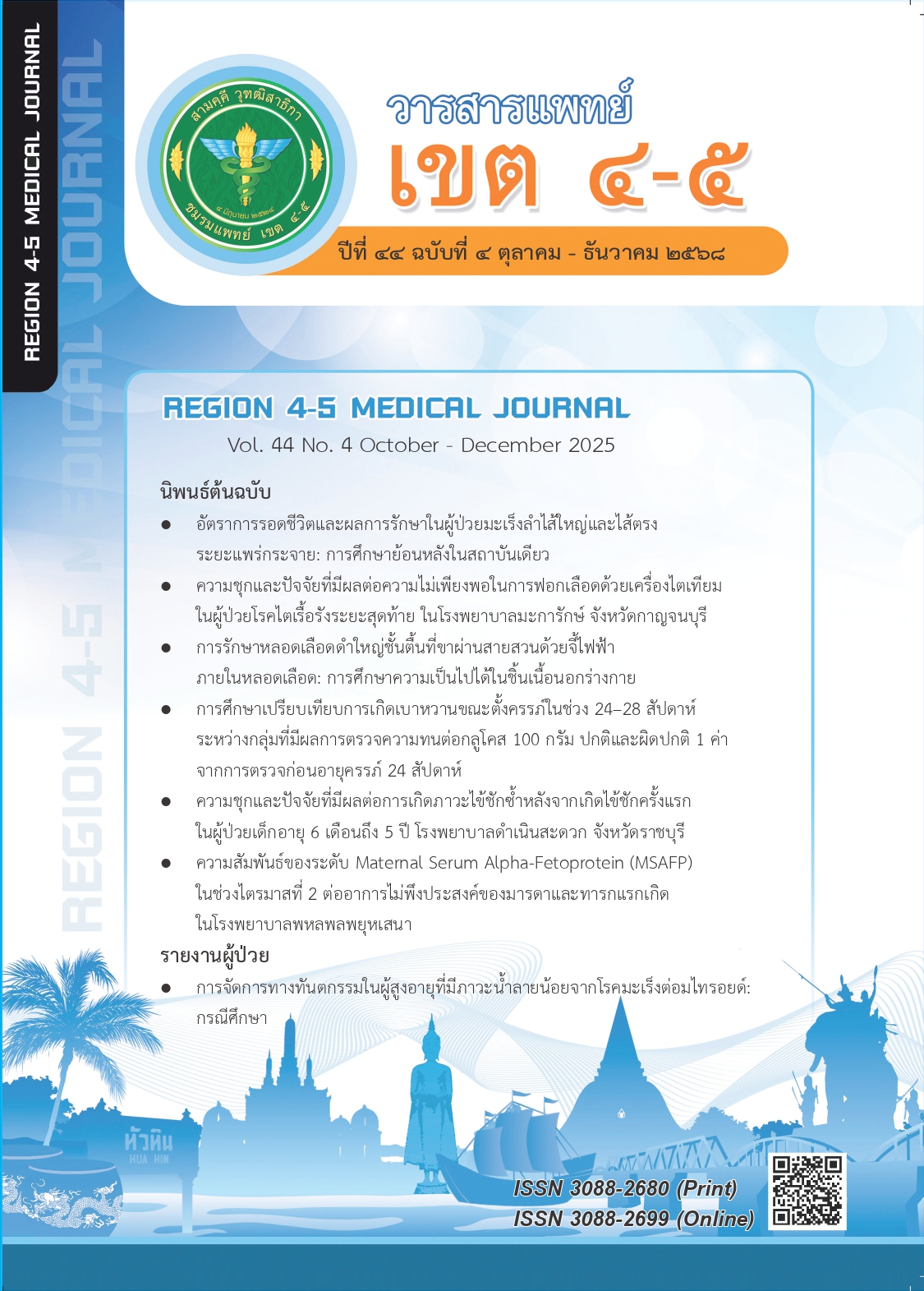
อัตราการรอดชีวิตและผลการรักษาในผู้ป่วยมะเร็งลำไส้ใหญ่และไส้ตรงระยะแพร่กระจาย: การศึกษาย้อนหลังในสถาบันเดียว
คำสำคัญ:
มะเร็งลำไส้ใหญ่และไส้ตรง, อัตราการรอดชีวิต, ระยะเวลาโรคสงบ, ปัจจัยการพยากรณ์โรคบทคัดย่อ
วัตถุประสงค์: เพื่อศึกษาระยะเวลาโรคสงบ และระยะเวลาการรอดชีวิต ในผู้ป่วยโรคมะเร็งลำไส้ใหญ่และไส้ตรงระยะแพร่กระจาย 5 ปี รวมทั้งศึกษาปัจจัยการพยากรณ์โรค และศึกษาอาการไม่พึงประสงค์ที่เกิดจากการให้ยาเคมีบำบัด
วิธีการศึกษา: การวิจัยครั้งนี้เป็นการศึกษาเชิงพรรณนาย้อนหลัง ในผู้ป่วยมะเร็งลำไส้ใหญ่และไส้ตรงมะเร็งลำไส้ใหญ่และไส้ตรงระยะแพร่กระจาย ของโรงพยาบาลนครปฐม ในช่วงเวลา 5 ปี (พ.ศ. 2562–2567 ) วิเคราะห์ข้อมูลด้วยจำนวน ร้อยละ ค่าเฉลี่ย และส่วนเบี่ยงเบนมาตรฐาน เปรียบเทียบตัวแปรด้วย t test และ chi-square test รายงานอัตราการรอดชีวิต Kaplan-Meier test เปรียบเทียบอัตราการรอดชีวิตระหว่างกลุ่มใช้สถิติ log-rank test และ Cox regression analysis
ผลการศึกษา: ระยะเวลาโรคสงบในผู้ป่วยโรคมะเร็งลำไส้ใหญ่และไส้ตรงระยะแพร่กระจาย 5 ปี ค่าเฉลี่ยอยู่ที่ 6 เดือน (HR 1.26; 95% CI 0.88–1.81; p = .206) และอัตราการรอดชีวิตในผู้ป่วยโรคมะเร็งลำไส้ใหญ่และไส้ตรงระยะแพร่กระจาย 5 ปี ค่าเฉลี่ยอยู่ที่ 12 เดือน (HR 0.99; 95% CI 0.67–1.46; p = .964)
สรุป: อัตราการรอดชีวิตและผลการรักษาในผู้ป่วยมะเร็งลำไส้ใหญ่และไส้ตรงระยะแพร่กระจาย ในโรงพยาบาลนครปฐม ในช่วงเวลา 5 ปี (พ.ศ. 2562–2567) เป็นการเก็บข้อมูลจริงจากผู้ป่วยจำนวน 150 รายพบว่า ระยะเวลาโรคสงบย้อนหลัง 5 ปี ค่าเฉลี่ยอยู่ที่ 6 เดือน คิดเป็นร้อยละ 8 และอัตราการรอดชีวิตเฉลี่ยอยู่ที่ 12 เดือน คิดเป็นร้อยละ 24 และพบว่าตำแหน่งที่มะเร็งกระจายไปที่ตับเป็นปัจจัยที่ผลต่อการพยากรณ์โรคทำให้การรอดชีวิตและระยะเวลาที่โรคสงบนั้นสั้นลง
เอกสารอ้างอิง
Arnold M, Sierra MS, Laversanne M, Soerjomataram I, Jemal A, Bray F. Global patterns and trends in colorectal cancer incidence and mortality. Gut. 2017;66(4):683–91. doi:10.1136/gutjnl-2015-310912
Siegel RL, Wagle NS, Cercek A, Smith RA, Jemal A. Colorectal cancer statistics, 2023. CA Cancer J Clin. 2023;73(3):233–54. doi:10.3322/caac.21772
Shin A, Jung KW, Won YJ. Colorectal cancer mortality in Hong Kong of China, Japan, South Korea, and Singapore. World J Gastroenterol. 2013;19(7):979–83. doi:10.3748/wjg.v19.i7.979
Malvezzi M, Carioli G, Bertuccio P, Boffetta P, Levi F, La Vecchia C, et al. European cancer mortality predictions for the year 2018 with focus on colorectal cancer. Ann Oncol. 2018;29(4):1016–22. doi:10.1093/annonc/mdy033
Moghimi-Dehkordi B, Safaee A. An overview of colorectal cancer survival rates and prognosis in Asia. World J Gastrointest Oncol. 2012;4(4):71–5. doi:10.4251/wjgo.v4.i4.71
Moghimi-Dehkordi B, Safaee A, Zali MR. Prognostic factors in 1,138 Iranian colorectal cancer patients. Int J Colorectal Dis. 2008;23(7):683–8. doi:10.1007/s00384-008-0463-7
Ghazali AK, Musa KI, Naing NN, Mahmood Z. Prognostic factors in patients with colorectal cancer at Hospital Universiti Sains Malaysia. Asian J Surg. 2010;33(3):127–33. doi:10.1016/S1015-9584(10)60022-X
Ratto C, Sofo L, Ippoliti M, Merico M, Doglietto GB, Crucitti F. Prognostic factors in colorectal cancer. Literature review for clinical application. Dis Colon Rectum. 1998;41(8):1033–49. doi:10.1007/BF02237397
Wang J, Li S, Liu Y, Zhang C, Li H, Lai B. Metastatic patterns and survival outcomes in patients with stage IV colon cancer: A population-based analysis. Cancer Med. 2020;9(1):361–73. doi:10.1002/cam4.2673
Zeineddine FA, Zeineddine MA, Yousef A, Gu Y, Chowdhury S, Dasari A, et al. Survival improvement for patients with metastatic colorectal cancer over twenty years. NPJ Precis Oncol. 2023;7(1):16. doi:10.1038/s41698-023-00353-4
Yoshino T, Arnold D, Taniguchi H, Pentheroudakis G, Yamazaki K, Xu RH, et al. Pan-Asian adapted ESMO consensus guidelines for the management of patients with metastatic colorectal cancer: a JSMO-ESMO initiative endorsed by CSCO, KACO, MOS, SSO and TOS. Ann Oncol. 2018;29(1):44–70. doi:10.1093/annonc/mdx738
Cervantes A, Adam R, Roselló S, Arnold D, Normanno N, Taïeb J, et al. Metastatic colorectal cancer: ESMO Clinical Practice Guideline for diagnosis, treatment and follow-up. Ann Oncol. 2023;34(1):10–32. doi:10.1016/j.annonc.2022.10.003
Douillard JY, Cunningham D, Roth AD, Navarro M, James RD, Karasek P, et al. Irinotecan combined with fluorouracil compared with fluorouracil alone as first-line treatment for metastatic colorectal cancer: a multicentre randomised trial. Lancet. 2000;355(9209):1041–7. doi:10.1016/s0140-6736(00)02034-1
de Gramont A, Figer A, Seymour M, Homerin M, Hmissi A, Cassidy J, et al. Leucovorin and fluorouracil with or without oxaliplatin as first-line treatment in advanced colorectal cancer. J Clin Oncol. 2000;18(16):2938–47. doi:10.1200/JCO.2000.18.16.2938
Arkenau HT, Arnold D, Cassidy J, Diaz-Rubio E, Douillard JY, Hochster H, et al. Efficacy of oxaliplatin plus capecitabine or infusional fluorouracil/leucovorin in patients with metastatic colorectal cancer: a pooled analysis of randomized trials. J Clin Oncol. 2008;26(36):5910–7. doi:10.1200/JCO.2008.16.7759
Cassidy J, Clarke S, Díaz-Rubio E, Scheithauer W, Figer A, Wong R, et al. Randomized phase III study of capecitabine plus oxaliplatin compared with fluorouracil/folinic acid plus oxaliplatin as first-line therapy for metastatic colorectal cancer. J Clin Oncol. 2008;26(12):2006–12. doi:10.1200/JCO.2007.14.9898
Ng SL, Burns WI, Snyder RD, Newnham GM, McLachlan SA, Liew D, et al. A retrospective cohort study of metastatic colorectal cancer patients treated with oxaliplatin-based chemotherapy, with an exploratory analysis of changing serum carcinoembryonic antigen levels. Asia Pac J Clin Oncol. 2012;8(2):172–9. doi:10.1111/j.1743-7563.2011.01486.x
ดาวน์โหลด
เผยแพร่แล้ว
รูปแบบการอ้างอิง
ฉบับ
ประเภทบทความ
สัญญาอนุญาต

อนุญาตภายใต้เงื่อนไข Creative Commons Attribution-NonCommercial-NoDerivatives 4.0 International License.
ลิขสิทธิ์บทความเป็นของผู้เขียนบทความ แต่หากผลงานของท่านได้รับการพิจารณาตีพิมพ์ลงวารสารแพทย์เขต 4-5 จะคงไว้ซึ่งสิทธิ์ในการตีพิมพ์ครั้งแรกด้วยเหตุที่บทความจะปรากฎในวารสารที่เข้าถึงได้ จึงอนุญาตให้นำบทความในวารสารไปใช้ประโยชน์ได้ในเชิงวิชาการโดยจำเป็นต้องมีการอ้างอิงถึงชื่อวารสารอย่างถูกต้อง แต่ไม่อนุญาตให้นำไปใช้ในเชิงพาณิชย์