The Effect of the THAI MODEL Program on the Social Emotional Development of Children with Autism Spectrum Disorders, Interaction Skills and Caregiver Stress: A Case Study of Hat Yai District, Songkhla Province
Keywords:
Social emotional developmental stimulation, autistic, caregiver, THAI modelAbstract
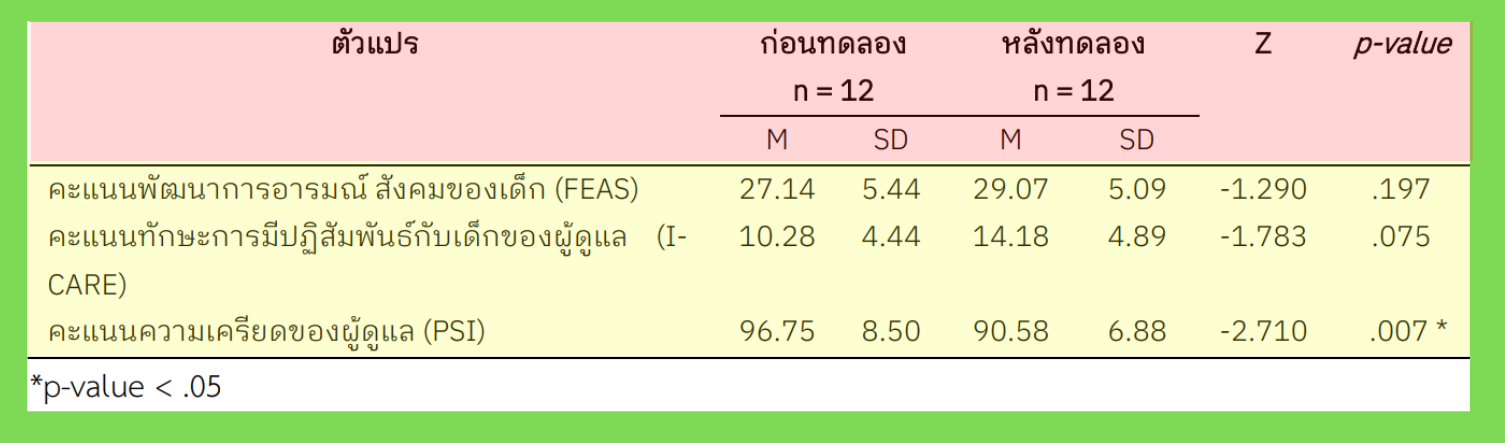
The aim of this study was to investigate the effects of the Thai Home-based Autism Intervention Model (THAI Model) program on the social emotional development of children with autism spectrum disorders, interaction skills and caregiver stress. It was a quasi-experimental single group with pretest-posttest design. The study subjects consisted of 12 families of autistic children, including 12 autistic children and 12 caregivers, selected by purposive sampling. The THAI Model program is consisting of 1) Parental classroom, 2) Clinic visits by promoting child development and coaching caregivers in the clinic by occupational therapists, 3) Home based program to promote home development by caregivers, and 4) Home visits. Data were collected consisting of 1) the Functional Emotional Assessment Scale, 2) the Child Interaction Scale, and 3) the Parenting Stress Index. Data were analyzed using descriptive statistics and Wilcoxon Signed Rank Test. Six months after program completion, children had higher mean scores for social emotion development (Z = -1.29, p =.197) and caregivers had higher mean scores for child interaction skills (Z = -1.783, p =. .075). Caregiver’s stress scores were significantly decreased (Z = -2.71, p = .007). In conclusion, THAI Model program can enhance families more skills in caring for autistic children, reduce family stress, and can be practiced at home. We suggest for further study by increasing the sample size and longer follow-up period.
References
American Psychiatric Association. (2013). Diagnostic and statistical manual of mental disorders (DSM-5) (5th ed). American Psychiatric Pub.
Apaiyanukorn, S., Kohprasert, K., & Kohprasert, M., (2013). The Development of a Model on Early Intervention Service for Children with Autism in Regional Hospital. The Journal of Psychiatric and Mental Health, 27(2), 99–111. (in Thai)
Autistic Thai Foundation. (2010). The Situation of Autistic persons in Thailand 2010. Retrieved 8 Jun 2022, from http://oknation.nationtv.tv/blog/autisticthai/2010/06/04/entry-2.
(in Thai)
Centers for Disease Control and Prevention. (2022). Data and Statistics on Autism Spectrum Disorder. Retrieved 9 Jun 2022, from https://www.cdc.gov/ncbddd/autism/data.html
Greenspan, S., Degangi, G., & Wieder, S. (2009). Engaging autism: Covering all types of ASD, including Asperger syndrome, from the earliest signs in infancy through the school years and on the adulthood. Da Capo Press.
Health Data Center. (2019). Percentage of autistic person access to service. Retrieved 10 May 2022, from https://hdcservice.moph.go.th/hdc/main/index.php. (in Thai)
Hirsch, K. H., & Paquin, J. D. (2019). “The Stress of the Situation has Changed us Both”: A Grounded Theory Analysis of the Romantic Relationship of Parents Raising Children with Autism. Journal of Child and Family Studies, 28(10), 2673–2689.
Klongdee, K., Nintachan, P., & Sangon, S. (2016). Factors related to parenting stress in caregiver of children with attention-deficit/hyperactivity disorder. The Journal of Psychiatric Nursing and Mental Health. 30(1), 52–68. (in Thai)
Kosasena, U., & Yunibhand, J. (2013). Effects of play therapy with family involvement on social, intellectual, and language development of Autistic children. The Journal of Psychiatric and Mental Health, 27(3), 125–137. (in Thai)
Kunlaka, S. (2017). Caring for Children with Autism Spectrum: A Case Study. Journal of Ramathibodi Nursing, 24(3), 227–238. (in Thai)
Muenphet, S., Hongchayangkool, K., Rodklai, A., Sornsrivichai, V., & Balthip, K. (2021). The Participatory Care for People with autism using the Innovative Care for Chronic Condition framework, Hatyai, Songkhla. Journal of Ratchasuda College for Research and Development of Person with Disabilities, 17(2), 34–48. (in Thai)
Munir, K. M., Lavelle, T. A., Helm, D. T., Thompson, D., Prestt, J., & Azeem, M. W. (2016). Autism: A global framework for action. Retrieved 6 Jun 2022, from https://www.wish.org.qa/reports/autism-a-global-framework-for-action/
National Institute for Child and Family Development. (2021). THAI Model. Retrieved 10 Jun 2022, from https://www.mahidolclinic.com/thai-model.html. (in Thai)
Nitithaveeratsakul, P., & Bhulapatna, P. (2020). A study on using sensory integration therapy program to improve sensory skills of preschoolers with Autism Spectrum Disorder (ASD): A case study of UDONSENSORY SCHOOL UDON THANI Province. Journal of research and develop in special education, 9(2), 1–15. (in Thai)
Occupational Therapy Department, Hat yai Hospital. Occupational therapy statistics report. Songkhla Province, Thailand; 2019. (in Thai)
Piyasil, V. (2015). Children with disabilities. Pentagon advertising. (in Thai)
Punphong, S., Yunibhand, J., & Suktrakul, S. (2019). The effect of enhancing family caregiving ability program on autistic symptoms among autistic preschoolers. Journal of Nursing Science Chulalongkorn University, 31(3), 74–86. (in Thai)
Reis, H., Pereira, S., & Almeida, L. (2018). Intervention effects on communication skills and sensory regulation on children with ASD. Journal of Occupational Therapy, Schools, & Early Intervention, 11(3), 1–14.
Singsathorn, D., Suksong, W., & Permsirivanich, W. (2016). Effects of Development Promotion based on DIR/Floortime Techniques in Autistic Children, Queen Savang Vadhana Memorial Hospital. Journal of Phrapokklao Nursing College, 27(1), 104–122. (in Thai)
Siriumpunkul, P. (2019). Effectiveness of parental competencies and developmental stimulation program by playing on the knowledge, parental child-care, and adaptive behavior of Children with Autism. Journal of The Royal Thai Army Nurses, 20(1), 311–320. (in Thai)
Sri-Amnuay, R. (2018). The lived experiences of parents who raise children with autism spectrum disorder: Implications for providing family-based early intervention. Journal of research and development in special education, 7(1), 82–103. (in Thai)
Suppasri, J., Nukaew, O., & Suttharangsee, W. (2017). The Effect of a family psychoeducation program for Children with Autism on the burden of caregivers: A Preliminary Study. The Southern College Network Journal of Nursing and Public Healtht, 4(special), 196–213. (in Thai)
White, S., Mcmorris, C., Weiss, J., & Lunsky, Y. (2012). The experience of crisis in families of Individuals with Autism Spectrum Disorder across the lifespan. Journal of Child and Family Studies - J CHILD FAM STUD, 21(3), 457–465.
Downloads
Published
How to Cite
Issue
Section
License
Copyright (c) 2023 Thai Journal of Public Health and Health Sciences

This work is licensed under a Creative Commons Attribution-NonCommercial-NoDerivatives 4.0 International License.
บทความทุกบทความที่ได้รับการตีพิมพ์ถือเป็นลิขสิทธิ์ของ วารสารสาธารณสุข