The Prevalence and Selected Factors Associated with Workplace Hazards in Thailand's Prefabricated Roof Installation Enterprises
Keywords:
Selected Factors, Accident, Working at Height, Prefabricated Roof Installation EnterprisesAbstract
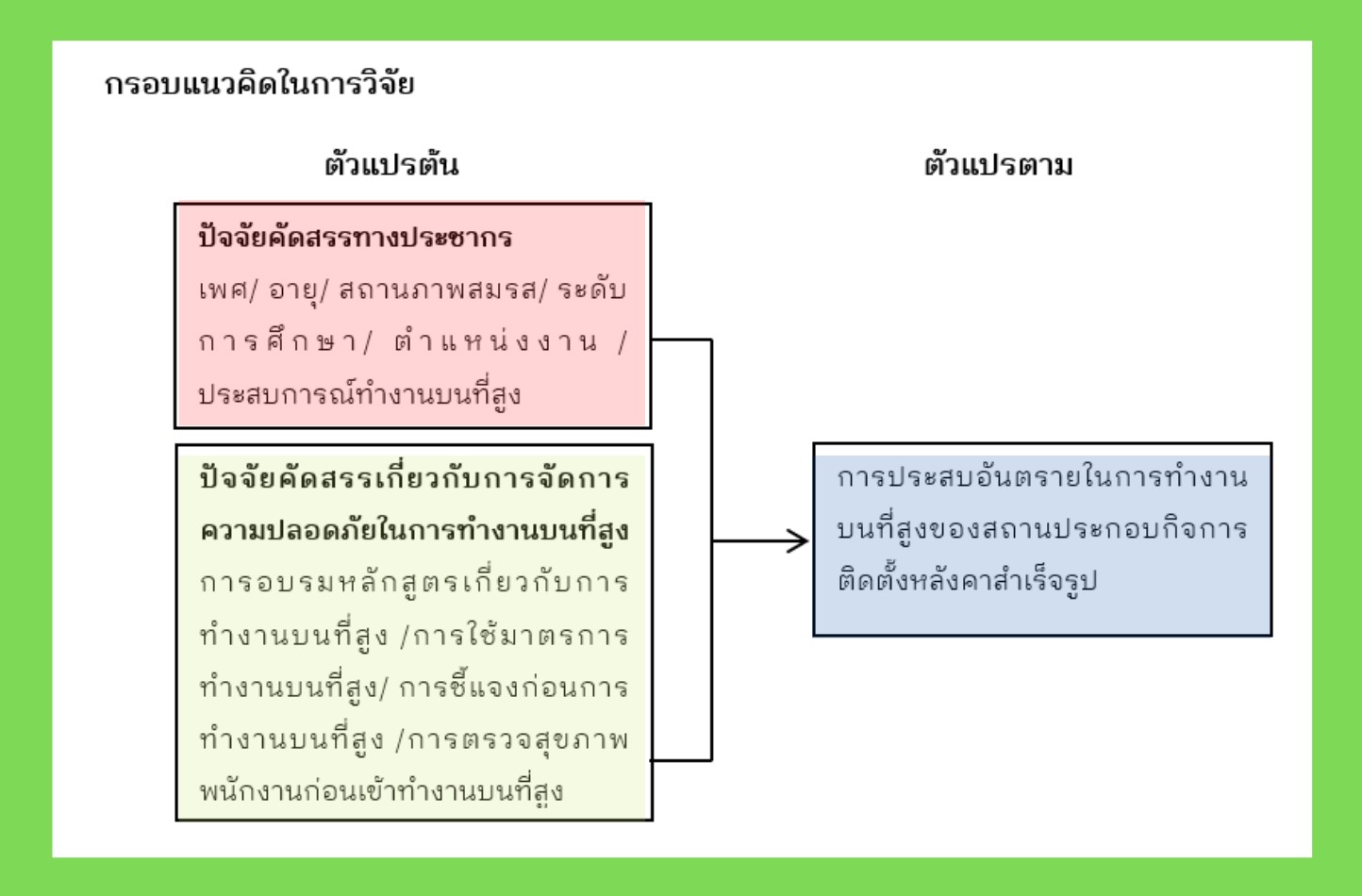
This cross-sectional analytical study aimed to investigate the prevalence and risk aspects relevant to working at heights in Thailand's prefabricated roof installation enterprises. Employees of operators were used as an example. A total sample size of 392 participants was utilized in a multi-stage random sampling. A questionnaire was constructed as a data collection instrument. Descriptive statistics were examined, and multivariate logistic regression was applied to examine factors that influence accidental injury while working at height. 1) The prevalence of accidents or injuries was 26.30%, according to the findings. 2) Factors for marital status and educational level, working at height experience, and the application of standards were statistically significantly associated with the hazards of working at height. Single status was associated with a 2.06-fold increased risk (ORadj =2.06, 95% CI: 1.06-4.02). Work experience of less than 20 years and workplaces that did not apply work standards at height increased the risk by 3.25 times (ORadj = 3.25, 95% CI: 0.13-0.33) and 1.81 times (ORadj = 1.81, 95% CI: 1.09-3.01), respectively. The protective factor was determined to be a bachelor's degree or higher, which had 0.22 times fewer risks than the risk group (ORadj = 0.22, 95% CI: 0.11-0.44). Knowledge and safe working behaviors should be encouraged, and all enterprises should implement working at height standards.
References
Arifuddin, R., Latief, R. U., & Suraji, A. (2020). An investigation of fall accident in a high-rise buildingproject. In IOP Conference Series: Earth and Environmental Science (Vol. 419, No. 1, p. 012144). IOP Publishing.
Baraza, X., & Cugueró-Escofet, N. (2021). Severity of occupational agricultural accidents in Spain, 2013–2018. Safety science, 143, 105422.
Tummavong, A. (2021). Factors related to behavior Safety, Occupational Health and Working
Environment for Employees Siri Success Supply Co., Ltd., A Theses Submitted in Partial Fulfillment of the Requirements for Master of Science (Environmental Management), National Institute of Development Administration.
Krutharoj, A., Lormphongs, S., Phatrabuddha, N., & Pusapukdepob, J. (2018). Factors Related to Safety Behavior of Working at Height among Electric Railway Workers in Bangkok Metropolis. Journal of Safety and Health, 11 (3), 27-34.
Sonprom, B. (2012). Attitude of construction workers on accidents in construction industry: a case study of SWT technology & construction Co., Ltd. A Dissertation Submitted in Partial Fulfillment of the Requirements for Civil Engineering. Suranaree University of Technology.
Hon, C.K., & Chan, A.P. (2013). Fatalities of repair, maintenance, minor alteration, and addition works in Hong Kong. Saf. Sci., 51, 85–93.
Huang, X., & Hinze, J. (2003). Analysis of construction worker fall accidents. J. Constr. Eng. Manag., 129, 262–271.
Krungsri Research. (2020).Business/Industry Outlook 2021-2023: Construction Materials Business, 2021. Available from: https://www.krungsri.com. (in Thai)
Lipscomb, H.J., Dement, J.M., Nolan, J., Patterson, D., Li, L., Cameron, W. (2003). Falls in residential carpentry and drywall installation: Findings from active injury surveillance with union carpenters. J. Occup. Environ. Med., 45, 881–890.
Maryani, A., Wignjosoebroto, S., & Partiwi, S. G. (2015). A system dynamics approach for modeling construction accidents. Procedia Manufacturing, 4, 392-401.
Mersha, H., Mereta, S. T., & Dube, L. (2017). Prevalence of occupational injuries and associated factors among construction workers in Addis Ababa, Ethiopia. Journal of public health and epidemiology, 9 (1), 1-8.
Neuman, W. L. (1991). Social research methods: Qualitative and quantitative approaches. Boston: Allyn and Bacon.
Rana, S., & Goswami, P. (1996). Hazard Associated with Construction Sites in India and Various Techniques for Preventing Accidents due to Fall from Height. Res. Pract. Fall Inj. Control Workplace, 1, 188–191.
Real Estate Information Center, Government Housing Bank. (2020). Fierce competition in truss roofstructure market 3 companies win share - Easy Trust expands the project. Available from: https://www.reic.or.th/News/RealEstate/439029. (in Thai)
Siripanich, S., Meanpoung, P., & Sangchatip, A. (2016). Trends and characteristics of occupational injuries in Thailand, 2002-2010. OSIR Journal, 7(3), 8-15. (in Thai)
Social Security Office, Ministry of Labour. (2020). Report on situations of danger or illness due to workfor the year 2016-2020. Available from: https://www.sso.go.th. (in Thai)
Wichairum., S. (2009). Risk factors of Construction Worker. Degree of Master of Science, Graduate School, Dhurakij Pundit University.
Thairath Online. (2020). Chonburi looks to sacrifice 3 bodies. A young worker fell from the roof of a warehouse 15 meters high and died on the spot. 7 May 2020. Available from: https://www.thairath.co.th/news/local/east/1838508. (in Thai)
Wibowo, T., Sukaryawan, I. M., & Hamoko, J. U. D. (2020). Identifying Causal Factors of Accidents Related to Working at Height: A Case Study of a Construction Company. In Proceedings of the International Conference on Engineering and Information Technology for Sustainable Industry, 1-7.
Wong, F. K., Chan, A. P., Yam, M. C., Wong, E. Y., Kenny, T. C., Yip, K. K., et al. (2009). Findings from a research study of construction safety in Hong Kong: Accidents related to fall of person from height. Journal of Engineering, Design and Technology, 7 (2), 130-142.
Zerguine, H., Tamrin, S. B. M., & Jalaludin, J. (2018). Prevalence, source and severity of work-related injuries among “foreign” construction workers in a large Malaysian organisation: a cross-sectional study. Industrial health, 56(3), 264-273.
Downloads
Published
Versions
- 2023-08-08 (2)
- 2023-08-08 (1)
How to Cite
Issue
Section
License
Copyright (c) 2023 Thai Journal of Public Health and Health Sciences

This work is licensed under a Creative Commons Attribution-NonCommercial-NoDerivatives 4.0 International License.
บทความทุกบทความที่ได้รับการตีพิมพ์ถือเป็นลิขสิทธิ์ของ วารสารสาธารณสุข