Development of Home Isolation Care Application System for COVID-19 Patients
Keywords:
Development, Care Application System, COVID-19 Patients, Home Isolation, ApplicationAbstract
The objective of this Mixed Methods study was to develop a home isolation care application system for COVID-19 patients in Sikao hospital, Trang Province. The study was conducted between December 2021 and January 2023. Two groups of target samples, including: (1) 15 healthcare workers for model development process, and (2) 395 healthcare workers and patient participants, and 3,062 COVID-19 report forms for evaluation process were recruited. Systematic sampling method of participant recruitment was performed. Qualitative and quantitative data were collected by focus group discussions, observations, and in-depth interviews. Data were analyzed using percentage, mean, standard deviation, One Sample T-test, Independent-t-test, One-Way ANOVA and Content analysis.
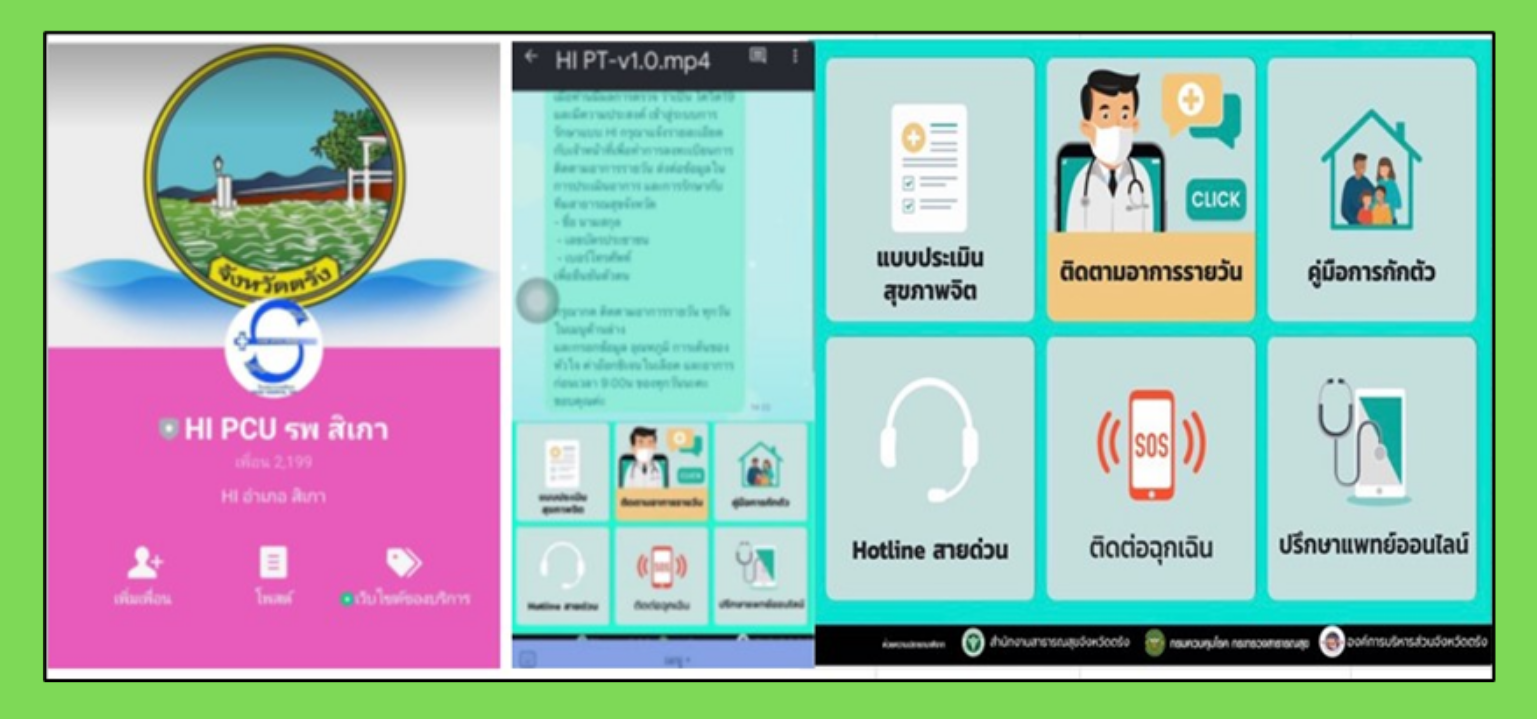
The study results revealed that the 3 main dimensions (3S) of the developed home isolation system for COVID-19 patients in this study were presented as follow: (1) Service: LINE Official Account, personal line, and DOCTOR A to Z applications, telephone, and patient’s chart, (2) Structure: Connection Patient – Hospital, Home based with referral system, Quality and Safety, and (3) Staff: Multidisciplinary medical team. After the home isolation care system development, quality service assessment score for home isolation care system of patient participants (Mean=4.11±0.56) and healthcare worker participants (Mean=4.25±0.66) were observed at the high level. Statistical differences in quality service assessment scores among ages groups, and marital status were found at the significant level 0.05 (p=0.046, and 0.007, respectively). There was no difference in quality service assessment scores between patient participants and healthcare workers groups (p=0.261). In addition, Mean scores of quality service assessments were significantly higher than the target values. (p<0.001). These findings indicated that a home isolation care application system could truly benefit to patients and healthcare personnel. This home isolation system can be developed and applied to other target groups. However, the system can be expected to vary across regions due to differences in origin and cultural diversity.
References
Arungjit, T. (2022). Effectiveness of nursing care for Coronavirus disease 2019 patients in the Home Isolation System, Wang Chao Hospital, Tak Province. Journal of Public Health, Tak Province. 2(2), 1-14. (in Thai)
Best, J., & John, W. (1977). Research in Education. (3rd ed.). New Jersey: Prentice Hall, Inc.
Department of disease control, (2022). Guidelines for surveillance, prevention and control of Corona virus infection 2019. Nonthaburi: Ministry of Public Health. (in Thai)
Department of Medical Services. (2022). Guidelines for medical personnel for providing patient advice and home isolation services for COVID-19 patients. Nonthaburi: Ministry of Public Health. (in Thai)
Earp, J.A., & Ennett, S.,T. (1991). Conceptual models for health education research and practice. Health Education Research, 6(2), 163–171.
Emergency Operations Center, Department of disease control, (2022). Coronavirus 2019 Disease Situation Report. Department of disease control. Nonthaburi: Ministry of Public Health. (in Thai)
Jarungjit, Th., (2021). Effectiveness of nursing care for coronavirus disease 2019 patients in the Home Isolation System, Wang Chao Hospital, Tak Province. Wang Chao Hospital Wang Chao District, Tak Province. (in Thai)
Krejcie, R.V., & Morgan, D.W. (1970). Determining Sample Size for Research Activities. Educational and Psychological Measurement, 30, 607-610.
Kumprasit, U. (2021). Development of Nursing Model during the COVID-19 Outbreaks: In-Patient Department, Nonthai Hospital. Regional Health Promotion Center 9 Journal, 16(1), 30-44. (in Thai)
Matatratip, C., Pissawongprakan, P., Nonsrirach, T., (2021). Factors Affecting Access to the Health Promotion Service System through LINE Official Account of Regional Health Promotion Center 7 Khon Kaen: Good health is Rewardsed of the People in the Responsible Area. Regional Health Promotion Center 7 Journal Khon Kaen, 14(2), 14-33. (in Thai)
Srina, S. (2021). Development of Care Model for Diabetic Type 2 by Line Application. Journal of Research and Health Innovative Development, 2(1), 123-133. (in Thai)
Sungkasrisombut, K., Machara, A., Promsri, M., Panit N. (2022). Development of Health Education and Health CounselingModelUsingLINE Official AccountApplicationfor Mothers in Caring for Infants with Premature Births. Regional Health Promotion Center 9 Journal. 16(2), 623-641. (in Thai)
Wirifai, S., & Luddangam, P. (2022). Home Isolation: Guidance for Patients with COVID-19 Infection. Regional Health Promotion Center 9 Journal, 16(2), 597-611. (in Thai)
World Health Organization. (2022). Coronavirus disease (COVID-19) questions and answers (general). Geneva, Switzerland. Retrieved 19 May 2022 from https://www.who.int/thailand/emergencies/novel-coronavirus.
Downloads
Published
How to Cite
Issue
Section
License
Copyright (c) 2023 Thai Journal of Public Health and Health Sciences

This work is licensed under a Creative Commons Attribution-NonCommercial-NoDerivatives 4.0 International License.
บทความทุกบทความที่ได้รับการตีพิมพ์ถือเป็นลิขสิทธิ์ของ วารสารสาธารณสุข