Results of the village health volunteer capacity development program on knowledge of NCDs health care behavior with lifestyle medicine through participatory learning program, Don Sai Subdistrict, Pak Tho District, Ratchaburi Province
Keywords:
Village Health Volunteers, Noncommunicable Diseases, Lifestyle Medicine, Participatory LearningAbstract
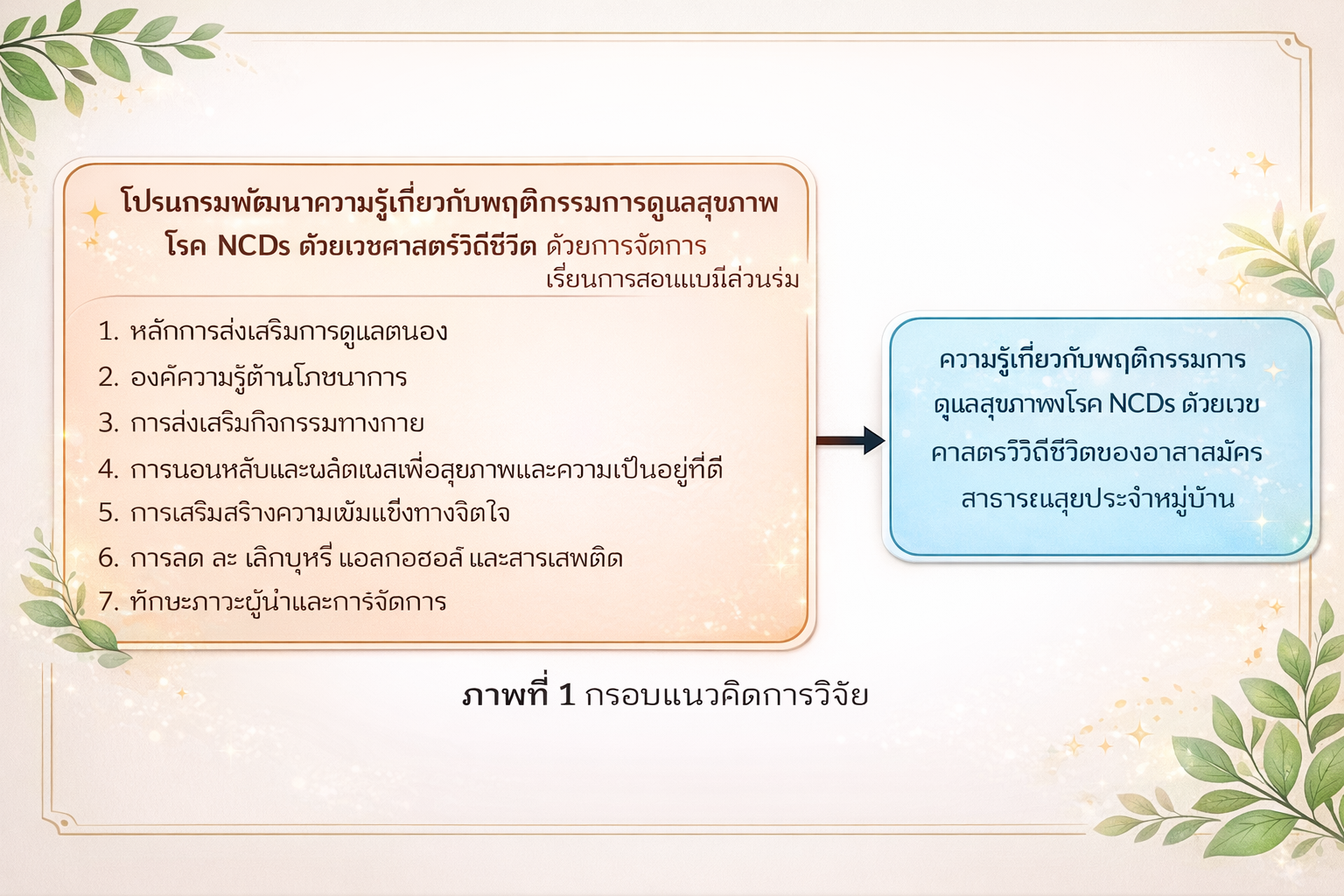
This quasi-experimental study aimed to compare knowledge of non-communicable disease (NCD) health care behaviors based on lifestyle medicine using a participatory learning program. Knowledge levels were assessed before and after the intervention in both experimental and control groups. The sample comprised 60 village health volunteers, with 30 participants in each group. Research instruments included a structured questionnaire and an 8-week participatory learning program. Data were analyzed using descriptive statistics, paired t-tests, and independent t-tests.
The findings indicated that the experimental and control groups were comparable in their demographic characteristics. Most participants were female, aged 41–50 years, married, had primary-level education, earned a monthly income of no more than 5,000 baht, and had 1–5 years or 16–20 years of experience as village health volunteers in similar proportions. Prior to the intervention, there was no statistically significant difference in mean knowledge scores between the experimental and control groups (M = 24.6, SD = 3.8 and M = 24.6, SD = 4.2, respectively; p = .955), indicating comparable baseline knowledge. Within-group analysis showed that, following the intervention, the experimental group demonstrated significantly higher mean knowledge scores in several domains compared to pre-intervention levels, including principles of self-care promotion (M = 3.7 vs. 3.1, p = .003), physical activity promotion (M = 3.4 vs. 2.8, p = .002), and reduction and cessation of smoking, alcohol consumption, and substance use (M = 3.7 vs. 3.2, p = .050), at the .05 level of statistical significance. However, no statistically significant improvements were observed in knowledge related to nutrition, sleep and health outcomes, mental resilience, or leadership and management skills. Between-group comparisons after the intervention revealed that the experimental group had significantly higher overall mean knowledge scores than the control group (M = 26.7, SD = 3.5 vs. M = 25.0, SD = 2.6; p = .032). These findings suggest that the participatory learning program was effective in enhancing NCD-related health care knowledge among village health volunteers. It is therefore recommended that relevant agencies, such as sub-district health promoting hospitals and district public health offices, consider scaling up and integrating this participatory learning program into routine capacity-building initiatives.
References
American College of Lifestyle Medicine. (2021). What is lifestyle medicine? Retrieved March 29, 2025, from https://www.lifestylemedicine.org/ACLM/About/What_is_Lifestyle_Medicine/ACLM/About/What_is_Lifestyle_Medicine_/Lifestyle_Medicine.aspx
Bureau of Non-Communicable Diseases, Department of Disease Control, Ministry of Public Health. (2017). National Strategic Plan for Prevention and Control of Non-communicable Diseases 5 Years (2017-2021). Nonthaburi: Ministry of Public Health. (in Thai)
Butrsorn, A., Homsin, P. & Samran, K. (2018). Effects of Village Health Volunteer Capacity Development Program in Smoking Cessation. Journal of Health Science, 27(2), 223-231. (in Thai)
Churungsarit, C. (2016). ‘MS’ Learning Management and Thai Education. Nonthaburi: Sukhothai Thammathirat Open University Press. (in Thai)
Chuprapawan, C., Kerdmongkol, P., Kanjanakunn, K. & Kamhong, S. (2020). Effects of Learning Activities to Promote Health Literacy in Type 2 Diabetes Patients. Journal of Nursing Science, Ubon Ratchathani University, 1, 76-92. (in Thai)
Don Sai Subdistrict Health Promoting Hospital. (2020). Public Health Statistics Report of Don Sai Subdistrict 2020. Ratchaburi: Don Sai Subdistrict Health Promoting Hospital. (in Thai)
Eiumsupasit, S. (2013). Behavior Modification Theories and Techniques. (8th ed.). Bangkok: Chulalongkorn University Press. (in Thai)
Juangpanich, U., Tantayotai, W. & Chanyadham, K. (2020). Development of Self-Care Ability Promotion Program for Type 2 Diabetes Patients Through Health Team Participation. Thai Journal of Nursing Council, 35(2), 5-21. (in Thai)
Kolb, D. A. (2014). Experiential learning: Experience as the source of learning and development. (2nd ed.). New Jersey: Pearson Education.
Knowles, M. S. (1984). Andragogy in Action: Applying Modern Principles of Adult Education. San Francisco: Jossey-Bass.
Laowichaya, N., Prompitagkul, P. & Watcharasin, J. (2021). Effects of Health Personnel Capacity Development Program in Lifestyle Medicine. Songklanagarind Journal of Nursing, 41(1), 55-66. (in Thai)
Limsatrakul, P., Khumpalikij, S., Srisathitnarakun, B. & Luangamornlert, S. (2020). Village Health Volunteers Capacity Development on Health Literacy Regarding Care for Type 2 Diabetes Mellitus Patients in Community, Phetchaburi Province. Ramathibodi Nursing Journal, 26(2), 175-187. (in Thai)
Luangubon, J., Ngamukhote, C. & Panoothum, S. (2017). Health Literacy Regarding Non-Communicable Diseases Among Village Health Volunteers in Phichit Province. Journal of Health Science, 26(4), 718-727. (in Thai)
Manee, C. & Kowit, L. (2015). Effects of Applying the Participatory Learning According to Kolb’s Learning Styles Toward the Changing of Health Behaviors of the Elderly in the Elderly School. Nursing Journal, 42, 92-103. (in Thai)
Mekwimol, W., Pantametheeruthi, B. & Youngvaniseth, S. (2018). Effects of Participatory Health Promotion Program in Community on Prevention and Control Behaviors of Hypertension and Diabetes Among Village Health Volunteers. Journal of Nurses Association of Thailand, North-Eastern Division, 36(3), 11-20. (in Thai)
Prasomrak, P., Aekplakorn, W. & Suksomboon, N. (2019). Development of Health Promotion Model for Chronic Non-Communicable Disease Care by Village Health Volunteers. Journal of Health Systems Research, 13(1), 16-30. (in Thai)
Saenprasert, P., Watcharasin, J. & Diawisares, W. (2019). Effects of Self-Health Care Promotion Activity Package on Self-Health Care Advice Behaviors for Non-Communicable Disease Patients Among Village Health Volunteers. Nursing and Education, 12(4), 142-155. (in Thai)
Saeng-on, S., Rattanagrittakul, S. & Putthawattana, P. (2016). Effects of Empowerment Program on Self-Care Behaviors Among Patients After Coronary Artery Bypass Graft Surgery. Ramathibodi Nursing Journal, 22(2), 145-159. (in Thai)
Srivanichakorn, S., Jiracheeppattana, W. & Ravivorrakul, T. (2017). Effects of Competency Development Program for Village Health Volunteers in Caring for Patients with Chronic Non-Communicable Diseases in Communities. Journal of Nursing Science and Health, 40(3), 81-89. (in Thai)
Steering Committee for the Development of the 12th National Health Development Plan, B.E. 2560-2564. (2016). The 12th National Health Development Plan, B.E. 2560-2564 (2017-2021). Nonthaburi: Office of the Permanent Secretary, Ministry of Public Health. (in Thai)
Thai Health Promotion Foundation. (2020). Annual Report 2019. Bangkok: Thai Health Promotion Foundation. Retrieved March 29, 2025, from https://www.thaihealth.or.th/Content/53435-Annual%20Report%202019.html (in Thai)
Thongnuadee, B. & Jiracheeppattana, W. (2018). Factors Related to Village Health Volunteers’ Participation in Non-Communicable Disease Prevention and Control in Suphan Buri Province. Journal of Health Science, 27, 273-282. (in Thai)
Wannapong, C. (2019). Effects of Participatory Learning Program on Self-Care Behaviors Among Elderly at Risk of Diabetes in Community (Master’s thesis). Bangkok: Chulalongkorn University. (in Thai)
World Health Organization. (2018). Noncommunicable diseases country profiles 2018. Geneva: World Health Organization. Retrieved March 29, 2025, from https://apps.who.int/iris/handle/10665/274512
Downloads
Published
How to Cite
Issue
Section
License
Copyright (c) 2026 Thai Journal of Public Health and Health Sciences

This work is licensed under a Creative Commons Attribution-NonCommercial-NoDerivatives 4.0 International License.
บทความทุกบทความที่ได้รับการตีพิมพ์ถือเป็นลิขสิทธิ์ของ วารสารสาธารณสุข