ผลของโปรแกรมการพัฒนาศักยภาพอาสาสมัครสาธารณสุขประจำหมู่บ้านความรู้เกี่ยวกับพฤติกรรมการดูแลสุขภาพโรค NCDs ด้วยเวชศาสตร์วิถีชีวิตโดยโปรแกรมการเรียนรู้แบบมีส่วนร่วม ตำบลดอนทราย อำเภอปากท่อ จังหวัดราชบุรี
คำสำคัญ:
อาสาสมัครสาธารณสุข, โรคไม่ติดต่อเรื้อรัง , เวชศาสตร์วิถีชีวิต , การเรียนรู้แบบมีส่วนร่วมบทคัดย่อ
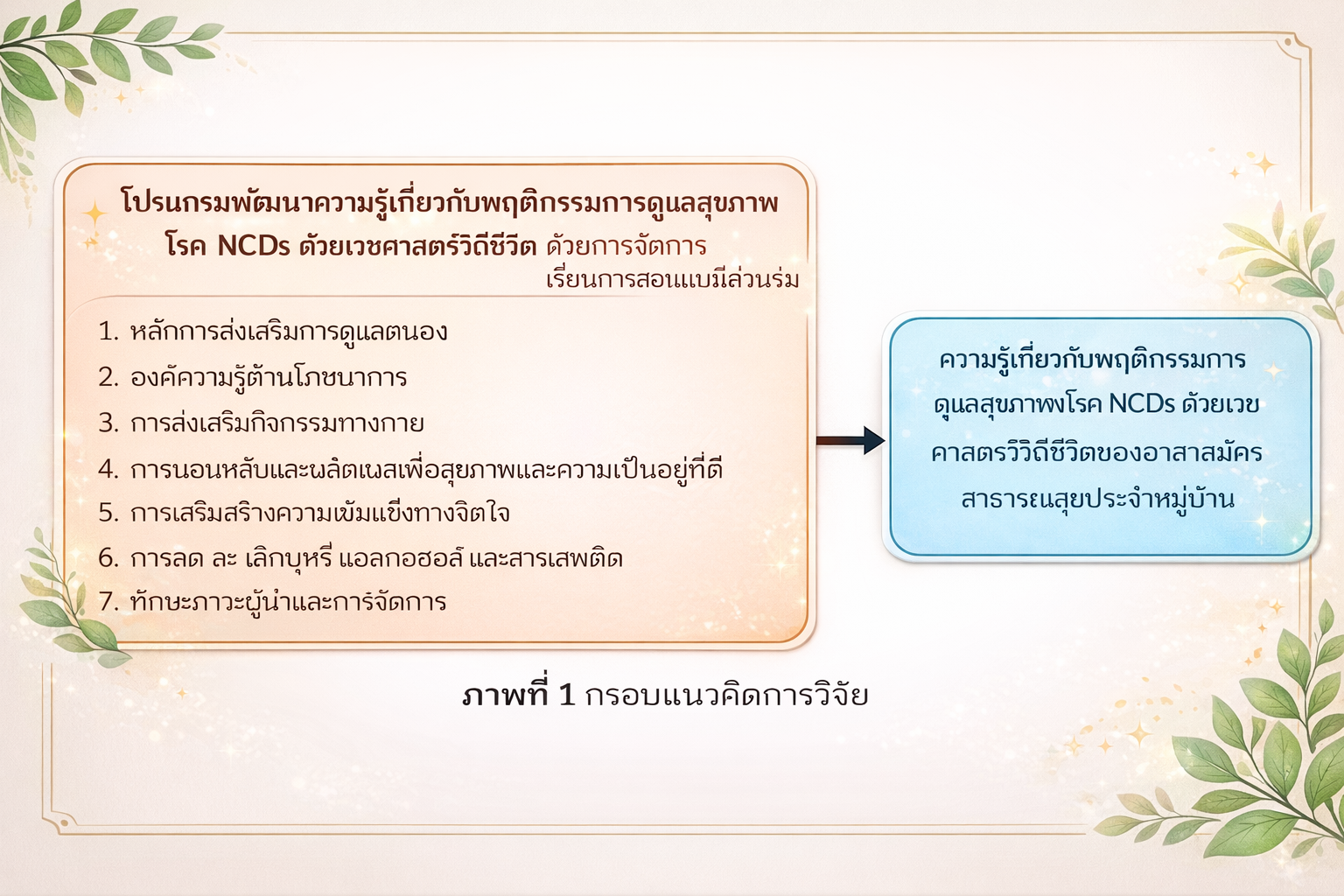
การวิจัยครั้งนี้เป็นการวิจัยกึ่งทดลอง มีวัตถุประสงค์เพื่อเปรียบเทียบความรู้เกี่ยวกับพฤติกรรมการดูแลสุขภาพเกี่ยวกับพฤติกรรมการดูแลสุขภาพโรค NCDs ด้วยเวชศาสตร์วิถีชีวิตโดยโปรแกรมการเรียนรู้แบบมีส่วนร่วม ในกลุ่มทดลองและกลุ่มควบคุม วัดผลก่อนและหลังการทดลอง กลุ่มตัวอย่างเป็นอาสาสมัครสาธารณสุขประจำหมู่บ้าน จำนวน 60 คน ได้แก่ กลุ่มทดลอง 30 คน และกลุ่มควบคุม 30 คน เครื่องมือเป็นแบบสอบถามและโปรแกรมเรียนรู้แบบมีส่วนร่วม 8 สัปดาห์ วิเคราะห์ข้อมูลด้วยสถิติเชิงพรรณนา paired t-test และ independent t-test
ผลการวิจัยพบว่า กลุ่มทดลองและกลุ่มควบคุมมีลักษณะทางประชากรที่คล้ายคลึงกัน กล่าวคือ ส่วนใหญ่เป็นเพศหญิง มีอายุระหว่าง 41–50 ปี สถานภาพสมรส ระดับการศึกษาประถมศึกษา รายได้ต่อเดือนไม่เกิน 5,000 บาท และมีประสบการณ์ปฏิบัติงานเป็น อสม. 1–5 ปี และ 16–20 ปี ในสัดส่วนใกล้เคียงกัน นอกจากนี้ กลุ่มทดลองและกลุ่มควบคุมมีคะแนนความรู้เกี่ยวกับพฤติกรรมการดูแลสุขภาพโรค NCDs ด้วยเวชศาสตร์วิถีชีวิตก่อนการทดลองไม่แตกต่างกันอย่างมีนัยสำคัญทางสถิติ (M = 24.6, SD = 3.8 และ M = 24.6, SD = 4.2 ตามลำดับ, p = .955) แสดงว่าทั้งสองกลุ่มมีพื้นฐานความรู้เริ่มต้นที่เทียบเคียงกันได้ เมื่อเปรียบเทียบภายในกลุ่มทดลอง พบว่าหลังได้รับโปรแกรม กลุ่มทดลองมีคะแนนเฉลี่ยความรู้ด้านหลักการส่งเสริมการดูแลตนเอง (M = 3.7 vs 3.1, p = .003) การส่งเสริมกิจกรรมทางกาย (M = 3.4 vs 2.8, p = .002) และการลด ละ เลิกบุหรี่ แอลกอฮอล์ และสารเสพติด (M = 3.7 vs 3.2, p = .050) สูงกว่าก่อนการทดลองอย่างมีนัยสำคัญทางสถิติที่ระดับ .05 ในขณะที่ความรู้ด้านโภชนาการ การนอนหลับและผลลัพธ์ต่อสุขภาพการเสริมสร้างความเข้มแข็งทางจิตใจ และทักษะภาวะผู้นำและการจัดการ ไม่แตกต่างจากก่อนการทดลอง เมื่อเปรียบเทียบระหว่างกลุ่มหลังการทดลอง พบว่า กลุ่มทดลองมีคะแนนเฉลี่ยความรู้ โดยรวมสูงกว่ากลุ่มควบคุมอย่างมีนัยสำคัญทางสถิติที่ระดับ .05 (M = 26.7, SD = 3.5 และ M = 25.0, SD = 2.6 ตามลำดับ, p = .032) ผลการวิจัยแสดงให้เห็นว่าโปรแกรมการเรียนรู้แบบมีส่วนร่วมมีประสิทธิผลในการพัฒนาความรู้ของ อสม. ด้านพฤติกรรมสุขภาพโรค NCDs ดังนั้นจึงมีข้อเสนอแนะให้หน่วยงานที่เกี่ยวข้อง เช่น รพ.สต. และสำนักงานสาธารณสุขอำเภอ นำโปรแกรมนี้ไปขยายผลในพื้นที่อื่น และควรศึกษาติดตามผลระยะยาวเพื่อประเมินความคงทนของความรู้และพฤติกรรมสุขภาพของ อสม. ต่อไป
เอกสารอ้างอิง
American College of Lifestyle Medicine. (2021). What is lifestyle medicine? Retrieved March 29, 2025, from https://www.lifestylemedicine.org/ACLM/About/What_is_Lifestyle_Medicine/ACLM/About/What_is_Lifestyle_Medicine_/Lifestyle_Medicine.aspx
Bureau of Non-Communicable Diseases, Department of Disease Control, Ministry of Public Health. (2017). National Strategic Plan for Prevention and Control of Non-communicable Diseases 5 Years (2017-2021). Nonthaburi: Ministry of Public Health. (in Thai)
Butrsorn, A., Homsin, P. & Samran, K. (2018). Effects of Village Health Volunteer Capacity Development Program in Smoking Cessation. Journal of Health Science, 27(2), 223-231. (in Thai)
Churungsarit, C. (2016). ‘MS’ Learning Management and Thai Education. Nonthaburi: Sukhothai Thammathirat Open University Press. (in Thai)
Chuprapawan, C., Kerdmongkol, P., Kanjanakunn, K. & Kamhong, S. (2020). Effects of Learning Activities to Promote Health Literacy in Type 2 Diabetes Patients. Journal of Nursing Science, Ubon Ratchathani University, 1, 76-92. (in Thai)
Don Sai Subdistrict Health Promoting Hospital. (2020). Public Health Statistics Report of Don Sai Subdistrict 2020. Ratchaburi: Don Sai Subdistrict Health Promoting Hospital. (in Thai)
Eiumsupasit, S. (2013). Behavior Modification Theories and Techniques. (8th ed.). Bangkok: Chulalongkorn University Press. (in Thai)
Juangpanich, U., Tantayotai, W. & Chanyadham, K. (2020). Development of Self-Care Ability Promotion Program for Type 2 Diabetes Patients Through Health Team Participation. Thai Journal of Nursing Council, 35(2), 5-21. (in Thai)
Kolb, D. A. (2014). Experiential learning: Experience as the source of learning and development. (2nd ed.). New Jersey: Pearson Education.
Knowles, M. S. (1984). Andragogy in Action: Applying Modern Principles of Adult Education. San Francisco: Jossey-Bass.
Laowichaya, N., Prompitagkul, P. & Watcharasin, J. (2021). Effects of Health Personnel Capacity Development Program in Lifestyle Medicine. Songklanagarind Journal of Nursing, 41(1), 55-66. (in Thai)
Limsatrakul, P., Khumpalikij, S., Srisathitnarakun, B. & Luangamornlert, S. (2020). Village Health Volunteers Capacity Development on Health Literacy Regarding Care for Type 2 Diabetes Mellitus Patients in Community, Phetchaburi Province. Ramathibodi Nursing Journal, 26(2), 175-187. (in Thai)
Luangubon, J., Ngamukhote, C. & Panoothum, S. (2017). Health Literacy Regarding Non-Communicable Diseases Among Village Health Volunteers in Phichit Province. Journal of Health Science, 26(4), 718-727. (in Thai)
Manee, C. & Kowit, L. (2015). Effects of Applying the Participatory Learning According to Kolb’s Learning Styles Toward the Changing of Health Behaviors of the Elderly in the Elderly School. Nursing Journal, 42, 92-103. (in Thai)
Mekwimol, W., Pantametheeruthi, B. & Youngvaniseth, S. (2018). Effects of Participatory Health Promotion Program in Community on Prevention and Control Behaviors of Hypertension and Diabetes Among Village Health Volunteers. Journal of Nurses Association of Thailand, North-Eastern Division, 36(3), 11-20. (in Thai)
Prasomrak, P., Aekplakorn, W. & Suksomboon, N. (2019). Development of Health Promotion Model for Chronic Non-Communicable Disease Care by Village Health Volunteers. Journal of Health Systems Research, 13(1), 16-30. (in Thai)
Saenprasert, P., Watcharasin, J. & Diawisares, W. (2019). Effects of Self-Health Care Promotion Activity Package on Self-Health Care Advice Behaviors for Non-Communicable Disease Patients Among Village Health Volunteers. Nursing and Education, 12(4), 142-155. (in Thai)
Saeng-on, S., Rattanagrittakul, S. & Putthawattana, P. (2016). Effects of Empowerment Program on Self-Care Behaviors Among Patients After Coronary Artery Bypass Graft Surgery. Ramathibodi Nursing Journal, 22(2), 145-159. (in Thai)
Srivanichakorn, S., Jiracheeppattana, W. & Ravivorrakul, T. (2017). Effects of Competency Development Program for Village Health Volunteers in Caring for Patients with Chronic Non-Communicable Diseases in Communities. Journal of Nursing Science and Health, 40(3), 81-89. (in Thai)
Steering Committee for the Development of the 12th National Health Development Plan, B.E. 2560-2564. (2016). The 12th National Health Development Plan, B.E. 2560-2564 (2017-2021). Nonthaburi: Office of the Permanent Secretary, Ministry of Public Health. (in Thai)
Thai Health Promotion Foundation. (2020). Annual Report 2019. Bangkok: Thai Health Promotion Foundation. Retrieved March 29, 2025, from https://www.thaihealth.or.th/Content/53435-Annual%20Report%202019.html (in Thai)
Thongnuadee, B. & Jiracheeppattana, W. (2018). Factors Related to Village Health Volunteers’ Participation in Non-Communicable Disease Prevention and Control in Suphan Buri Province. Journal of Health Science, 27, 273-282. (in Thai)
Wannapong, C. (2019). Effects of Participatory Learning Program on Self-Care Behaviors Among Elderly at Risk of Diabetes in Community (Master’s thesis). Bangkok: Chulalongkorn University. (in Thai)
World Health Organization. (2018). Noncommunicable diseases country profiles 2018. Geneva: World Health Organization. Retrieved March 29, 2025, from https://apps.who.int/iris/handle/10665/274512
ดาวน์โหลด
เผยแพร่แล้ว
รูปแบบการอ้างอิง
ฉบับ
ประเภทบทความ
สัญญาอนุญาต
ลิขสิทธิ์ (c) 2026 วารสารสาธารณสุขและวิทยาศาสตร์สุขภาพ

อนุญาตภายใต้เงื่อนไข Creative Commons Attribution-NonCommercial-NoDerivatives 4.0 International License.
บทความทุกบทความที่ได้รับการตีพิมพ์ถือเป็นลิขสิทธิ์ของ วารสารสาธารณสุข