Relationships between Health Literacy, Dietary Behaviors, Physical Activity, and Quality of Life among Thai Elderly
Keywords:
Older Adults, Health Literacy, Physical Activity, Health BehaviorAbstract
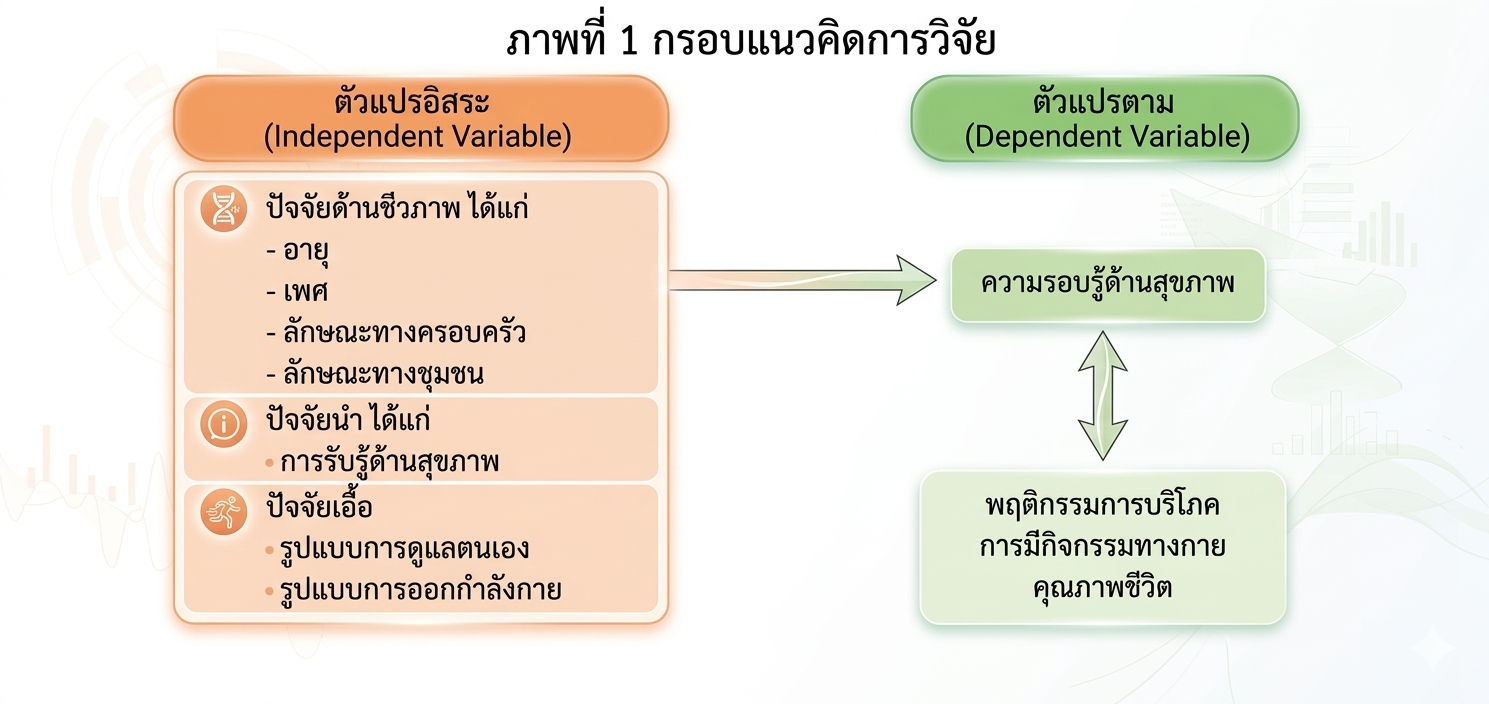
This study aimed to examine the relationships influencing health literacy, dietary behaviors, physical activity, and quality of life among older adults in Thailand. It also analyzed the relationship between physical activity behaviors and quality of life among older adults across the five regions of Thailand. This research employed a quantitative approach, collecting data from 335 older adults across five regions using a questionnaire as the primary instrument. Data were analyzed using descriptive statistics and Pearson’s correlation.
The findings revealed that most older adults had a high level of quality of life, which showed a moderate positive correlation with physical activity behaviors (r = 0.85, p < 0.01). Good health literacy was associated with balanced dietary behaviors. In certain regions, such as the northern and eastern regions, higher health literacy directly contributed to increased levels of physical activity. However, in other regions, physical activity among older adults was not solely determined by knowledge factors but was also shaped by social contexts and lifestyles, such as engagement in agricultural work, manual labor, and local community support. Therefore, promoting sustainable health behaviors requires integrating health literacy with contextual and lifestyle factors specific to each locality.
References
Basnet, S., Merikanto, I., Lahti, T., Mannisto, S., Laatikainen, T., Vartiainen, E., et al. (2016). Associations of common chronic non-communicable diseases and medical conditions withsleep-related problems in a population-based health examination study. Sleep Science, 9(3), 249–254.
Bull, F. C., Maslin, T. S., & Armstrong, T. (2009). Global physical activity questionnaire (GPAQ): Nine-country reliability and validity study. Journal of Physical Activity and Health, 6(6), 790–804.
Chow, B. C., Duong, T. V., Jiao, J., Hassel, H., Kwok, T. C. Y., Nguyen, M. H., & Liu, H. (2024). Health literacy mediates the relationships of cognitive and physical functions with health-related quality of life in older adults. Frontiers in Public Health, 12, 1–12.
https://doi.org/10.3389/fpubh.2024.135539
Chuenjai, S., & Chatprasart, W. (2021). Factors related to life satisfaction among elderly club members under Kanchanaburi Municipality. Journal of Health Science Research, 15(1), 125–136.
Department of Health. (2021). Guidelines for promoting nutrition for older adults. Bangkok, Thailand: Nutrition Division, Department of Health, Ministry of Public Health. Retrieved from https://nutrition.anamai.moph.go.th
Edwards, M., Wood, F., Davies, M., & Edwards, A. (2012). The development of health literacy in patients with a long-term health condition: The health literacy pathway model. BMC Public Health, 12, 130. https://doi.org/10.1186/1471-2458-12-130
Green, T. J., Allen, O. B., & O'Connor, D. L. (1998). A three-day weighed food record and a semiquantitative food-frequency questionnaire are valid measures for assessing the folate and vitamin B-12 intakes of women aged 16 to 19 years. The Journal of Nutrition, 128(10), 1665–1671. https://doi.org/10.1093/jn/128.10.1665
McHill, A. W., Phillips, A. J., Czeisler, C. A., Keating, L., Yee, K., Barger, L. K., et al. (2017). Later circadian timing of food intake is associated with increased body fat. The American Journal of Clinical Nutrition, 106(5), 1213–1219.
National Statistical Office. (2020). Household socioeconomic survey report 2020. Bangkok, Thailand: National Statistical Office. Retrieved from https://www.nso.go.th
Nutbeam, D. (2000). Health literacy as a public health goal: A challenge for contemporary health education and communication strategies into the 21st century. Health Promotion International, 15(3), 259–267. https://doi.org/10.1093/heapro/15.3.259
Supakan, B., et al. (2019). Study of food consumption behaviors of older adults in Southern Thailand. Journal of Public Health Research, 28(3), 112–125.
Suerungreang, S., Chamnankhong, K., Wanwaja, M., & Kloaiam, S. (2024). Health literacy survey of Thai people aged 15 years and over, 2023 (2nd ed.): Promoting health literacy in Thailand—Current situation, determinants, and policy recommendations. Nonthaburi, Thailand: Health Systems Research Institute.
Suwimol, C. (2021). Physical activity and well-being of older adults in rural areas. Community Public Health Journal, 17(2), 45–59.
Suwimol, P. (2017). Introduction to research (12th ed.). Bangkok, Thailand: Suwiriyasarn.
Taylor, D. (2014). Physical activity is medicine for older adults. Postgraduate Medical Journal, 90(1059), 26–32. https://doi.org/10.1136/postgradmedj-2012-131366
Thanwawan, C. (2018). Food consumption behaviors of older adults in urban areas, Chiang Mai province. Journal of Public Health Nursing, 32(1), 45–56.
Wongnoy, K., Juwa, S., & Srisookkum, T. (2023). Behavior, social support and quality of life among socially dependent elderly people in Phayao Province, Thailand. Journal of Public Health and Development, 21(2), 189–200.
World Health Organization. (2010). Global recommendations on physical activity for health. Retrieved from https://www.who.int/publications/i/item/9789241599979
World Health Organization. (2015). Healthy diet: Fact sheet No. 394. Retrieved from https://www.who.int/news-room/fact-sheets/detail/healthy-diet
Downloads
Published
How to Cite
Issue
Section
License
Copyright (c) 2026 Thai Journal of Public Health and Health Sciences

This work is licensed under a Creative Commons Attribution-NonCommercial-NoDerivatives 4.0 International License.
บทความทุกบทความที่ได้รับการตีพิมพ์ถือเป็นลิขสิทธิ์ของ วารสารสาธารณสุข