Factors related to oral health-related quality of life of dependent patients in Muang-Trang District, Trang Province.
Keywords:
Factors, Oral Health-Related Quality of life, Oral Health, Dependent Patients, Trang ProvinceAbstract
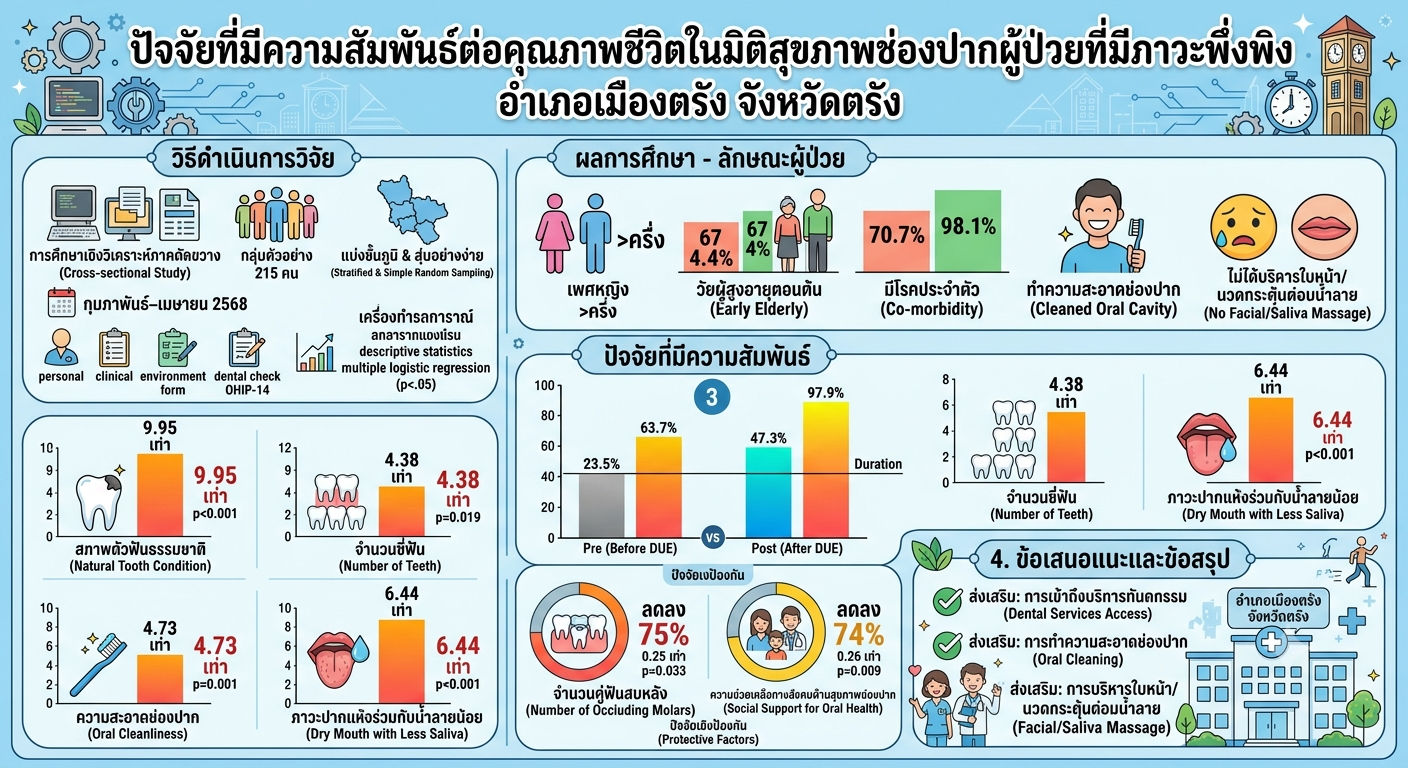
This analytical cross-sectional study aimed to investigate factors associated with oral health-related quality of life among dependent patients in Mueang Trang District, Trang Province. The sample comprised 215 participants selected by stratified random sampling from all subdistricts proportionate to population size, followed by simple random sampling using a non-replacement lottery method from the patient registry. Data were collected from February to April 2025 using questionnaires on personal, clinical, and environmental factors, an oral health examination form, and the Oral Health Impact Profile-14 (OHIP-14). Data were analyzed using descriptive statistics and multiple logistic regression, with statistical significance set at .05.
More than half of the participants were female (67.4%), were young-old adults (70.7%), had underlying diseases (72.1%), and practiced oral cleaning (98.1%). Most (87.9%) did not perform facial exercises or massage to stimulate salivary glands. Factors associated with oral health-related quality of life were natural tooth condition (adjusted OR = 9.95, 95% CI: 3.81–25.97, p < 0.001), oral cleanliness (ORadj = 4.73, 95% CI: 1.95–11.47, p = 0.001), number of teeth (ORadj = 4.38, 95% CI: 1.28–14.98, p = 0.019), and dry mouth with reduced salivary flow (ORadj = 6.44, 95% CI: 2.40–18.97, p < 0.001). The number of posterior occluding tooth pairs (ORadj = 0.25, 95% CI: 0.07–0.90, p = 0.033) and social support for oral health (ORadj = 0.26, 95% CI: 0.09–0.72, p = 0.009) were protective factors. Access to dental services, oral cleaning, facial exercises, and salivary gland stimulation massage.
References
กรมกิจการผู้สูงอายุ กระทรวงการพัฒนาสังคมและความมั่นคงของมนุษย์. (2566). สถานการณ์ผู้สูงอายุไทย พ.ศ. 2565 (พิมพ์ครั้งที่ 1). กรุงเทพมหานคร: บริษัท อมรินทร์ คอร์เปอเรชั่นส์ จำกัด (มหาชน).
กรมอนามัย กระทรวงสาธารณสุข. (2565). ระบบสารสนเทศสนับสนุนงานส่งเสริมสุขภาพและอนามัยสิ่งแวดล้อม: ข้อมูลกลุ่มวัยผู้สูงอายุ ปี 2565. สืบค้นเมื่อ 17 ตุลาคม 2567 จาก https://dashboard.anamai.moph.go.th/elderlyage?year=2022.
พัชรี เรืองาม. (2564). คุณภาพชีวิตในมิติสุขภาพช่องปากของผู้สูงอายุในเขตรับผิดชอบโรงพยาบาลพรานกระต่าย. สวรรค์ประชารักษ์เวชสาร, 18(2), 130-141.
ระบบคลังข้อมูลด้านการแพทย์และสุขภาพ จังหวัดตรัง. (2567, 1 ตุลาคม). จำนวนผู้สูงอายุในเขตพื้นที่รับผิดชอบจำแนกตามความสามารถในการทำกิจวัตรประจำวัน. สืบค้นเมื่อ 29 ตุลาคม 2567 จาก https://trg.hdc.moph.go.th/hdc/reports/report.phpsource=pformated/format1.php&cat_id=6966b0664b89805a484d7ac96c6edc48&id=953a2fc648be8ce76a8115fbb955bb51.
ระบบคลังข้อมูลสุขภาพ กระทรวงสาธารณสุข. (2566). ข้อมูลทันตกรรมบริการ. สืบค้นเมื่อ 6 ธันวาคม 2567 จากhttps://trg.hdc.moph.go.th/hdc/reports/page.php?cat_id=fc73b811eb6d9206e7
e5baf8ad20d7b9.
ศูนย์ผู้สูงอายุและผู้พิการ เทศบาลนครตรัง. (2567). ข้อมูลการคัดกรองและประเมินสุขภาพผู้สูงอายุ เขตเทศบาลนครตรัง. ข้อมูลการดำเนินงาน ส่งเสริมสุขภาพเชิงรุก. น. 8-12.
สถาบันวิจัยระบบสาธารณสุข และมูลนิธิสถาบันวิจัยและพัฒนาผู้สูงอายุไทย. (2559). คู่มือการดูแลผู้สูงวัย: ช่องปากสุขี. กรุงเทพมหานคร: บริษัท โอเพ่นเวิลด์ส พับลิชชิ่ง เฮาส์ จำกัด.
สุดาดวง กฤษฎาพงษ์. (2564). คุณภาพชีวิตในมิติสุขภาพช่องปาก Oral Health-Related Quality of Life (พิมพ์ครั้งที่ 2). กรุงเทพมหานคร: สำนักพิมพ์ จุฬาลงกรณ์มหาวิทยาลัย.
สุเทียน แก้วมะคำ และอารีย์ แก้วมะคำ. (2561). คุณภาพชีวิตในมิติสุขภาพช่องปากของผู้สูงอายุติดบ้านในอำเภอเชียงของ จังหวัดเชียงราย. เชียงรายเวชสาร, 10(1), 37-47.
สำนักทันตสาธารณสุข กรมอนามัย กระทรวงสาธารณสุข. (2567). รายงานผลการสำรวจสภาวะสุขภาพช่องปากแห่งชาติ ครั้งที่ 9 ประเทศไทย พ.ศ. 2566. กรุงเทพมหานคร: สำนักพิมพ์อักษรกราฟฟิคแอนด์ดีไซน์.
สมฤทัย มะนะโส. (2567, 15 สิงหาคม). การดำเนินงานเชิงรุกในผู้ป่วยที่มีภาวะพึ่งพิง. พยาบาลวิชาชีพชำนาญการ หัวหน้าศูนย์ผู้สูงอายุและผู้พิการ เทศบาลนครตรัง. สัมภาษณ์.
อารีย์ ภูมิประเสริฐโชค. (2566). สภาวะสุขภาพช่องปากและคุณภาพชีวิตด้านมิติสุขภาพช่องปากของผู้สูงอายุในคลินิกผู้สูงอายุ. พุทธชินราชเวชสาร, 40(3), 246-259.
อรวรรณ นามมนตรี, กานต์ชนก สมใจ, อสมาภรณ์ บุญข่าย, และเสาวนีย์ บุพตา. (2565). คุณภาพชีวิตในมิติสุขภาพช่องปากของผู้สูงอายุในเขตตำบลห้วยเหนือ อำเภอขุขันธ์ จังหวัดศรีสะเกษ. วารสารทันตาภิบาล, 33(1), 14-27.
อัญชิษฐฐา ศิริคำเพ็ง และภักดี โพธิ์สิงห์. (2560). การดูแลผู้สูงอายุระยะยาวที่มีภาวะพึ่งพิงในยุคประเทศไทย 4.0. วารสารวิชาการธรรมทรรศน์, 17(3), 236-242.
Bursac Z, Gauss CH, Williams DK, & Hosmer DW. (2008). Purposeful selection of variables in logistic regression. Source Code for Biology and Medicine. 3(17), 1-18. doi:10.1186/1751-0473-3-17.
Fagundes MLB., do Amaral Junior OL., Menegazzo GR., & Melgarejo do Amaral Giordani J. (2022). Association between perceived discrimination in health services and oral health-related quality of life in older adults. J Dent. 125, 104-249. doi:10.1016/j.jdent.2022.104249.
Frost J. (2019). Introduction to statistics: An intuitive guide for analyzing data and unlocking discoveries. 1st ed. State College (PA), Statistics By Jim Publishing.
F. Y. Hsieh, Daniel A. Bloch, & Michael D. Larsen. (1998). A simple method of sample size calculation for linear and logistic regression. Statistics in Medicine. 17(14), 78–83. doi.org/10.1002/(SICI)10970258(19980730)17:14<1623: AID-SIM871>3.0.CO;2-S.
Jaqueline Colaco, F. Muniz, Damieli Peron, Milena Giotti Marostega, Jéssica J. Dias, C. Rosing, & P. R. G. Colussi. (2020). Oral health-related quality of life and associated factors in the elderly: a population-based cross-sectional study. Cienc saúde coletiva. 25(10), 3901–12.doi:10.1590/1413-812320202510.02 202019.
Lyu Y., Chen S., Li A., Zhang T., Zeng X., & Sooranna S. R. (2024). Socioeconomic status and tooth loss impact on oral health–related quality of life in Chinese elderly. Int Dent J. 74(2), 268–75. doi:10.1016/j.identj.2023.09.003.
Masood M., Newton T., Bakri N. N., Khalid T., & Masood Y. (2017). The relationship between oral health and oral health related quality life among elderly people in United Kingdom. Journal of Dentistry. 56, 78-83. doi.org/10.1016/j.jdent.2016.11.002.
Nammontri O. (2017). Validation of the Thai Version of the 14- Item Oral Health Impact Profile (Thai OHIP-14) amongst the General Thai Adult Population in a Community Setting. Journal of Health Research. 31(6), 481-486.
O’Brien RM. (2007). A caution regarding rules of thumb for variance inflation factors. Qual Quant. 41(5), 673–90. doi.org/10.1007/s11135-006-9018-6.
Puranen T., Hiltunen K., Kautiainen H., Merja H. Suominen, Salminen K., et al. (2023). Relationship between oral frailty, health-related quality of life, and survival among long-term care residents. Eur Geriatr Med. 14(6), 1307–15. doi:10.1007/s41999-023-00859-x.Singh V. (2025). Variance inflation factor: How to detect multicollinearity. Retrieved April 7, 2025, from https://www.datacamp.com/tutorial/variance-inflation-factor.
UNESCO. (1978). Indicators of environmental quality and quality of life. Paris: UNESCO.
World Health Organization. (2012). PROGRAMME ON MENTAL HEALTH WHOQOL User Manual.
WHO/MNH/MHP. 98(4), 1-11.
Downloads
Published
How to Cite
Issue
Section
License
Copyright (c) 2026 Thai Journal of Public Health and Health Sciences

This work is licensed under a Creative Commons Attribution-NonCommercial-NoDerivatives 4.0 International License.
บทความทุกบทความที่ได้รับการตีพิมพ์ถือเป็นลิขสิทธิ์ของ วารสารสาธารณสุข