Prevalence and Factors Associated with Insomnia among the Elderly in Huai-Yot Sub-District, Huai-Yot District, Trang Province
Keywords:
Insomnia, Older adults, Factors associated, Trang provinceAbstract
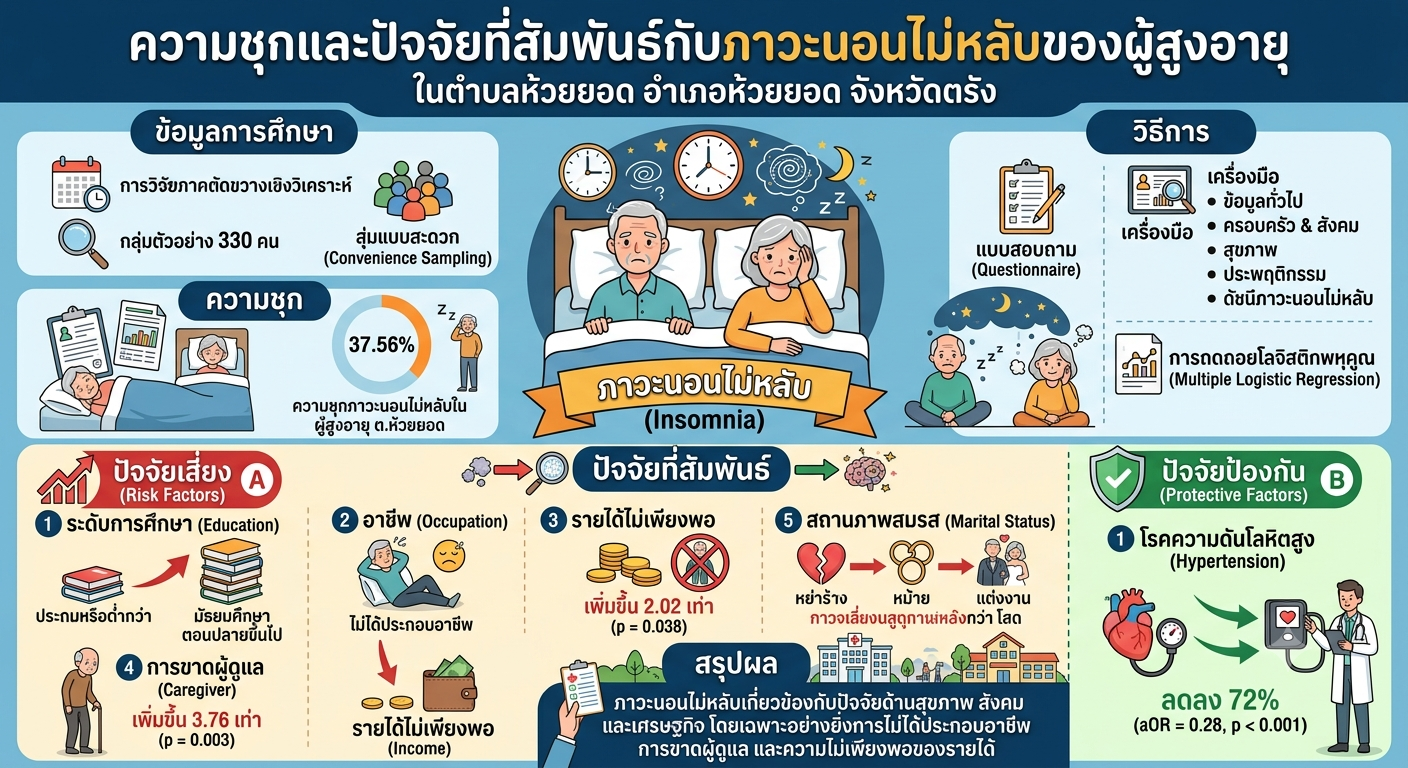
This cross-sectional study aimed to determine the prevalence and identify factors associated with insomnia among older adults in Huai Yot Sub-district, Huai Yot District, Trang Province. A total of 330 participants were recruited using a convenience sampling technique. Data were collected by a content-validated questionnaire covering general characteristics, family, socioeconomic information, health and behavioral factors, and the Insomnia Severity Index. Data were analyzed using descriptive statistics and multiple logistic regression analysis.
Prevalence of insomnia among older adults in Huai Yot Subdistrict was 37.56%. Factors significantly associated with insomnia included: education level, occupation, marital status, presence of a caregiver, income sufficiency, and hypertension. Older adults with primary education or lower, and those with upper secondary education or higher, had significantly higher odds of insomnia compared with the lower secondary education group. Unemployed participants had 2.78 times higher odds of insomnia compared with employed participants (p-value < 0.001). Those who were divorced, widowed, or married had significantly higher risks compared with single individuals. The absence of a caregiver increased the odds of insomnia by 3.76 times (p-value = 0.003). Participants with insufficient income had 2.02 times higher odds of insomnia compared with sufficient income participants (p-value = 0.038). Interestingly, hypertension was identified as a protective factor, as older adults with hypertension had approximately 72% lower odds of insomnia compared with non-hypertensive participants (adjusted OR = 0.28, p-value < 0.001), maybe from The Healthy Adherer Effect. In conclusion, insomnia among older adults in Huai Yot Sub-district is associated with health, social, and economic factors, especially unemployment, lack of caregiver, and insufficiency income.
References
กรมกิจการผู้สูงอายุ. (2565). สถิติผู้สูงอายุไทย ปี 2565 โดยกลุ่มนโยบายและยุทธศาสตร์ กรมกิจการผู้สูงอายุ. สืบค้น 8 ธันวาคม 2565, จาก http://www.dop.go.th/th/know/side/1/1/1962
กรมกิจการผู้สูงอายุ. (2566). สถิติผู้สูงอายุ มิถุนายน 2566. สืบค้น 8 ธันวาคม 2566, จาก http://www.dop.go.th/th/know/side/1/1/2449
โชติมันต์ ชินวรารักษ์, สุขเจริญ ตั้งวงษ์ไชย, และ นัฎศรา ดำรงพิวัฒน์. (2561). คุณภาพการนอนหลับและปัจจัยที่เกี่ยวข้องในผู้สูงอายุที่หมู่บ้านประชานิเวศน์. วารสารสมาคมจิตแพทย์แห่งประเทศไทย, 63(2), 199-21
สถาบันเวชศาสตร์ผู้สูงอายุ กรมการแพทย์. (2558). แนวทางการดูแลรักษากลุ่มอาการสูงอายุ (Geriatric syndromes). กรุงเทพฯ: อิส ออกัส.
สถาบันเวชศาสตร์ผู้สูงอายุ กรมการแพทย์ กระทรวงสาธารณสุข. (2551). แนวทางเวชปฏิบัติการดูแลรักษาผู้สูงอายุที่มีความผิดปกติเกี่ยวกับการนอนหลับ. กรุงเทพฯ: ชุมนุมสหกรณ์การเกษตรแห่งประเทศไทย.
สถาบันเวชศาสตร์สมเด็จพระสังฆราชญาณสังวรเพื่อผู้สูงอายุ กรมการแพทย์ กระทรวงสาธารณสุข. (2565). แนวทางการป้องกันเหตุการณ์ไม่พึงประสงค์จากการใช้ยาในผู้สูงอายุ. กรุงเทพฯ: สินทวีการพิมพ์.
สำนักข่าวกรมประชาสัมพันธ์ จังหวัดตรัง. (2566). แผนปฏิบัติราชการพัฒนาสุขภาพ ประจำปีงบประมาณ พ.ศ. 2566 จังหวัดตรัง. สืบค้นจาก https://thainews.prd.go.th/
กัมปนาท สุริย์, กุลนิดา สุนันท์ศิริกูล, และ กิตติยารัตน์ ต้นสุวรรณ์. (2021). คุณภาพของการนอนหลับและปัจจัยที่เกี่ยวข้องในผู้สูงอายุชุมชนเขตเมืองจังหวัดนครสวรรค์. Region 3 Medical and Public Health Journal - วารสารวิชาการแพทย์และสาธารณสุข เขตสุขภาพที่ 3, 19(1), 15-27.
Daniel, W. W. (2009). Biostatistics: A foundation for analysis in the health sciences (9th ed.). Hoboken, NJ: John Wiley & Sons.
Foley, D., Ancoli-Israel, S., Britz, P., & Walsh, J. (2004). Sleep disturbances and chronic disease in older adults: Results of the 2003 National Sleep Foundation Sleep in America Survey. Journal of Psychosomatic Research, 56(5), 497–502. https://doi.org/10.1016/j.jpsychores.2004.02.010
Harvey, A. G. (2002). A cognitive model of insomnia. Behaviour Research and Therapy, 40(8), 869–893. https://doi.org/10.1016/S0005-7967(01)00061-4
Jaussent, I., Dauvilliers, Y., Ancelin, M.-L., Dartigues, J.-F., Tavernier, B., Touchon, J., … Besset, A. (2011). Insomnia symptoms in older adults: Associated factors and gender differences. The American Journal of Geriatric Psychiatry, 19(1), 88–97. https://doi.org/10.1097/JGP.0b013e3181e049b6
Korkmaz Aslan, G., İnci, F. H., & Kartal, A. (2020). The prevalence of insomnia and its risk factors among older adults in a city in Turkey’s Aegean Region. Psychogeriatrics, 20(1), 111–117. https://doi.org/10.1111/psyg.12464
Li, J., Yao, Y., Dong, Q., Dong, Y., Liu, J., Yang, L., & Huang, F. (2013). Characterization and factors associated with sleep quality among rural elderly in China. Archives of Gerontology and Geriatrics, 56(1), 237–243. https://doi.org/10.1016/j.archger.2012.08.002
Likitkumchorn, N., & Supasirisun, Y. (2024). Prevalence and Factors Associated with Poor Sleep Quality Among Older Urban Adults in the Outpatient Department of Vajira Hospital. Journal of Primary Care and Family Medicine (PCFM), 7(2), 150–160.
Mander, B. A., Winer, J. R., & Walker, M. P. (2017). Sleep and human aging. Neuron, 94(1), 19–36. https://doi.org/10.1016/j.neuron.2017.02.004
Mookerjee, N., Schmalbach, N., Antinori, G., Thampi, S., Windle-Puente, D., Gilligan, A., … Roy, S. (2023). Comorbidities and risk factors associated with insomnia in the elderly population. Journal of Primary Care & Community Health, 14, 1–9. https://doi.org/10.1177/21501319231168721
Morin, C. M., & Benca, R. (2012). Chronic insomnia. The Lancet, 379(9821), 1129–1141. https://doi.org/10.1016/S0140-6736(11)60750-2
Ohayon, M. M., & Reynolds, C. F. (2009). Epidemiological and clinical relevance of insomnia diagnosis algorithms according to the DSM-IV and the International Classification of Sleep Disorders (ICSD). Sleep Medicine, 10(9), 952–960. https://doi.org/10.1016/j.sleep.2009.07.008
Rattanaphongset, P., Bosittipichet, T., & Nakawiro, P. (2021). Factors Associated with Insomnia Symptoms among Elderly in Primary Care Unit. Journal of Preventive Medicine Association of Thailand, 11(1), 188–201. retrieved from https://he01.tci-thaijo.org/index.php/JPMAT/article/view/247246
Riemann, D., Spiegelhalder, K., Feige, B., Voderholzer, U., Berger, M., Perlis, M., & Nissen, C. (2010). The hyperarousal model of insomnia: A review of the concept and its evidence. Sleep Medicine Reviews, 14(1), 19–31. https://doi.org/10.1016/j.smrv.2009.04.002
Simpson, S. H., Eurich, D. T., Majumdar, S. R., Padwal, R. S., Tsuyuki, R. T., Varney, J., & Johnson, J. A. (2006). A meta-analysis of the association between adherence to drug therapy and mortality. BMJ, 333(7557), 15. https://doi.org/10.1136/bmj.38875.675486.55
Vitiello, M. V., Moe, K. E., & Prinz, P. N. (2002). Sleep complaints cosegregate with illness in older adults: Clinical research informed by and informing epidemiological studies of sleep. Journal of Psychosomatic Research, 53(1), 555–559. https://doi.org/10.1016/S0022-3999(02)00435-X
Downloads
Published
How to Cite
Issue
Section
License
Copyright (c) 2026 Thai Journal of Public Health and Health Sciences

This work is licensed under a Creative Commons Attribution-NonCommercial-NoDerivatives 4.0 International License.
บทความทุกบทความที่ได้รับการตีพิมพ์ถือเป็นลิขสิทธิ์ของ วารสารสาธารณสุข