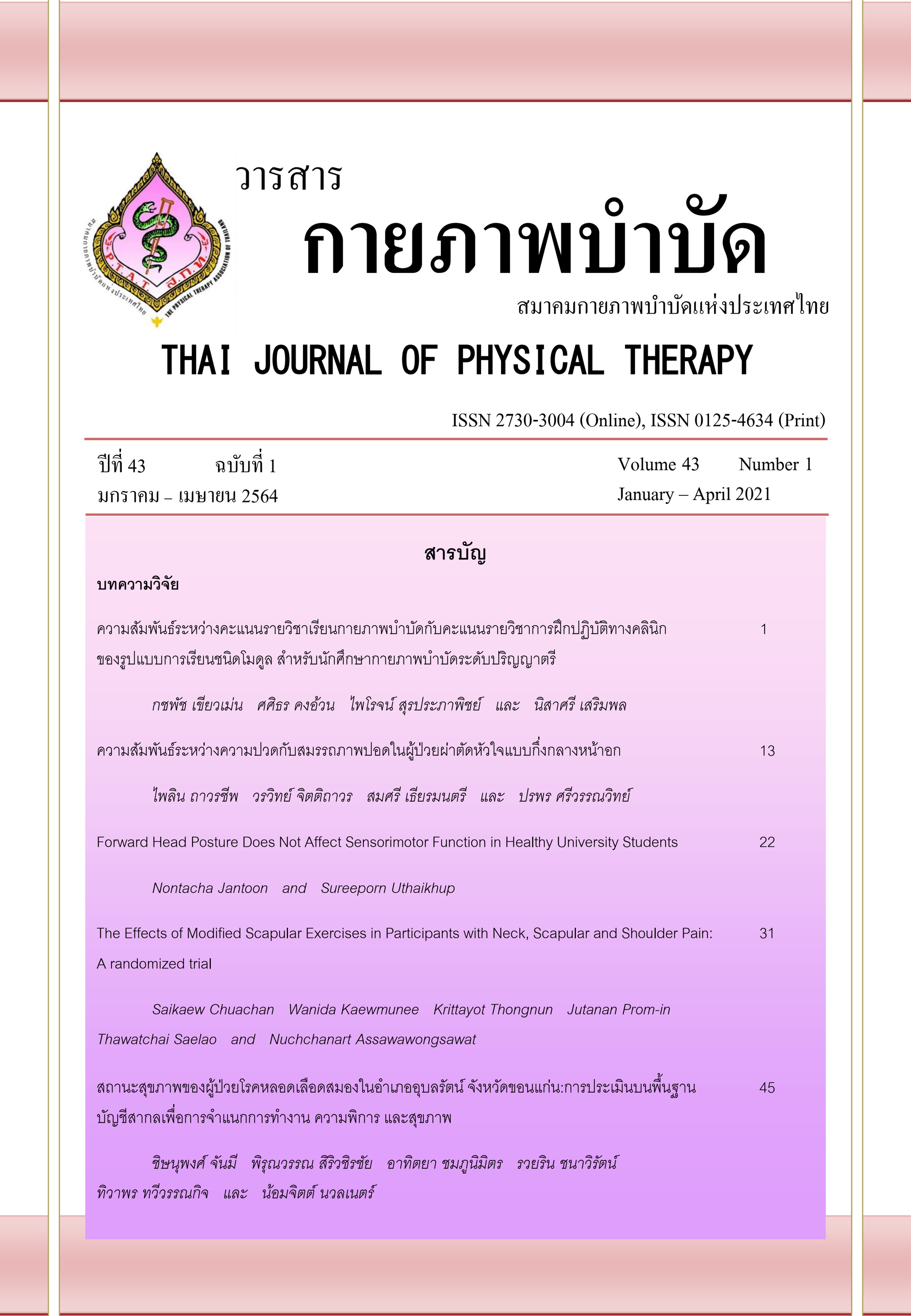
Forward head posture does not affect sensorimotor function in young healthy adults
Article Sidebar
Main Article Content
Abstract
Background: Forward head posture has been proposed to affect sensorimotor function. However, its effect on the cervical proprioceptive sense (JPS) and postural control remains unclear.
Objective: To determine whether forward head posture affects cervical joint position sense and standing balance in healthy university students.
Methods: 60 university students (30 with forward head posture and 30 with normal head posture), aged between 19 and 24, were included in this study. Forward head posture was screened by craniovertebral (CV) angle. The CV angle ≤ 48 degrees was considered as having a forward head posture. The cervical JPS was measured in cervical extension and rotation to the right and left sides, using a laser pointer attached to the head. Standing balance was measured using a sway meter under two conditions: narrow stance with eyes open and closed. The outcome measures were cervical joint position error (JPE), and postural sway area, and displacement in anteroposterior (AP) and mediolateral (ML) directions.
Results: There were no significant differences between groups for the cervical JPE in all directions (all p > 0.05). The total sway area and displacement in AP and ML directions during standing with eyes open and closed were not found to be different between both groups (all p > 0.05)
Conclusion: Forward head posture did not affect the cervical joint position sense and standing balance in healthy university students. This may suggest that forward head posture does not contribute to sensorimotor integration.
Article Details
References
Grimmer-Somers K, Milanese S, Louw Q. Measurement of cervical posture in the sagittal Plane. J Manipulative Physiol Ther. 2008;31(7):509-17.
Griegel-Morris P, Larson K, Mueller-Klaus K, Oatis CA. Incidence of common postural abnormalities in the cervical, shoulder, and thoracic regions and their association with pain in two age groups of healthy subjects. Phys Ther. 1992;72(6):425-31.
Edmondston SJ, Sharp M, Symes A, Alhabib N, Allison GT. Changes in mechanical load and extensor muscle activity in the cervico-thoracic spine induced by sitting posture modification. Ergonomics. 2011;54(2):179-86.
Nejati P, Lotfian S, Moezy A, Nejati M. The study of correlation between forward head posture and neck pain in Iranian office workers. Int J Occup Med Environ Health. 2015;28(2):295-303.
Silva AG, Punt TD, Sharples P, Vilas-Boas JP, Johnson MI. Head posture and neck pain of chronic nontraumatic origin: a comparison between patients and pain-free persons. Arch Phys Med Rehabil. 2009;90(4):669-74.
Yip CH, Chiu TT, Poon AT. The relationship between head posture and severity and disability of patients with neck pain. Man Ther. 2008;13(2):148-54.
Quek J, Pua YH, Clark RA, Bryant AL. Effects of thoracic kyphosis and forward head posture on cervical range of motion in older adults. Man Ther. 2013;18(1):65-71.
Mousavi-khatir R, Talebian S, Maroufi N, Olyaie G. Effect of static neck flexion in cervical flexion-relaxation phenomenon in healthy males and females. J Bodyw Mov Ther. 2015;20(2):235-42.
Shimaa T. Abu El Kasem OMK, Neveen A. Abdel Raoof, Ibrahim M. Moustafa. Effect of forward head posture on sensorimotor integration. Int J Phys Ther. 2017;4(2):118-25.
Mayoux-Benhamou MA, Revel M, Vallee C, Roudier R, Barbet JP, Bargy F. Longus colli has a postural function on cervical curvature. Surg Radiol Anat. 1994;16(4):367-71.
Boyd-Clark LC, Briggs CA, Galea MP. Muscle spindle distribution, morphology, and density in longus colli and multifidus muscles of the cervical spine. Spine J. 2002;27(7):694-701.
Liu JX, Thornell LE, Pedrosa-Domellof F. Muscle spindles in the deep muscles of the human neck: a morphological and immunocytochemical study. J Histochem Cytochem. 2003;51(2):175-86.
Goh JYK, O’Leary S, Chow A, Russell T, McPhail S. The relationship between forward head posture and cervical muscle performance in healthy individuals. J Physiother. 2015. doi: 10.1016/j.physio.2015.03.3247
Kang JH, Park RY, Lee SJ, Kim JY, Yoon SR, Jung KI. The effect of the forward head posture on postural balance in long time computer based worker. Ann Rehabil Med. 2012;36(1):98-104.
Silva AG, Johnson MI. Does forward head posture affect postural control in human healthy volunteers? Gait Posture. 2013;38(2):352-3.
Hickey ER, Rondeau MJ, Corrente JR, Abysalh J, Seymour CJ. Reliability of the cervical range of motion (CROM) device and plumb-line techniques in measuring resting head posture (RHP). J Man Manip Ther. 2000;8(1):10-7.
Hazar Z, Karabicak GO, Tiftikci U. Reliability of photographic posture analysis of adolescents. J Phys Ther Sci. 2015;27(10):3123-6.
Ruivo RM, Pezarat-Correia P, Carita AI. Cervical and shoulder postural assessment of adolescents between 15 and 17 years old and association with upper quadrant pain. Braz J Phys Ther. 2014;18(4):364-71.
Revel M, Andre-Deshays C, Minguet M. Cervicocephalic kinesthetic sensibility in patients with cervical pain. Arch Phys Med Rehabil. 1991;72(5):288-91.
Lord SR, Clark RD, Webster IW. Postural stability and associated physiological factors in a population of aged persons. J Gerontol. 1991;46(3):69-76.
Lord SR, Menz HB, Tiedemann A. A physiological profile approach to falls risk assessment and prevention. Phys Ther. 2003;83(3):237-52.
De-la-Llave-Rincon AI, Fernandez-de-las-Penas C, Palacios-Cena D, Cleland JA. Increased forward head posture and restricted cervical range of motion in patients with carpal tunnel syndrome. J Orthop Sports Phys Ther. 2009;39(9):658-64.
Manchester D, Woollacott M, Zederbauer-Hylton N, Marin O. Visual, vestibular and somatosensory contributions to balance control in the older adult. J Gerontol. 1989;44(4):118-27.
Kristjansson E, Treleaven J. Sensorimotor function and dizziness in neck pain: implications for assessment and management. J Orthop Sports Phys Ther. 2009;39(5):364-77.
Dolan KJ, Green A. Lumbar spine reposition sense: the effect of a 'slouched' posture. Man Ther. 2006;11(3):202-7.
Paulus I, Brumagne S. Altered interpretation of neck proprioceptive signals in persons with subclinical recurrent neck pain. J Rehabil Med. 2008;40(6):426-32.
Uremovic M, Cvijetic S, Pasic MB, Seric V, Vidrih B, Demarin V. Impairment of proprioception after whiplash injury. Coll Antropol. 2007;31(3):823-7.
