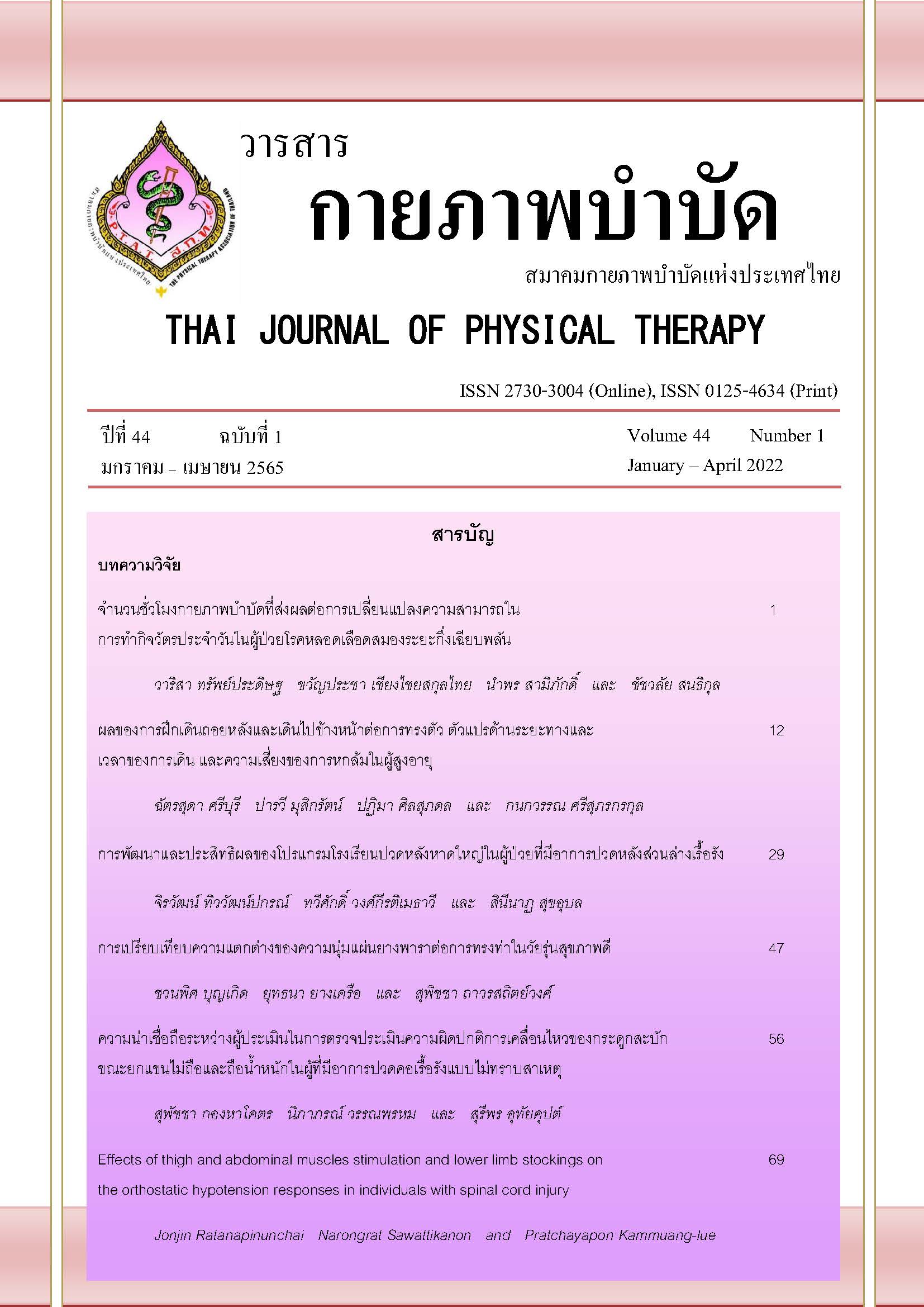
Effects of thigh and abdominal muscles stimulation and lower limb stockings on the orthostatic hypotension responses in individuals with spinal cord injury
Article Sidebar
Main Article Content
Abstract
Background: No information comparing the effectiveness of thigh or abdominal muscle stimulation combined with stockings on the orthostatic hypotension responses in patients with spinal cord injury (SCI).
Objective: To compare the effects of three different interventions: lower limb stockings (LLS), thigh muscle stimulation, and a combination of the abdominal muscles stimulation and LLS on mean blood pressure (MBP) and heart rate (HR) during passive standing in patients with SCI.
Methods: A crossover design was used in this study. Thirteen patients with C3 to T1 SCI participated in the study. Participants were randomly tested during passive standing on a tilt table of the following three conditions: (1) the control (CON) using LLS (2) stimulation at the quadriceps and hamstrings (QH), and (3) stimulation at the abdominal muscle combined with LLS (Abd). The MBP and HR were measured at rest, 1 minute, every 3 minutes after tilting-up, and immediately after tilting-down. The tilting time up to 30 minutes was also recorded.
Results: Hypotension and faster HR occurred significantly after tilting-up when compared to resting in all three conditions. However, the MBP (p=0.19) and HR (p=0.43) after tilting up did not differ significantly among the three conditions. There were no significant differences in tilting time when comparing across these conditions (CON=24:06±11:13; QH=19:35±11:53; and Abd=21:08±11:48 minutes:seconds, p=0.96).
Conclusions: Stimulation only at the thigh muscles or the abdominal muscle combined with LLS, or using only LLS does not minimize cardiovascular responses during passive standing in patients with SCI.
Keywords: Blood pressure, Heart rate, Electrical stimulation, Spinal cord injury, Orthostatic hypotension
Article Details

This work is licensed under a Creative Commons Attribution-NonCommercial-NoDerivatives 4.0 International License.
References
Clinicians SCICPL. Clinical guideline for standing adults following spinal cord injury. United Kingdom and Ireland: Multidisciplinary Association of Spinal Cord; 2013 [cited 2019, Feb 4]Available from https://www.mascip. co.uk/wp-content/ uploads/2015/05/Clinical-Guidelines-for-Standing-Adults-Following-Spinal-Cord-Injury.pdf.
Illman A, Stiller K, Williams M. The prevalence of orthostatic hypotension during physiotherapy treatment in patients with an acute spinal cord injury. Spinal Cord. 2000; 38 (12): 741-7.
Ben M, Harvey L, Denis S, Glinsky J, Goehl G, Chee S, et al. Does 12 weeks of regular standing prevent loss of ankle mobility and bone mineral density in people with recent spinal cord injuries? Aust J Physiother. 2005; 51 (4): 251-6.
Alekna V, Tamulaitiene M, Sinevicius T, Juocevicius A. Effect of weight-bearing activities on bone mineral density in spinal cord injured patients during the period of the first two years. Spinal Cord. 2008; 46 (11): 727-32.
Vaziri ND. Nitric oxide in microgravity-induced orthostatic intolerance: relevance to spinal cord injury. J Spinal Cord Med. 2003; 26 (1): 5-11.
Raymond J, Davis GM, Bryant G, Clarke J. Cardiovascular responses to an orthostatic challenge and electrical-stimulation-induced leg muscle contractions in individuals with paraplegia. Eur J Appl Physiol Occup Physiol. 1999; 80 (3): 205-12.
Wecht JM, de Meersman R, Weir J, Spungen A, Bauman W. Cardiac autonomic responses to progressive head up tilt in individuals with paraplegia. Clin Auton Res. 2004; 13 (6): 433-8.
Wallin B, Stiernberg L. Sympathetic activity in man after spinal cord injury. Brain. 1984; 107 (Pt 1): 183-198.
Claydon VE, Steeves JD, Krassioukov A. Orthostatic hypotension following spinal cord injury: understanding clinical pathophysiology. Spinal Cord. 2006; 44 (6): 341-51.
Munakata M, Kameyama J, Nunokawa T, Ito N, Yoshinaga K. Altered Mayer wave and baroreflex profiles in high spinal cord injury. Am J Hypertens. 2001;14 (2): 141-8.
Faghri PD, Yount JP, Pesce WJ, Seetharama S, Votto JJ. Circulatory hypokinesis and functional electric stimulation during standing in persons with spinal cord injury. Arch Phys Med Rehabil. 2001; 82 (11): 1587-95.
Faghri PD, Yount J. Electrically induced and voluntary activation of physiologic muscle pump: a comparison between spinal cord-injured and able-bodied individuals. Clin Rehabil. 2002; 16 (8): 878-85.
Krassioukov A, Wecht JM, Teasell RW, Eng JJ. Orthostatic hypotension following spinal cord injury. Spinal Cord Injury Rehabilitation Evidence. 2018 [cited 2019, Feb 1] Available from; https://scireproject.com/wp-content/ uploads/ OH-Chapter-2018-FINAL.pdf(version 5).
Krassioukov A, Eng JJ, Warburton DE, Teasell R. A systematic review of the management of orthostatic hypotension after spinal cord injury. Arch Phys Med Rehabil. 2009; 90 (5): 876-85.
Yoshida T, Masani K, Sayenko D, Miyatani M, Fisher J, Popovic M. Cardiovascular response of individuals with spinal cord injury to dynamic functional electrical stimulation under orthostatic stress. IEEE Trans Neural Syst Rehabil Eng. 2013; 21 (1): 37-46.
Sampson EE, Burnham RS, Andrews BJ. Functional electrical stimulation effect on orthostatic hypotension after spinal cord injury. Arch Phys Med Rehabil. 2000; 81 (2): 139-43.
Elokda AS, Nielsen DH, Shields RK. Effect of functional neuromuscular stimulation on postural related orthostatic stress in individuals with acute spinal cord injury. J Rehabil Res Dev. 2000; 37 (5): 535-42.
Chi L, Masani K, Miyatani M, Adam TT, Wayne JK, Mardimae A, et al. Cardiovascular response to functional electrical stimulation and dynamic tilt table therapy to improve orthostatic tolerance. J Electromyogr Kinesiol. 2008; 18 (6): 900-7.
Chao CY, Cheing GL. The effects of lower-extremity functional electric stimulation on the orthostatic responses of people with tetraplegia. Arch Phys Med Rehabil. 2005; 86 (7): 1427-33.
Tesini S, Frotzler A, Bersch I, Tobón A. Prevention of orthostatic hypotension with electric stimulation in persons with acute spinal cord injury. Biomed Tech (Berl). 2013; 58 Suppl1.
Miller JD, Pegelow DF, Jacques AJ, Dempsey JA. Skeletal muscle pump versus respiratory muscle pump: modulation of venous return from the locomotor limb in humans. J Physiol. 2005; 563 (3): 925-43.
Cresswell AG, Grundstrom H, Thorstensson A. Observations on intra-abdominal pressure and patterns of abdominal intra-muscular activity in man. Acta Physiol Scand. 1992; 144 (4): 409-18.
Mancia G, Fagard R, Narkiewicz K, Redón J, Zanchetti A, Böhm M, et al. 2013 ESH/ESC Guidelines for the management of arterial hypertension: The Task Force for the management of arterial hypertension of the European Society of Hypertension (ESH) and of the European Society of Cardiology (ESC). J Hypertens. 2013; 31 (7): 1281-357.
Brzezinski W. Blood pressure. In: Walker H, Hall W, Hurst J, eds. Clinical Methods: The history, physical, and laboratory examinations. Boston: Butterworths; 1990.
Deverdun J, Akbaraly TN, Charroud C, Abdennour M, Brickman AM, Chemouny S, et al. Mean arterial pressure change associated with cerebral blood flow in healthy older adults. Neurobiol Aging. 2016; 46: 49-57.
Harkema SJ, Ferreira CK, van den Brand RJ, Krassioukov AV. Improvements in orthostatic instability with stand locomotor training in individuals with spinal cord injury.J Neurotrauma. 2008; 25 (12): 1467-75.
Hirose T, Shiozaki T, Shimizu K, Mouri T, Noguchi K, Ohnishi M, et al. The effect of electrical muscle stimulation on the prevention of disuse muscle atrophy in patients with consciousness disturbance in the intensive care unit. J Crit Care. 2013; 28 (4): 536.e531-7.
Kim SY, Kim JH, Jung GS, Baek SO, Jones R, Ahn SH.The effects of transcutaneous neuromuscular electrical stimulation on the activation of deep lumbar stabilizing muscles of patients with lumbar degenerative kyphosis. J Phys Ther Sci. 2016; 28 (2): 399-406.
Drapper S. Effect size. 2002 [cited 2019, July 13] .Available from: http://www.psy.gla.ac.uk/~ steve/best/effect.html.
Recek C. Calf pump activity influencing venous hemodynamics in the lower extremity. Int J Angiol 2013; 22 (1): 23-30.
Furlan JC, Fehlings MG, Shannon P, Norenberg MD, Krassioukov AV. Descending vasomotor pathways in humans:
correlation between axonal preservation and cardiovascular dysfunction after spinal cord injury. J Neurotrauma. 2003; 20 (12): 1351-63.
Popa C, Popa F, Grigorean VT, Onose G, Sandu AM, Popescu M, et al.Vascular dysfunctions following spinal cord injury. J Med Life. 2010; 3 (3): 275-85.
McKinley WO, Tewksbury MA, Godbout CJ. Comparison of medical complications following nontraumatic and traumatic spinal cord injury. J Spinal Cord Med. 2002; 25 (2): 88-93.
West CR, Campbell IG, Shave RE, Romer LM. Effects of abdominal binding on cardiorespiratory function in cervical spinal cord injury. Respir Physiol Neurobiol. 2012; 180 (2-3): 275-82.
Castro MJ, Apple Jr DF, Rogers S, Dudley GA. Influence of complete spinal cord injury on skeletal muscle mechanics within the first 6 months of injury. Eur J Appl Physiol. 2000; 81 (1): 128-31.
