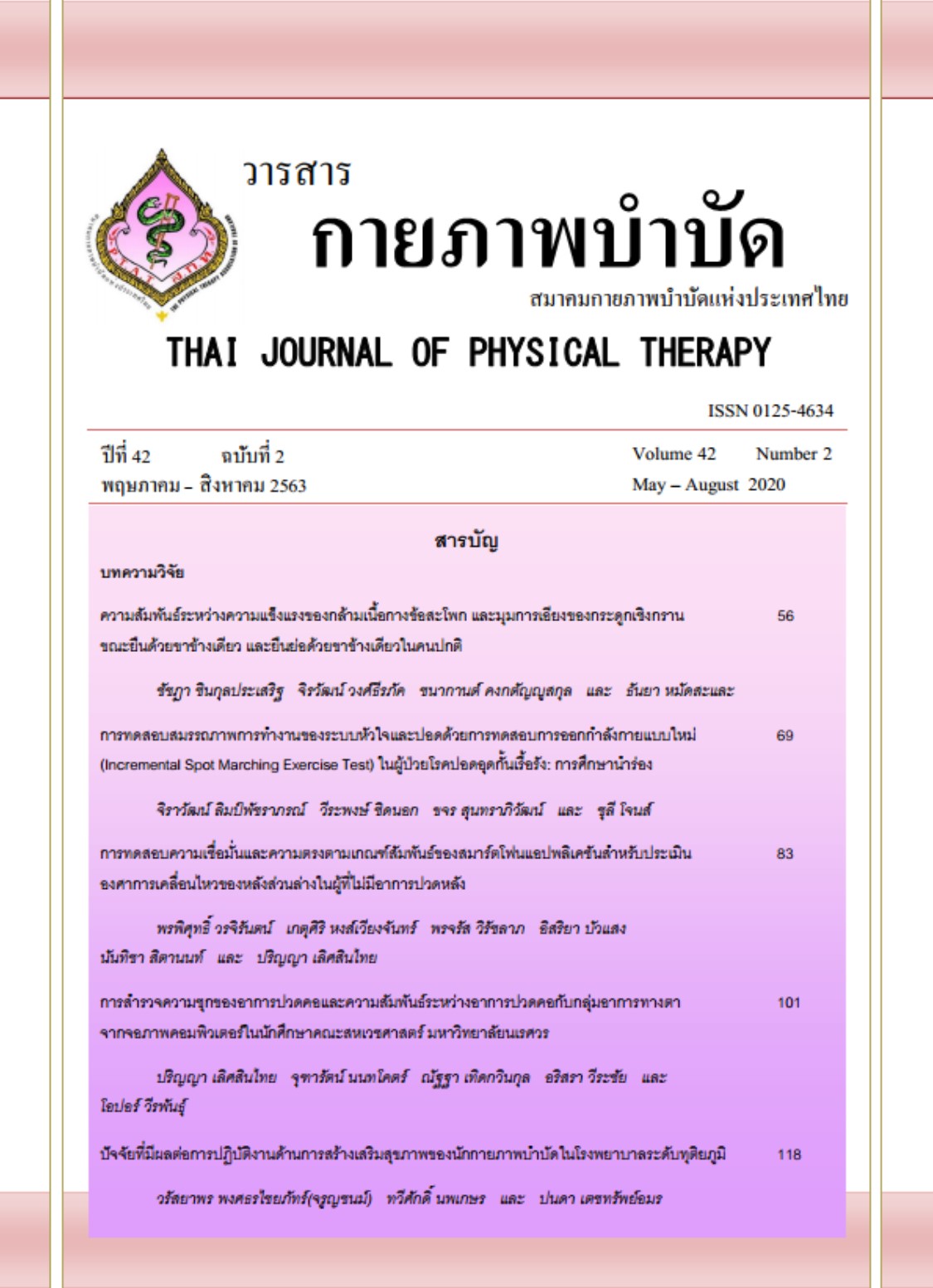
The relationship between hip abductor strength and pelvic obliquity angle during single leg stance and single leg squat in healthy subjects
Article Sidebar
Main Article Content
Abstract
Background: Single leg stance (SLST) and Single leg squat (SLSQ) are functional tests that are commonly used to evaluate hip abductor performance. The previous studies found that SLST and SLSQ testing in person with hip abductor weakness may not always exhibit the lateral pelvic drop. There are a few studies regarding the relationship between hip muscle strength and lateral pelvic drop during SLST and SLSQ that were still unclear.
Objective: To investigate the relationship between each hip abductor muscle (HABD) strength and pelvic obliquity angle (PO), Thoracic obliquity angle (TO) during SLST and SLSQ.
Methods: Fifty healthy males and females, aged 20.6±1.4 years, were measured HABD strength including gluteus maximus (GMax), gluteus medius (GMed) and tensor fascia latae (TFL) by hand-held dynamometer (HHD). Kinematic data were collected by using motion analysis system during SLST and SLSQ.
Results: During SLST, there were only significant correlations (p<0.05) between GMax and TO (r= -0.397), TFL and TO (r= -0.393), but there was no significant correlation between HABD strength and TO during SLSQ.
Conclusion: There was no significant correlation between three HABD strength and PO during SLST and SLSQ. It was possible that the HABD strength of all participants in the current study may be similar.
Article Details
References
Flack NA, Nicholson HD, Woodley SJ. A review of the anatomy of the hip abductor muscles, gluteus medius, gluteus minimus, and tensor fascia lata. Clin Anat. 2012;25(6):697-708.
Soderberg GL, Dostal WF. Electromyographic study of three parts of the gluteus medius muscle during functional activities. Phys Ther. 1978;58(6):691-6.
Flack NA, Nicholson HD, Woodley SJ. The anatomy of the hip abductor muscles. Clin Anat. 2014;27(2):241-53.
Gottschalk F, Kourosh S, Leveau B. The functional anatomy of tensor fasciae latae and gluteus medius and minimus. J Anat. 1989;166:179-89.
Hardcastle P, Nade S. The significance of the Trendelenburg test. J Bone Joint Surg Br. 1985;67(5):741-6.
Liebenson C. Functional exercises. J Body Mov Ther. 2002;6(2):108-13.
Mattacola CG, Livengood AL, DiMattia MA, Uhl TL. “Dynamic Trendelenburg”: Single-Leg-Squat Test for Gluteus Medius Strength. Athl Ther Today. 2004;9(1):24-5.
Kendall KD, Patel C, Wiley JP, Pohl MB, Emery CA, Ferber R. Steps toward the validation of the Trendelenburg test: the effect of experimentally reduced hip abductor muscle function on frontal plane mechanics. Clin J Sport Med. 2013;23(1):45-51.
Fetto JF, Austin KS. A missing link in the evolution of THR:" discovery" of the lateral femur. Orthopedics. 1994;17(4):347-51.
Grimaldi A. Assessing lateral stability of the hip and pelvis. Man Ther. 2011;16(1):26-32.
Kummer B. Is the Pauwels' theory of hip biomechanics still valid? A critical analysis, based on modern methods. Ann Anat. 1993;175(3):203-10.
Kendall KD, Schmidt C, Ferber R. The relationship between hip-abductor strength and the magnitude of pelvic drop in patients with low back pain. J Sport Rehabil. 2010;19(4):422-35.
Grace S, Deal M. Textbook of Remedial Massage. 1st ed. ed. Sydney: Elsevier Australia; 2012.
Westhoff B, Petermann A, Hirsch MA, Willers R, Krauspe R. Computerized gait analysis in Legg Calve Perthes disease--analysis of the frontal plane. Gait Posture. 2006;24(2):196-202.
DiMattia MA, Livengood AL, Uhl TL, Mattacola CG, Malone TR. What Are the Validity of the Single-Leg-Squat Test and Its Relationship to Hip-Abduction Strength? J Sport Rehabil. 2005;14(2):108-23.
Young RS, Andrew PD, Cummings GS. Effect of simulating leg length inequality on pelvic torsion and trunk mobility. Gait Posture. 2000;11(3):217-23.
Peterson-Kendall F, Kendall-McCreary E, Geise-Provance P, McIntyre-Rodgers M, Romani WA. Muscles testing and function with posture and pain: Philadelphia: Lippincott Williams & Wilkins; 2005.
Wuensch KL. Straightforward Statistic For the Behavioral Sciences. J Am Stat Assoc 1996;91(436):1750.
Penney T, Ploughman M, Austin MW, Behm DG, Byrne JM. Determining the activation of gluteus medius and the validity of the single leg stance test in chronic, nonspecific low back pain. Arch Phys Med Rehabil 2014;95(10):1969-76.
Horan SA, Watson SL, Carty CP, Sartori M, Weeks BK. Lower-limb kinematics of single-leg squat performance in young adults. Physiother Can. 2014;66(3):228-33.
