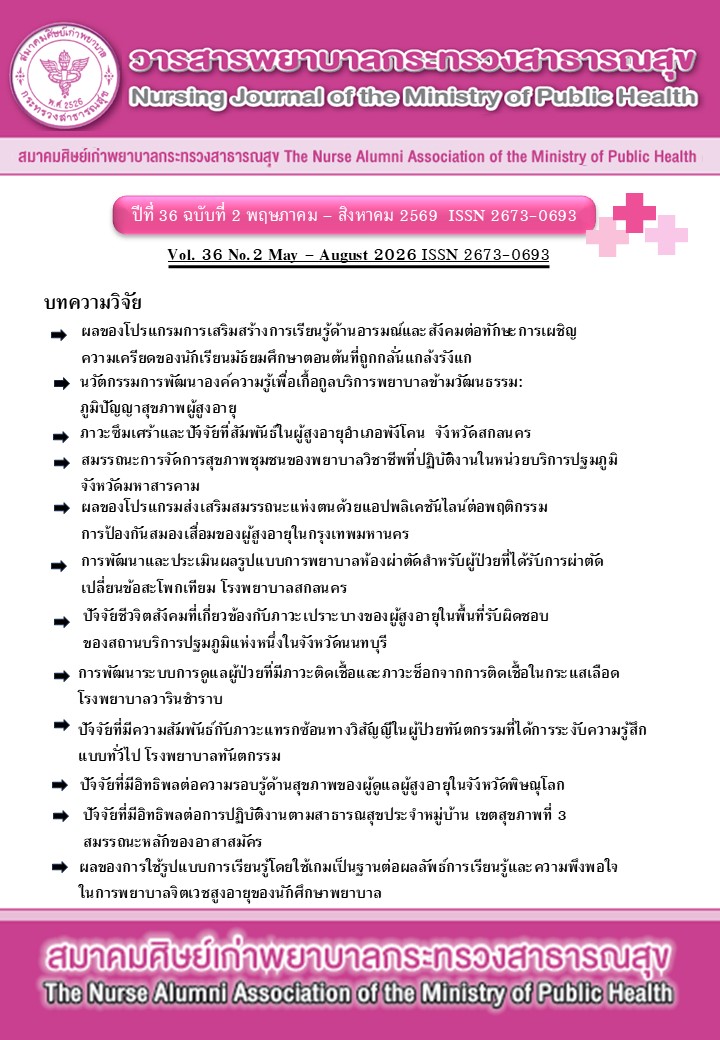
Effect of Using the Game-Based Learning Model for Nursing Students' Learning Outcomes and Satisfaction in Geriatric Psychiatric Nursing
Keywords:
game-based learning model, learning outcomes, nursing education, satisfactionAbstract
Current nursing education aims to foster practical knowledge through active student participation, develop problem-solving skills, and cultivate a satisfying learning environment. This study employed a quasi-experimental comparative design with a two-group pretest–posttest approach to examine the effect of game-based learning on learning outcomes and instructional satisfaction in geriatric psychiatric nursing content among nursing students. The sample consisted of 149 third-year nursing students, divided into an experimental group of 81 students and a comparison group of 68 students. The research instruments included a game-based learning model for geriatric psychiatric nursing, a learning outcomes test with a reliability coefficient (KR-20) of .85, and a satisfaction assessment with a reliability coefficient of .80. Data were analyzed using descriptive statistics, the Mann–Whitney U test, and the Wilcoxon signed-rank test. The results revealed that following game-based learning, the experimental group had significantly higher mean learning outcome scores than before the intervention and significantly higher than those of the comparison group. Furthermore, the experimental group demonstrated a significantly higher mean satisfaction score with instruction compared to the comparison group. In conclusion, the game-based learning model in geriatric psychiatric nursing can more effectively enhance learning outcomes and instruction satisfaction among nursing students than traditional lecture-based instruction.
References
Tavares N. The use and impact of game-based learning on the learning experience and knowledge retention of nursing undergraduate students: A systematic literature review. Nurse Educ Today. 2022;117:105484. doi: 10.1016/j.nedt.2022.105484.
National Higher Education Science Research and Innovation Policy Council. Reforming Thailand's education system to focus on skills development so that Thailand can keep pace with global changes [internet]. 2025 [cited 2025 January 11]. Available from: https:// www.nxpo.or.th/th/9456/. (in Thai).
Learning Innovation Center (LIC), Chulalongkorn University. Active learning [internet]. 2024 [cited 2025 January 12]. Available from: https://lic.chula.ac.th/images/Active% 20Learning/Active%20Learning_01.pdf. (in Thai).
Kathinthong C, Adipat S. The development of vocabulary learning using game based learning for grade 13 students. Journal of Modern Learning Development. 2022;7(4):320-31. (in Thai).
Choosang S, Chai-ngam N, Pongkiatchai R. Instructional design: under the concept of game based learning for nursing education. Journal of Food Health and Bioenvironmental Science 2023;16(1):60-70. (in Thai).
Wonggom P, Somjaivong B, Homvisetvongsa S, Potisopha W, Changrueang O, Ruaisungnoen W, Saensom D, Silarat M, Methakanjanasak N. Effects of game-based learning in caring for patients with intercostal drainage on knowledge, practical skills, and satisfaction in nursing students. Journal of Thailand Nursing and Midwifery Council. 2023;38(4):358-372. (in Thai).
Thongpradab J, Lohacheewa S, Preeyanon L. Effects of game-based learning on nursing students’ knowledge of English psychiatry terminology. Journal of Thailand Nursing and Midwifery Council 2022;37(4):111-124. (in Thai).
Beevi S, Veragi O P. Game based learning in nursing - an innovative strategy. Medicon Med Sci. 2023;4(2):4-7. doi:10.55162/MCMS.04.098.
Thamnamsin K, Noitung S, Punyapet K, Sorat W. Factors affecting to stress among nursing students in a private nursing college, Bangkok. Journal of Health and Health Management 2021;7(1):60-75. (in Thai).
Phiwma N. Effects of blended game-based learning in enhancing learning achievements in vocabulary, grammar, and idioms for formal presentations in “English for presentations” course of computer science students at Suan Dusit University. Academic Journal of Management Technology 2023;4(2):84-69. (in Thai).
Saiboonsri U, Kesonsuwan C, Nantasanee, S, Deeprasert A. The effectiveness of game-based learning for enhancing academic achievement in mental health promotion and psychiatric nursing studies among the third-year nursing students at faculty of nursing, Suan Dusit University. Suan Dusit Graduate Academic Journal 2022;19(1):129-145. (in Thai).
Commitee of Higher Education Standards. Details of the learning outcomes according to the Higher Education Qualifications Standards B.E. 2565 (2022) [internet]. 2025 [cited 2025 January 11]. Available from: https://www.ops.go.th/th/ches-downloads/edu- standard/item/6940-2022-07-22-02-54-49. (in Thai).
Pandach T. Developing the upper secondary school students' mole and chemical formula concepts using game-based learning. [master’s thesis]. Bangkok: Chulalongkorn University; 2018. (in Thai).
Downloads
Published
How to Cite
Issue
Section
License

This work is licensed under a Creative Commons Attribution-NonCommercial-NoDerivatives 4.0 International License.
บทความและรายงานวิจัยในวารสารพยาบาลกระทรวงสาธารณสุข เป็นความคิดเห็นของ ผู้เขียน มิใช่ของคณะผู้จัดทำ และมิใช่ความรับผิดชอบของสมาคมศิษย์เก่าพยาบาลกระทรวงสาธารณสุข ซึ่งสามารถนำไปอ้างอิงได้


