
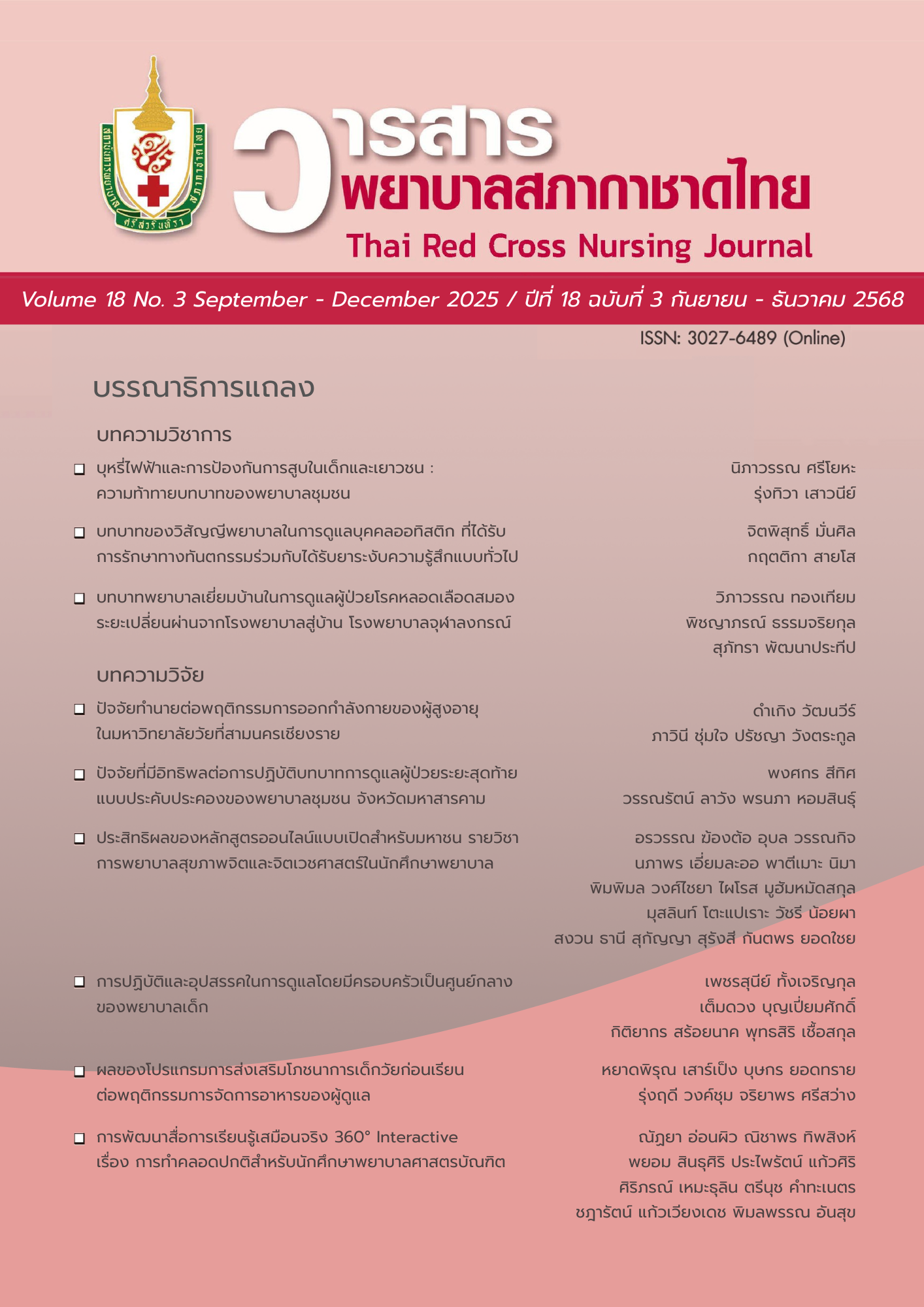
Factors Influencing the Performance of Palliative Care Roles among Community Nurses, Maha Sarakham Province
DOI:
https://doi.org/10.64767/trcn.2025.275288Keywords:
palliative care, end of life patient, role performance, community nurse, predictorsAbstract
Community nurses play a crucial role in providing palliative care for end-of-life patients at home, as they are the primary care personnel with the closest connections to individuals and communities. However, factors predicting their performance in this role have not been studied comprehensively or in sufficient depth. This predictive correlational study aimed to study the role of community nurses in palliative care for end-of-life patients and the predictive factors influencing this role. The sample comprised 240 community nurses in Maha Sarakham Province who met the specified criteria and were selected via cluster sampling. Data were collected from May to August 2024 using a six-part questionnaire: a palliative care role performance questionnaire, a role performance knowledge questionnaire, a role performance skills questionnaire, a role performance resource questionnaire, a role performance motivation questionnaire, and a role performance information access questionnaire. All instruments were reviewed for content validity by five experts and demonstrated reliability coefficients of 0.99, 0.78 (KR-20), 0.99, 0.98, 0.99, and 0.98, respectively. Descriptive statistics and stepwise multiple regression analysis were used for data analysis.
The results indicated that community nurses in Maha Sarakham Province demonstrated a moderate level of palliative care role performance in caring for end-of-life patients (Meanadj = 2.44, S.D. = 0.30). Caregiving experience (β = .48) and role performance skills (β = .28) jointly predicted 51% of the variance in palliative care role performance (R²adj = .51, F = 123.95, p < .001). Recommendations: A program should be developed to enhance community nurses’ palliative care performance, with an emphasis on strengthening role-related skills, particularly among nurses with limited experience. Experienced nurses should be supported to serve as mentors or consultants to improve the overall effectiveness of end-of-life palliative care within the community.
Downloads
References
Chulanont S. Ministerial regulations pursuant to section 12 of the National Health Act B.E. 2550 (2007). In: Jindawatthana A, editor. A guide for health service providers: laws and practices related to end-of-life care. Nonthaburi: National Health Commission Office; 2016. p. 7-11. (in Thai)
Knaul F, Radbruch L, Connor S, de Lima L, Arreola-Ornelas H, Mendez Carniado O, et al. How many adults and children are in need of palliative care worldwide? In: Connor SR, editor. Global atlas of palliative care. 2nd ed. London: Worldwide Hospice Palliative Care Alliance; 2020. p. 17-32.
World Health Organization. Palliative care [Internet]. 2020 [cited 2025 Jun 19]. Available from: https://www.who.int/news-room/fact-sheets/detail/palliative-care
ICT (Information and Communication Technology Center). Health data center [Internet]. 2020 [cited 2025 Jun 19]. Available from: https://hdc.moph.go.th/center/public/main
Khongsrichay O, Noonil N, Jaraeprapal U. Palliative care roles of nurses in primary care units of Health Region 11. Rama Nurs J 2020;26(3):310-24. (in Thai)
Ministry of Public Health. The Twenty-Year National Strategic Plan for Public Health (2017-2036). Nonthaburi: Office of the Permanent Secretary, Ministry of Public Health; 2017. (in Thai)
Office of the Decentralization to Local Government Organization Committee. Manual for the transfer of missions of sub-district health promoting hospitals (RorPorSorTor) to the Provincial Administrative Organization (PAO). Nonthaburi: Office of the Permanent Secretary, Prime Minister's Office; 2021. p.134. (in Thai)
Siraprapasiri P, Horatanaruang D, editors. Handbook for palliative and end-of-life patient care (for medical staff). Bangkok: Office of Printing Affairs, War Veterans Organization; 2020. (in Thai)
Sanothong K. Community health nursing and the roles of community nurse [Internet]. 2016 [cited 2025 Jun 19]. Available from: https://myblogcomnurse.blogspot.com/2016/01/blog-post.html (in Thai)
Junchom K, Sangsai Y, Polsavat B. Empowering family and community in end–of-life care: important role of nurses. J Health Sci BCNSP 2021;5(2):12-24. (in Thai)
Prichayudh N, Chatgitisan A, Khunin N, Junda T. Role synthesis of pediatric palliative care nurse in Ramathibodi Hospital: document research. Journal of Nursing Siam University 2021;22(42):60-74. (in Thai)
Suprayitno E, Setiawan I. Nurses’ roles in palliative care: an islamic perspective. Belitung Nurs J 2021;7(1):50-4. DOI: https://doi.org/10.33546/bnj.1254
Johansen H, Helgesen AK. Palliative care in the community-the role of the resource nurse, a qualitative study. BMC Palliat Care 2021;20(1):157. DOI: https://doi.org/10.1186/s12904-021-00860-w
Engel M, van Zuylen L, van der Ark A, van der Heide A. Palliative care nurse champions' views on their role and impact: a qualitative interview study among hospital and home care nurses. BMC Palliat Care 2021;20(1):34. DOI: https://doi.org/10.1186/s12904-021-00726-1
Chimchalong R. Palliative nurse specialist competencies and the role of nurse in palliative care. RTA Med J 2021;74(3):233-9. (in Thai)
Utthiya P. Role of home care nurses for older adults with end stage cancer. Journal of The Royal Thai Army Nurses 2020;21(1):18-25. (in Thai)
Thanomklom P. The roles of home health care nurses for end-of-life patients according to the Buddhist way of life. JOPN 2020;12(1):233-4. (in Thai)
Thaiautvitee T, Jumpamool A. Factors influencing patient-centered care as perceived by registered nurses working in Srinagarind Hospital. Srinagarind Med J 2019;34(2):198-204. (in Thai)
Subwongcharoen N, Chintapanyakun T. Role of palliative care nurses in tertiary hospitals. Journal of Royal Thai Army Nurses 2020;21(1):26-34. (in Thai)
Yach D. Innovations in care: meeting the challenge of chronic conditions. In: Epping-Jordan J, editor. Innovative care for chronic conditions. Geneva: World Health Organization; 2002. p. 43-74.
Johansen H, Grøndahl VA, Helgesen AK. Palliative care in home health care services and hospitals - the role of the resource nurse, a qualitative study. BMC Palliat Care 2022;21(1):64. DOI: https://doi.org/10.1186/s12904-022-00956-x
Hickman SE, Parks M, Unroe KT, Ott M, Ersek M. The Role of the palliative care registered nurse in the nursing facility setting. J Hosp Palliat Nurs 2020;22(2):152-158. DOI: https://doi.org/10.1097/NJH.0000000000000634
Cohen J. Statistical power analysis for the behavioral sciences. 2nd ed. Hillsdale (NJ): Lawrence Erlbaum Associates; 1988.
Hanucharurnkul S, Puttapitukpol S, Sirinakorn R. Standards for community nursing services. In: Likhitluecha N, Atthachaiwat A, Lapphakdee T, editors. Nursing standards in the community. Pathum Thani: Suetawan Publishing; 2012. p. 127-38. (in Thai)
Pairojkul S, Limratana N. Training of the trainers in palliative care: module 5 communication in palliative care [Internet]. 2017. [cited 2025 Jun 19]. Available from: https://www.karunruk.org/wp-content/uploads/2021/08/Module-5-Communication-in-palliative-care.pdf. (in Thai)
Leelachai T, Tanvatanakul V, Jaidee PH. Health resource management factors affecting effectiveness of public health services for dependent elderly in the community of subdistrict health promotion hospital in health region 6. The Public Health Journal of Burapha University 2023;18(2):31-44. (in Thai)
Herzberg F, Mausner B, Snyderman BB. The motivation to work. New York: John Wiley & Sons; 1959.
DGA (Digital Government Development Agency). Resource information: proportion of medical personnel in 2021 [Internet]. 2025 [cited 2025 Dec 9]. Available from: https://data.go.th/dataset/gdpublish-report-health-resource-64 (in Thai)
Sekse RJT, Hunskår I, Ellingsen S. The nurse's role in palliative care: a qualitative meta-synthesis. J Clin Nurs 2018;27(1-2):e21-e38. DOI: https://doi.org/10.1111/jocn.13912
Collins CM, Small SP. The nurse practitioner role is ideally suited for palliative care practice: a qualitative descriptive study. Can Oncol Nurs J 2019;29(1):4-9. DOI: https://doi.org/10.5737/2368807629149
Downloads
Published
How to Cite
Issue
Section
License
Copyright (c) 2025 Srisavarindhira Thai Red Cross Institute of Nursing

This work is licensed under a Creative Commons Attribution-NonCommercial-NoDerivatives 4.0 International License.
เนื้อหาบทความหรือข้อคิดเห็นต่างๆ ในวารสารพยาบาลสภากาชาดไทยนี้ เป็นความคิดเห็นของผู้เขียนบทความ ไม่ใช่ความเห็นของกองบรรณาธิการ หรือสถาบันการพยาบาลศรีสวรินทิรา สภากาชาดไทย


