
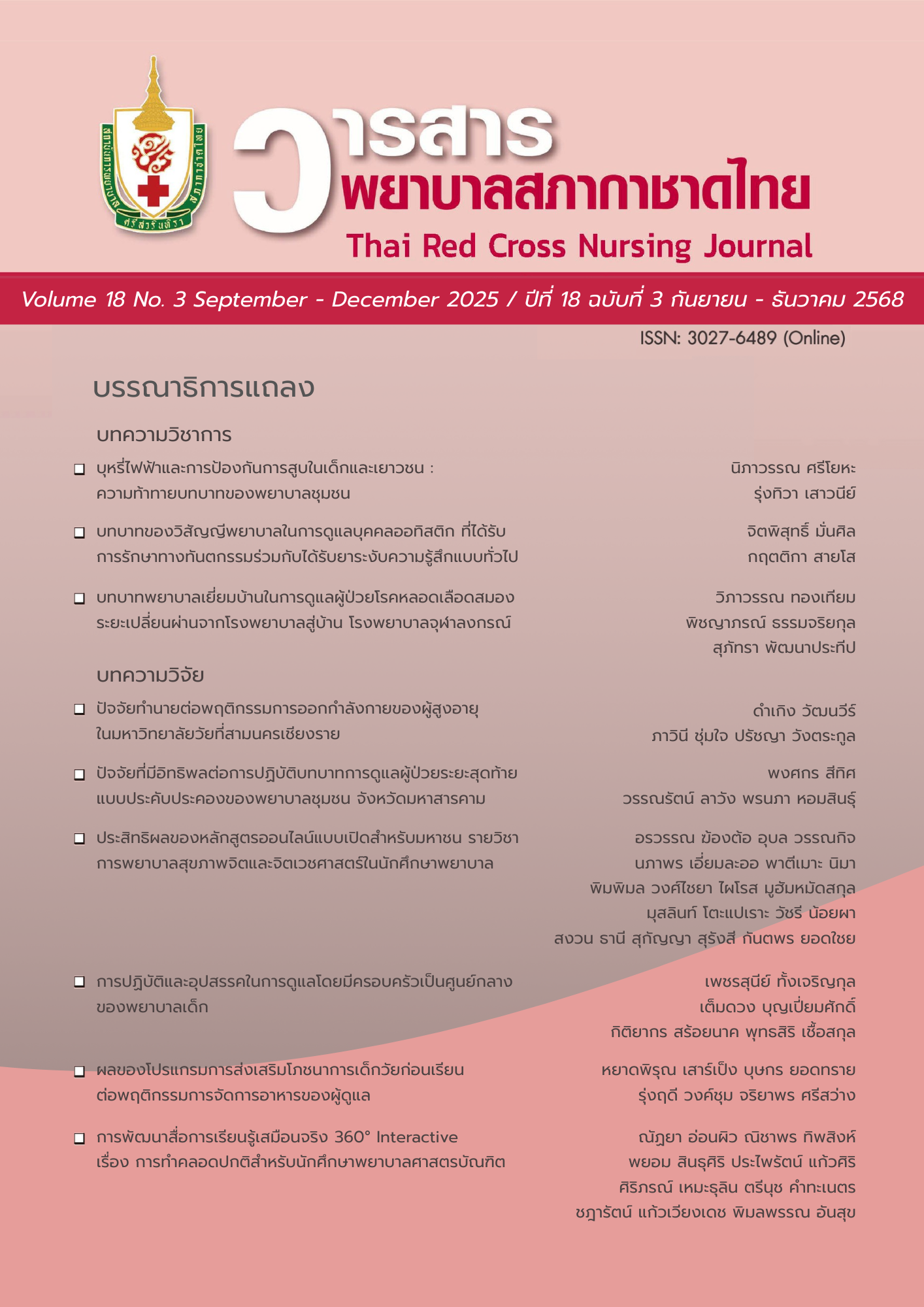
Pediatric Nurses’ Practices and Barriers in Family-Centered Care
DOI:
https://doi.org/10.64767/trcn.2025.277022Keywords:
family-centered care, pediatric nurses, nursing practice, barriers to careAbstract
This descriptive research aimed to: (1) examine barriers to family-centered care (FCC) among pediatric nurses, (2) investigate pediatric nurses’ practices of FCC, and (3) compare differences in FCC practices between nurses working in pediatric wards and those working in pediatric and neonatal intensive care units (PICUs/NICUs). The sample consisted of professional nurses who provided care for pediatric and neonatal patients in a tertiary hospital and met the inclusion criteria. Data were collected using a demographic questionnaire, the Thai version of the Family-Centered Care Practice Questionnaire based on the framework of Wilson and Dunst, and a perceived barriers to FCC practice questionnaire developed by the researcher. Data were analyzed using descriptive statistics and independent t-tests.
The results showed that the overall mean score of perceived barriers to family-centered care among pediatric nurses was at a moderate level (Mean = 2.18, S.D. = 0.56). The most frequently reported barriers were organizational factors (Mean = 2.24, S.D. = 0.69), followed by nursing personnel factors (Mean = 2.21, S.D. = 0.60). The overall mean score of FCC practice among pediatric nurses was at a high level (Mean = 3.73, S.D. = 0.32). Nurses working in PICUs/NICUs demonstrated significantly higher overall FCC practice scores (Mean = 3.80, S.D. = 0.25) than those working in pediatric wards (Mean = 3.65, S.D. = 0.38) (p < 0.05).
When comparing specific dimensions, relational-oriented practice scores among PICU/NICU nurses were significantly higher than those of pediatric ward nurses (p < 0.05), whereas no significant difference was found in participatory care practice between the two groups.
The findings suggest that hospital administrators should address organizational and nursing personnel barriers to enhance the implementation of family-centered care in pediatric nursing. Additionally, pediatric ward nurses should strengthen relational-oriented practices by incorporating identified organizational and personnel barriers into quality improvement plans to promote effective family-centered care.
Downloads
References
Institute for Population and Social Research, Mahidol University, Thailand, Report on the Population Prospects as of Mid-2025 (July 1). Mahidol Population Gazette. 34 (January, 2025). (in Thai)
Department of Health, Ministry of Public Health. Incident of birth asphyxia rate: province sectors 2023. 2023 [cited 2025 Aug 11]. Available from: https://dashboard.anamai.moph.go.th/dashboard/birthasphyxia/index?year=2023 (in Thai)
Moasuwan L, Sutra S, editors. The burden of diseases among Thai children and adolescents 2015-2019. Bangkok: The Royal College of Pediatricians of Thailand; 2023. (in Thai)
Yuennan C. A concept of family-centered nursing care among children with critical and chronic illness. Journal of Nurses Association of Thailand Northern Office 2017;23(2):59-68. (in Thai)
Bothipan S, Makma K, Wuttisirinukul W, Intasan A. Development of primary nursing system in intensive care unit, pediatric department, Buddhachinaraj Phitsanulok Hospital. Buddhachinaraj Medical Journal 2022;39(3):304-17. (in Thai)
Taweechart J, Thungjaroenkul P, Nantsupawat A. Barriers and practices based on family-centered care of nurses in the surgical intensive care unit. Kamphaeng Phet Hospital Journal 2021;25(2):19-28. (in Thai)
Aljawad B, Miraj SA, Alameri F, Alzayer H. Family-centered care in neonatal and pediatric critical care units: a scoping review of interventions, barriers, and facilitators. BMC Pediatr 2025;25(1):291. DOI: https://doi.org/10.1186/s12887-025-05620-w
Kuo DZ, Houtrow AJ, Arango P, Kuhlthau KA, Simmons JM, Neff JM. Family-centered care: current applications and future directions in pediatric health care. Matern Child Health J 2012;16(2):297-305. DOI: https://doi.org/10.1007/s10995-011-0751-7
Dunst CJ. Family-centered practices: birth through high school: birth through high school. The Journal of Special Education 2002;36(3):141-149. DOI: https://doi.org/10.1177/00224669020360030401
Dall'Oglio I, Di Furia M, Tiozzo E, Gawronski O, Biagioli V, Di Ciommo VM, et al. Practices and perceptions of family centered care among healthcare providers: a cross-sectional study in a pediatric hospital. J Pediatr Nurs 2018;43:e18-e25. DOI: https://doi.org/10.1016/j.pedn.2018.07.015
Sangnatsawang N. Perception and practice of family-centered care in health care professions [thesis]. Bangkok: Mahidol University; 2008. (in Thai)
Bruce B, Letourneau N, Ritchie J, Larocque S, Dennis C, Elliott MR. A multisite study of health professionals’ perceptions and practices of family-centered care. J Fam Nurs 2002;8(4):408-29. DOI: https://doi.org/10.1177/107484002237515
Prasopkittikun T, Srichantaranit A, Chunyasing S. Thai nurses' perceptions and practices of family-centered care: the implementation gap. Int J Nurs Sci 2019;7(1):74-80. DOI: https://doi.org/10.1016/j.ijnss.2019.09.013
Khamoonrot N, Nateethanasombat K, Khlangthamniam K. Factors predicting of nursing practice in family-centered care of community nurse practitioners. HCU Journal of Health Science 2018;21(42):13-28. (in Thai)
Cannon S. Family-centered care in the critical care setting: is it best practice? Dimens Crit Care Nurs 2011;30(5):241-5. DOI: https://doi.org/10.1097/DCC.0b013e3182276f9a
Dunst CJ, Trivette CM. Characteristics and consequences of family-centered helpgiving practices. CASEmakers 2005;1(6):1-4.
Dunst CJ, Espe-Sherwindt M. Family-centered practices in early childhood intervention. In: Reichow B, Boyd BA, Barton EE, Odom SL, editor. Handbook of early childhood special education. Switzerland: Springer International Publishing; 2016. p. 37-55. DOI: https://doi.org/10.1007/978-3-319-28492-7_3
Mierendorf SM, Gidvani V. Palliative care in the emergency department. Perm J 2014;18(2):77-85. DOI: https://doi.org/10.7812/TPP/13-103
Kiwanuka F, Shayan SJ, Tolulope AA. Barriers to patient and family-centred care in adult intensive care units: A systematic review. Nurs Open 2019;6(3):676-84. DOI: https://doi.org/10.1002/nop2.253
Lim SJ, Bang KS. The perceptions and performance of family-centered care among pediatric nurses at a children's hospital in South Korea: a descriptive study. Child Health Nurs Res 2023;29(3):207-17. DOI: https://doi.org/10.4094/chnr.2023.29.3.207
Cohen J. Statistical power analysis for the behavioral sciences. New York: Routledge; 2013. DOI: https://doi.org/10.4324/9780203771587
Wilson LL, Dunst CJ. Checklist for assessing adherence to family-centered practices. CASEtools 2005;1(1):1-6.
Srisa-ard B. Introduction to research. 10th ed. Bangkok: Suwiriyasarn; 2017. (in Thai)
Ward K. Perceived needs of parents of critically ill infants in a neonatal intensive care unit (NICU). Pediatr Nurs 2001;27(3):281-6.
Yoo HJ, Lim OB, Shim JL. Critical care nurses' communication experiences with patients and families in an intensive care unit: a qualitative study. PLoS One 2020;15(7):e0235694. DOI: https://doi.org/10.1371/journal.pone.0235694
Downloads
Published
How to Cite
Issue
Section
License
Copyright (c) 2025 Srisavarindhira Thai Red Cross Institute of Nursing

This work is licensed under a Creative Commons Attribution-NonCommercial-NoDerivatives 4.0 International License.
เนื้อหาบทความหรือข้อคิดเห็นต่างๆ ในวารสารพยาบาลสภากาชาดไทยนี้ เป็นความคิดเห็นของผู้เขียนบทความ ไม่ใช่ความเห็นของกองบรรณาธิการ หรือสถาบันการพยาบาลศรีสวรินทิรา สภากาชาดไทย


