
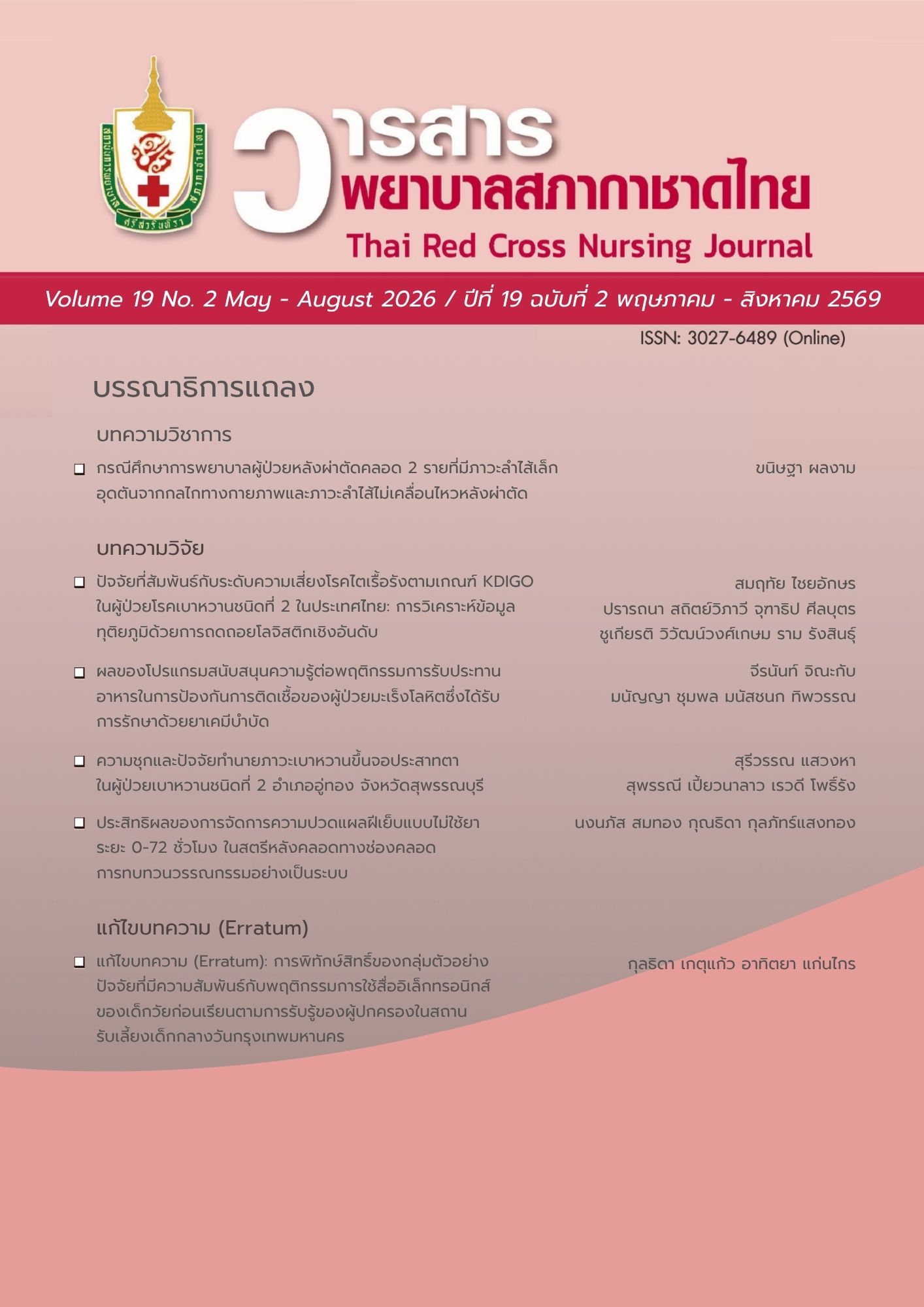
Effectiveness of Non-pharmacological Interventions for Perineal Pain Management within 0-72 Hours after Vaginal Delivery: A Systematic Review
DOI:
https://doi.org/10.64767/trcn.2026.280393Keywords:
non-pharmacological pain management, cold compression, perineal wound pain, postpartum women, systematic reviewAbstract
Background: Perineal wound pain is a common problem among women after vaginal delivery, affecting both their physiological and psychological well-being. It is typically most severe during the first 24 hours after childbirth and tends to decrease within 72 hours postpartum.
Objective: To synthesize the methods and outcomes of non-pharmacological management of perineal pain during the first 0–72 hours postpartum among women following vaginal delivery.
Methods: A systematic review was conducted in accordance with the JBI Manual for Evidence Synthesis. Two reviewers independently searched five electronic databases, PubMed, Cochrane Library, ScienceDirect, CINAHL, and ThaiJO guided by the PICOT framework. Studies were selected based on the PRISMA 2020 guidelines and reported using a PRISMA flow diagram. Methodological quality was appraised using the JBI Critical Appraisal Checklist for Randomized Controlled Trials, with a minimum quality threshold of 60%. Data were extracted using a researcher-developed form based on the JBI guidelines and descriptive synthesis.
Results: Seven studies met the inclusion criteria, all of which were randomized controlled trials (RCTs), classified as Level 1.c evidence according to the JBI criteria. The studies included a total of 731 participants from five countries. Four studies were rated as high quality, while three were rated as moderate quality.
Conclusions: Cold therapy may help reduce acute perineal pain during the early postpartum period, particularly in the short term. However, evidence regarding the optimal frequency of application remains insufficient. As a simple and practical intervention within the scope of nursing practice, cold therapy may be used as an adjunct to standard care, with its application tailored to each woman’s needs and the local clinical context.
Downloads
References
Choudhari RG, Tayade SA, Venurkar SV, Deshpande VP. A review of episiotomy and modalities for relief of episiotomy pain. Cureus 2022;14(11):e31620. DOI: https://doi.org/10.7759/cureus.31620
East CE, Sherburn M, Nagle C, Said J, Forster D. Perineal pain following childbirth: prevalence, effects on postnatal recovery and analgesia usage. Midwifery 2012;28(1):93-7. DOI: https://doi.org/10.1016/j.midw.2010.11.009
Laurita Longo V, Odjidja EN, Zanfini BA, Catarci S, Carducci B, Draisci G, et al. Risk factors associated with severe perineal lacerations during vaginal delivery: a 10-year propensity score-matched observational study. AJOG Glob Rep 2023;3(2):100174. DOI: https://doi.org/10.1016/j.xagr.2023.100174
RS S, D'lima SK, Shahanaz, Mateti UV, Sonkusare S. Assessment of pain and maternal complications after normal vaginal delivery. J Obstet Gynaecol 2022;42(5):989-93. DOI: https://doi.org/10.1080/01443615.2021.1980514
Department of Obstetrics and Gynecology Nursing, King Chulalongkorn Memorial Hospital. Statistics of perineal pain in the obstetric ward between July and August 2024 [unpublished internal report]. Bangkok: The Thai Red Cross Society; 2024. (in Thai)
Walsh M, Fitzpatrick M, Anglim B. Obstetric anal sphincter injury-the long game: primary and cumulative anal sphincter injury during childbirth and its long-term implications-a clinical practice review. Gynecol Pelv Med 2023;6:5. DOI: https://doi.org/10.21037/gpm-22-47
Pharmacologic stepwise multimodal approach for postpartum pain management: ACOG clinical consensus no. 1. Obstet Gynecol 2021;138(3):507-17. DOI: https://doi.org/10.1097/AOG.0000000000004517
Smith CA, Hill E, Denejkina A, Thornton C, Dahlen HG. The effectiveness and safety of complementary health approaches to managing postpartum pain: a systematic review and meta-analysis. Integr Med Res 2022;11(1):100758. DOI: https://doi.org/10.1016/j.imr.2021.100758
Kim HJ, An JW, Lee Y, Shin YS. The effects of cryotherapy on perineal pain after childbirth: a systematic review and meta-analysis. Midwifery 2020;89:102788. DOI: https://doi.org/10.1016/j.midw.2020.102788
Maghalian M, Alikamali M, Nabighadim M, Mirghafourvand M. The effects of warm perineal compress on perineal trauma and postpartum pain: a systematic review with meta-analysis and trial sequential analysis. Arch Gynecol Obstet 2024;309(3):843-69. DOI: https://doi.org/10.1007/s00404-023-07195-2
Ebrahimian A, Razavinia F, Iravani M. The effect of acupressure on postpartum perineal pain: a systematic review and meta-analysis. Adv Integr Med 2025;12(2):100470. DOI: https://doi.org/10.1016/j.aimed.2025.02.007
Aromataris E, Lockwood C, Porritt K, Pilla B, Jordan Z, editors. JBI manual for evidence synthesis [Internet]. Adelaide (AU): JBI; 2024 [cited 2026 Jul 1]. Available from: https://synthesismanual.jbi.global. DOI: https://doi.org/10.46658/JBIMES-24-01
Page MJ, McKenzie JE, Bossuyt PM, Boutron I, Hoffmann TC, Mulrow CD, et al. The PRISMA 2020 statement: an updated guideline for reporting systematic reviews. PLoS Med 2021;18(3):e1003583. DOI: https://doi.org/10.1371/journal.pmed.1003583
Landis JR, Koch GG. The measurement of observer agreement for categorical data. Biometrics 1977;33(1):159-74. DOI: https://doi.org/10.2307/2529310
Barker TH, Stone JC, Sears K, Klugar M, Tufanaru C, Leonardi-Bee J, et al. The revised JBI critical appraisal tool for the assessment of risk of bias for randomized controlled trials. JBI Evid Synth 2023;21(3):494-506. DOI: https://doi.org/10.11124/JBIES-22-00430
Tufanaru C, Munn Z, Aromataris E, Campbell J, Hopp L. Chapter 3: Systematic reviews of effectiveness. In: Aromataris E, Munn Z, editors. JBI manual for evidence synthesis [Internet]. Adelaide: JBI; 2020 [cited 2026 Aug 18]. Available from: https://jbi-global-wiki.refined.site/space/MANUAL/355599504/3.+Systematic+reviews+of+effectiveness DOI: https://doi.org/10.46658/JBIRM-17-03
JBI Levels of Evidence and Grades of Recommendation Working Party. Supporting document for the JBI levels of evidence and grades of recommendation [Internet]. Adelaide (AU): Joanna Briggs Institute; 2014 [cited 2026 Aug 19]. Available from: https://jbi.global/sites/default/files/2020-07/Supporting_Doc_JBI_Levels_of_Evidence_Grades_of_Recommendation.pdf
Beleza ACS, Ferreira CHJ, Driusso P, Dos Santos CB, Nakano AMS. Effect of cryotherapy on relief of perineal pain after vaginal childbirth with episiotomy: a randomized and controlled clinical trial. Physiotherapy 2017;103(4):453-8. DOI: https://doi.org/10.1016/j.physio.2016.03.003
Morais I, Lemos A, Katz L, Melo LF, Maciel MM, Amorim MMR. Perineal pain management with cryotherapy after vaginal delivery: a randomized clinical trial. Rev Bras Ginecol Obstet 2016;38(7):325-32. doi: 10.1055/s-0036-1584941. DOI: https://doi.org/10.1055/s-0036-1584941
Karim KK, Gan F, Hong J, Hamdan M, Razali N, Tan PC. Cold compared with room temperature compress on the repaired primiparous perineum following injury at normal vaginal delivery: a randomized controlled trial. Am J Obstet Gynecol MFM 2024;6(2):101271. doi: 10.1016/j.ajogmf.2023.101271. DOI: https://doi.org/10.1016/j.ajogmf.2023.101271
Francisco AA, de Oliveira SMJV, Steen M, Nobre MRC, De Souza EV. Ice pack induced perineal analgesia after spontaneous vaginal birth: randomized controlled trial. Women Birth 2018;31(5):e334-40. DOI: https://doi.org/10.1016/j.wombi.2017.12.011
Suvarna RR, Chippala P. Effect of ice pack on pain and activities of daily living after episiotomy: a randomised controlled trial. J Clin Diagn Res 2023;17(10):YC01-4. DOI: https://doi.org/10.7860/JCDR/2023/65320.18619
Senol DK, Aslan E. The effects of cold application to the perineum on pain relief after vaginal birth. Asian Nurs Res (Korean Soc Nurs Sci) 2017;11(4):276-82. DOI: https://doi.org/10.1016/j.anr.2017.11.001
Hatkaew N, Theerasopon P. The effect of cold polymer gel pack compression on postpartum perineal pain. J Phrapokklao Nurs Coll 2015;26(Suppl 1):1-13. (in Thai)
East CE, Dorward ED, Whale RE, Liu J. Local cooling for relieving pain from perineal trauma sustained during childbirth. Cochrane Database Syst Rev 2020;10(10):CD006304. DOI: https://doi.org/10.1002/14651858.CD006304.pub4
Huang LH, Lai YF, Chen GD, Lee MS, Ng SC. Effect of far-infrared radiation on perineal wound pain and sexual function in primiparous women undergoing an episiotomy. Taiwan J Obstet Gynecol 2019;58(1):68-71. DOI: https://doi.org/10.1016/j.tjog.2018.11.013
Ramesh S, Tripathy S, Sen M, Nandi D. Effects of far infrared radiation and sitz bath on perineal wound healing and pain in primiparous women undergoing an episiotomy: a randomized prospective parallel arm study. Cureus 2024;16(8):e67477. DOI: https://doi.org/10.7759/cureus.67477
Roma NZH, Essa RM, Rashwan ZI, Ahmed AH. Effect of dry heat application on perineal pain and episiotomy wound healing among primipara women. Obstet Gynecol Int 2023;2023:9572354. DOI: https://doi.org/10.1155/2023/9572354
Downloads
Published
How to Cite
Issue
Section
License
Copyright (c) 2026 Srisavarindhira Thai Red Cross Institute of Nursing

This work is licensed under a Creative Commons Attribution-NonCommercial-NoDerivatives 4.0 International License.
เนื้อหาบทความหรือข้อคิดเห็นต่างๆ ในวารสารพยาบาลสภากาชาดไทยนี้ เป็นความคิดเห็นของผู้เขียนบทความ ไม่ใช่ความเห็นของกองบรรณาธิการ หรือสถาบันการพยาบาลศรีสวรินทิรา สภากาชาดไทย


