
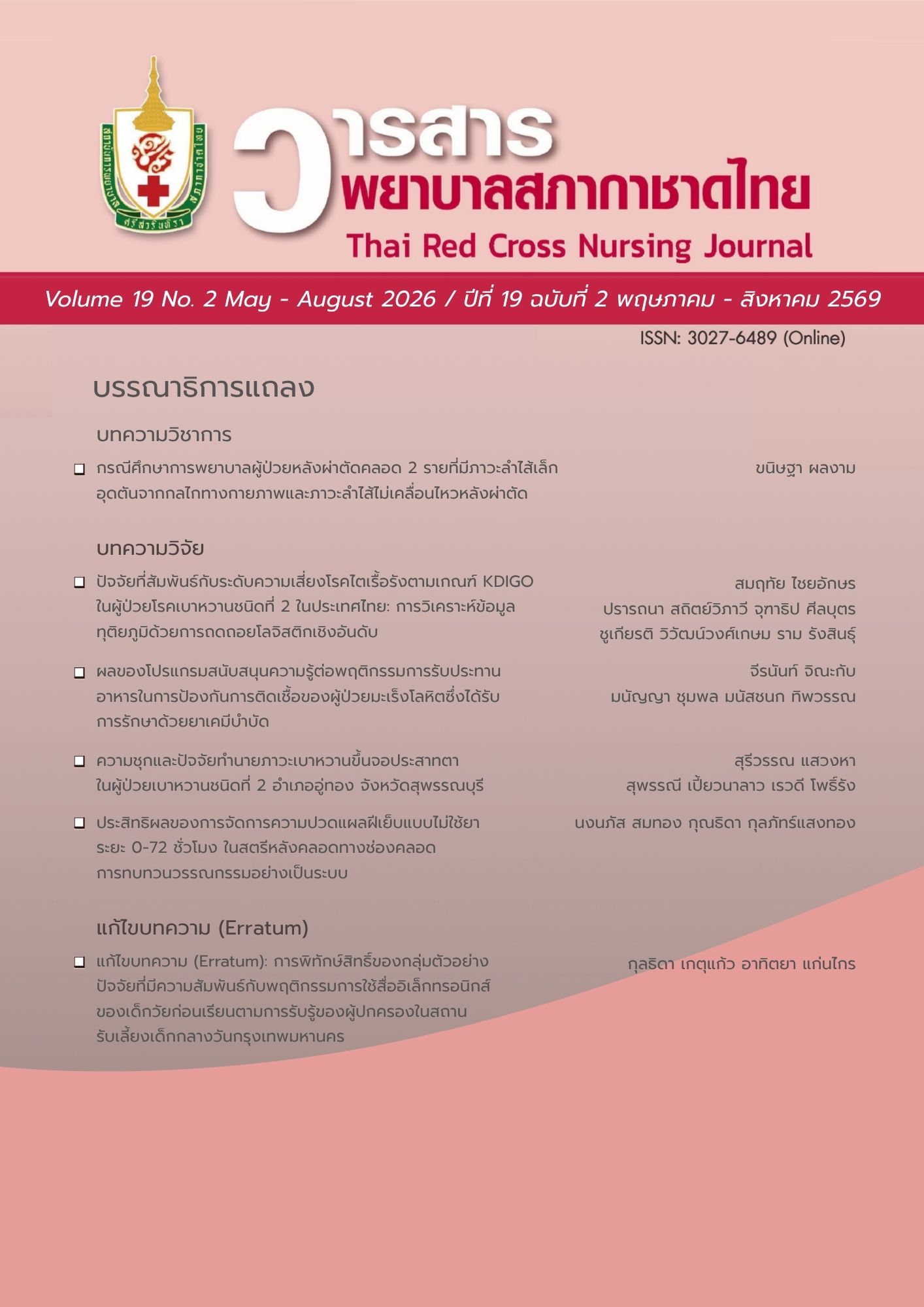
ประสิทธิผลของการจัดการความปวดแผลฝีเย็บแบบไม่ใช้ยา ระยะ 0-72 ชั่วโมง ในสตรีหลังคลอดทางช่องคลอด การทบทวนวรรณกรรมอย่างเป็นระบบ
DOI:
https://doi.org/10.64767/trcn.2026.280393คำสำคัญ:
การจัดการความปวดแบบไม่ใช้ยา, การประคบเย็น, ความปวดแผลฝีเย็บ, สตรีหลังคลอด, การทบทวนวรรณกรรมอย่างเป็นระบบบทคัดย่อ
บทนำ: ความปวดแผลฝีเย็บเป็นปัญหาที่พบบ่อยในสตรีหลังคลอดทางช่องคลอด ส่งผลกระทบต่อทั้งด้านร่างกายและจิตใจ โดยมักมีความรุนแรงในช่วง 24 ชั่วโมงแรกหลังคลอด และมีแนวโน้มลดลง
ภายใน 72 ชั่วโมงหลังคลอด
วัตถุประสงค์: เพื่อสังเคราะห์วิธีการและผลลัพธ์ของการจัดการความปวดแผลฝีเย็บแบบไม่ใช้ยาในระยะ 0-72 ชั่วโมงหลังคลอดในสตรีหลังคลอดทางช่องคลอด
วิธีการศึกษา: การทบทวนวรรณกรรมอย่างเป็นระบบตามแนวทาง JBI Manual for Evidence Synthesis โดยผู้วิจัย 2 คนคัดเลือกและประเมินงานวิจัยอย่างเป็นอิสระ สืบค้นงานวิจัยจากฐานข้อมูลอิเล็กทรอนิกส์ 5 ฐาน ได้แก่ PubMed, Cochrane Library, ScienceDirect, CINAHL และ ThaiJO ภายใต้กรอบแนวคิด PICOT คัดเลือกงานวิจัยด้วยแบบคัดเลือกตามแนวทาง PRISMA 2020 รายงานผลด้วย PRISMA flow diagram ประเมินคุณภาพงานวิจัยด้วย JBI Critical Appraisal Checklist for Randomized Controlled Trials กำหนดเกณฑ์การผ่านคุณภาพไม่น้อยกว่าร้อยละ 60 สกัดข้อมูลด้วยแบบสกัดข้อมูลที่ผู้วิจัยพัฒนาขึ้นตามแนวทาง JBI Manual for Evidence Synthesis และสังเคราะห์ข้อมูลเชิงพรรณนา
ผลการวิจัย: งานวิจัยผ่านเกณฑ์คัดเลือกจำนวน 7 เรื่อง เป็นการวิจัยแบบสุ่มและมีกลุ่มควบคุม (RCT) ทั้งหมด จัดเป็นหลักฐานระดับ 1.c ตามเกณฑ์ JBI มีกลุ่มตัวอย่างรวม 731 ราย จาก 5 ประเทศ โดยมีคุณภาพระดับสูง 4 เรื่อง และระดับปานกลาง 3 เรื่อง ส่วนใหญ่ของการศึกษาพบว่า การใช้ความเย็นช่วยลดคะแนนความปวดอย่างมีนัยสำคัญทางสถิติ โดยผลชัดเจนในระยะปวดเฉียบพลัน และมีผลลดความปวดในระยะสั้น แต่เนื่องจากมีความไม่เป็นเนื้อเดียวกันของผลการศึกษา จึงไม่สามารถวิเคราะห์อภิมานได้ และจัดระดับข้อเสนอแนะเป็น ระดับ B (weak recommendation)
สรุป: การประคบเย็นมีแนวโน้มช่วยลดความปวดแผลฝีเย็บในระยะเฉียบพลันช่วงต้นหลังคลอด โดยมีผลลดความปวดในระยะสั้น และยังมีหลักฐานไม่เพียงพอเกี่ยวกับความถี่ที่เหมาะสมของการประคบเย็น การประคบเย็นเป็นวิธีที่ปฏิบัติได้ง่าย และสามารถดำเนินการภายใต้บทบาทของพยาบาล จึงอาจใช้เป็นทางเลือกเสริมร่วมกับการดูแลตามมาตรฐาน โดยปรับให้เหมาะสมกับบริบทของหน่วยบริการ และผู้รับบริการแต่ละราย
Downloads
เอกสารอ้างอิง
Choudhari RG, Tayade SA, Venurkar SV, Deshpande VP. A review of episiotomy and modalities for relief of episiotomy pain. Cureus 2022;14(11):e31620. DOI: https://doi.org/10.7759/cureus.31620
East CE, Sherburn M, Nagle C, Said J, Forster D. Perineal pain following childbirth: prevalence, effects on postnatal recovery and analgesia usage. Midwifery 2012;28(1):93-7. DOI: https://doi.org/10.1016/j.midw.2010.11.009
Laurita Longo V, Odjidja EN, Zanfini BA, Catarci S, Carducci B, Draisci G, et al. Risk factors associated with severe perineal lacerations during vaginal delivery: a 10-year propensity score-matched observational study. AJOG Glob Rep 2023;3(2):100174. DOI: https://doi.org/10.1016/j.xagr.2023.100174
RS S, D'lima SK, Shahanaz, Mateti UV, Sonkusare S. Assessment of pain and maternal complications after normal vaginal delivery. J Obstet Gynaecol 2022;42(5):989-93. DOI: https://doi.org/10.1080/01443615.2021.1980514
Department of Obstetrics and Gynecology Nursing, King Chulalongkorn Memorial Hospital. Statistics of perineal pain in the obstetric ward between July and August 2024 [unpublished internal report]. Bangkok: The Thai Red Cross Society; 2024. (in Thai)
Walsh M, Fitzpatrick M, Anglim B. Obstetric anal sphincter injury-the long game: primary and cumulative anal sphincter injury during childbirth and its long-term implications-a clinical practice review. Gynecol Pelv Med 2023;6:5. DOI: https://doi.org/10.21037/gpm-22-47
Pharmacologic stepwise multimodal approach for postpartum pain management: ACOG clinical consensus no. 1. Obstet Gynecol 2021;138(3):507-17. DOI: https://doi.org/10.1097/AOG.0000000000004517
Smith CA, Hill E, Denejkina A, Thornton C, Dahlen HG. The effectiveness and safety of complementary health approaches to managing postpartum pain: a systematic review and meta-analysis. Integr Med Res 2022;11(1):100758. DOI: https://doi.org/10.1016/j.imr.2021.100758
Kim HJ, An JW, Lee Y, Shin YS. The effects of cryotherapy on perineal pain after childbirth: a systematic review and meta-analysis. Midwifery 2020;89:102788. DOI: https://doi.org/10.1016/j.midw.2020.102788
Maghalian M, Alikamali M, Nabighadim M, Mirghafourvand M. The effects of warm perineal compress on perineal trauma and postpartum pain: a systematic review with meta-analysis and trial sequential analysis. Arch Gynecol Obstet 2024;309(3):843-69. DOI: https://doi.org/10.1007/s00404-023-07195-2
Ebrahimian A, Razavinia F, Iravani M. The effect of acupressure on postpartum perineal pain: a systematic review and meta-analysis. Adv Integr Med 2025;12(2):100470. DOI: https://doi.org/10.1016/j.aimed.2025.02.007
Aromataris E, Lockwood C, Porritt K, Pilla B, Jordan Z, editors. JBI manual for evidence synthesis [Internet]. Adelaide (AU): JBI; 2024 [cited 2026 Jul 1]. Available from: https://synthesismanual.jbi.global. DOI: https://doi.org/10.46658/JBIMES-24-01
Page MJ, McKenzie JE, Bossuyt PM, Boutron I, Hoffmann TC, Mulrow CD, et al. The PRISMA 2020 statement: an updated guideline for reporting systematic reviews. PLoS Med 2021;18(3):e1003583. DOI: https://doi.org/10.1371/journal.pmed.1003583
Landis JR, Koch GG. The measurement of observer agreement for categorical data. Biometrics 1977;33(1):159-74. DOI: https://doi.org/10.2307/2529310
Barker TH, Stone JC, Sears K, Klugar M, Tufanaru C, Leonardi-Bee J, et al. The revised JBI critical appraisal tool for the assessment of risk of bias for randomized controlled trials. JBI Evid Synth 2023;21(3):494-506. DOI: https://doi.org/10.11124/JBIES-22-00430
Tufanaru C, Munn Z, Aromataris E, Campbell J, Hopp L. Chapter 3: Systematic reviews of effectiveness. In: Aromataris E, Munn Z, editors. JBI manual for evidence synthesis [Internet]. Adelaide: JBI; 2020 [cited 2026 Aug 18]. Available from: https://jbi-global-wiki.refined.site/space/MANUAL/355599504/3.+Systematic+reviews+of+effectiveness DOI: https://doi.org/10.46658/JBIRM-17-03
JBI Levels of Evidence and Grades of Recommendation Working Party. Supporting document for the JBI levels of evidence and grades of recommendation [Internet]. Adelaide (AU): Joanna Briggs Institute; 2014 [cited 2026 Aug 19]. Available from: https://jbi.global/sites/default/files/2020-07/Supporting_Doc_JBI_Levels_of_Evidence_Grades_of_Recommendation.pdf
Beleza ACS, Ferreira CHJ, Driusso P, Dos Santos CB, Nakano AMS. Effect of cryotherapy on relief of perineal pain after vaginal childbirth with episiotomy: a randomized and controlled clinical trial. Physiotherapy 2017;103(4):453-8. DOI: https://doi.org/10.1016/j.physio.2016.03.003
Morais I, Lemos A, Katz L, Melo LF, Maciel MM, Amorim MMR. Perineal pain management with cryotherapy after vaginal delivery: a randomized clinical trial. Rev Bras Ginecol Obstet 2016;38(7):325-32. doi: 10.1055/s-0036-1584941. DOI: https://doi.org/10.1055/s-0036-1584941
Karim KK, Gan F, Hong J, Hamdan M, Razali N, Tan PC. Cold compared with room temperature compress on the repaired primiparous perineum following injury at normal vaginal delivery: a randomized controlled trial. Am J Obstet Gynecol MFM 2024;6(2):101271. doi: 10.1016/j.ajogmf.2023.101271. DOI: https://doi.org/10.1016/j.ajogmf.2023.101271
Francisco AA, de Oliveira SMJV, Steen M, Nobre MRC, De Souza EV. Ice pack induced perineal analgesia after spontaneous vaginal birth: randomized controlled trial. Women Birth 2018;31(5):e334-40. DOI: https://doi.org/10.1016/j.wombi.2017.12.011
Suvarna RR, Chippala P. Effect of ice pack on pain and activities of daily living after episiotomy: a randomised controlled trial. J Clin Diagn Res 2023;17(10):YC01-4. DOI: https://doi.org/10.7860/JCDR/2023/65320.18619
Senol DK, Aslan E. The effects of cold application to the perineum on pain relief after vaginal birth. Asian Nurs Res (Korean Soc Nurs Sci) 2017;11(4):276-82. DOI: https://doi.org/10.1016/j.anr.2017.11.001
Hatkaew N, Theerasopon P. The effect of cold polymer gel pack compression on postpartum perineal pain. J Phrapokklao Nurs Coll 2015;26(Suppl 1):1-13. (in Thai)
East CE, Dorward ED, Whale RE, Liu J. Local cooling for relieving pain from perineal trauma sustained during childbirth. Cochrane Database Syst Rev 2020;10(10):CD006304. DOI: https://doi.org/10.1002/14651858.CD006304.pub4
Huang LH, Lai YF, Chen GD, Lee MS, Ng SC. Effect of far-infrared radiation on perineal wound pain and sexual function in primiparous women undergoing an episiotomy. Taiwan J Obstet Gynecol 2019;58(1):68-71. DOI: https://doi.org/10.1016/j.tjog.2018.11.013
Ramesh S, Tripathy S, Sen M, Nandi D. Effects of far infrared radiation and sitz bath on perineal wound healing and pain in primiparous women undergoing an episiotomy: a randomized prospective parallel arm study. Cureus 2024;16(8):e67477. DOI: https://doi.org/10.7759/cureus.67477
Roma NZH, Essa RM, Rashwan ZI, Ahmed AH. Effect of dry heat application on perineal pain and episiotomy wound healing among primipara women. Obstet Gynecol Int 2023;2023:9572354. DOI: https://doi.org/10.1155/2023/9572354
ดาวน์โหลด
เผยแพร่แล้ว
รูปแบบการอ้างอิง
ฉบับ
ประเภทบทความ
สัญญาอนุญาต
ลิขสิทธิ์ (c) 2026 สถาบันการพยาบาลศรีสวรินทิรา สภากาชาดไทย

อนุญาตภายใต้เงื่อนไข Creative Commons Attribution-NonCommercial-NoDerivatives 4.0 International License.
เนื้อหาบทความหรือข้อคิดเห็นต่างๆ ในวารสารพยาบาลสภากาชาดไทยนี้ เป็นความคิดเห็นของผู้เขียนบทความ ไม่ใช่ความเห็นของกองบรรณาธิการ หรือสถาบันการพยาบาลศรีสวรินทิรา สภากาชาดไทย


