
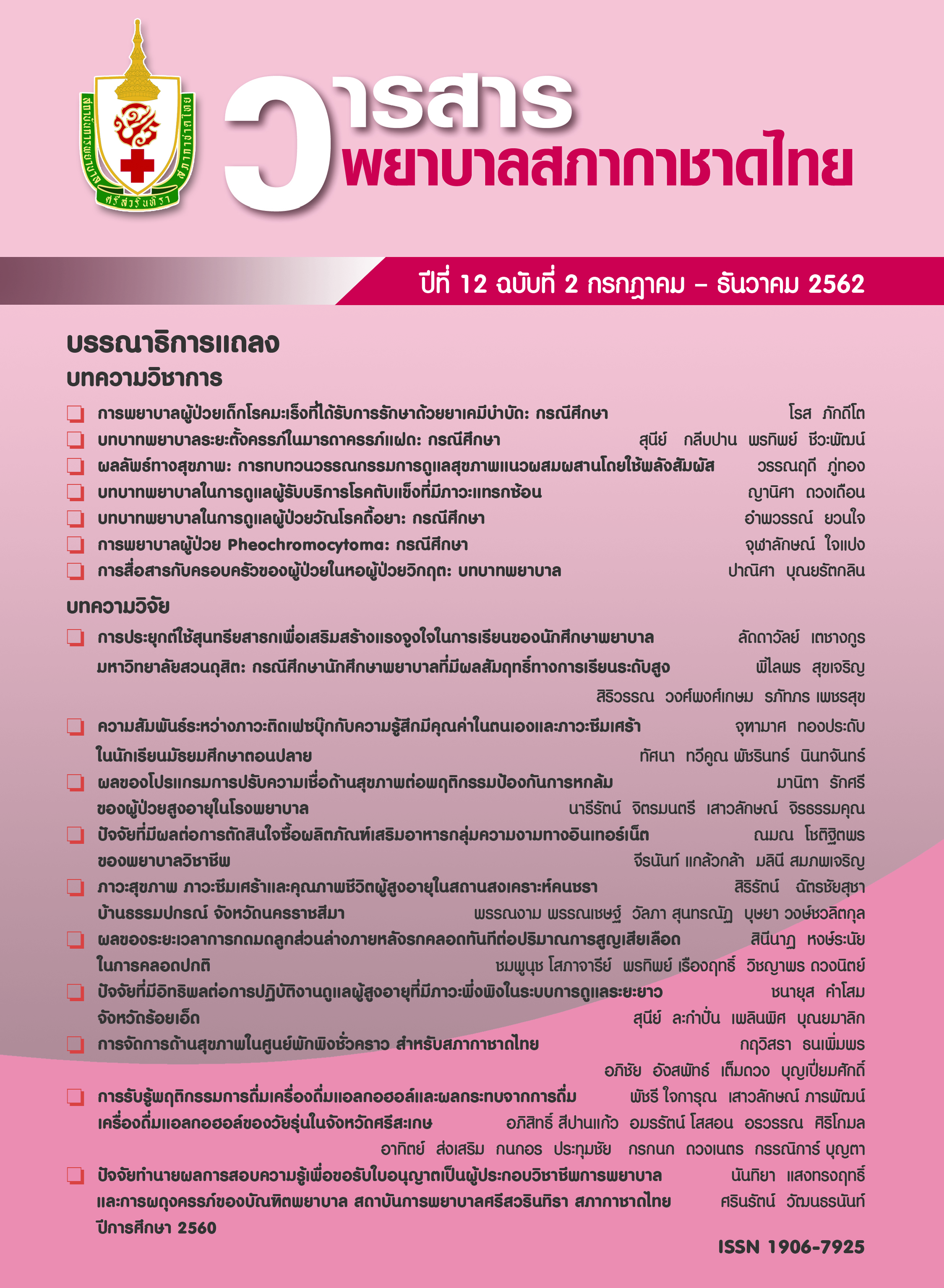
การประยุกต์ใช้สุนทรียสาธกเพื่อเสริมสร้างแรงจูงใจในการเรียน ของนักศึกษาพยาบาล มหาวิทยาลัยสวนดุสิต: กรณีศึกษานักศึกษาพยาบาลที่มีผลสัมฤทธิ์ทางการเรียนระดับสูง
คำสำคัญ:
แรงจูงใจในการเรียน, นักศึกษาพยาบาล, โปรแกรมสุนทรียสาธกบทคัดย่อ
การวิจัยนี้เพื่อประยุกต์ใช้สุนทรียสาธกในการเสริมสร้างแรงจูงใจในการเรียนของนักศึกษาพยาบาล ใช้การวิจัยเชิงคุณภาพด้วยการวิจัยเชิงปฏิบัติการแบบมีส่วนร่วม เลือกผู้ให้ข้อมูลสำคัญแบบเจาะจง คือ นักศึกษาพยาบาลชั้นปีที่ 1 ปีการศึกษา 2560 มหาวิทยาลัยสวนดุสิต ที่มีผลสัมฤทธิ์ทางการเรียนสูง 10 คน รวบรวมข้อมูล 2 เดือน โดยใช้กรอบสุนทรียสาธก เครื่องมือ ได้แก่ แนวคำถามที่ใช้ในการสนทนากลุ่ม สร้างความเชื่อถือได้ด้วยการตรวจสอบสามเส้าด้านบุคคลผู้ให้ข้อมูล วิธีรวบรวมข้อมูล และความตรงจากผู้ให้ข้อมูล ผลการวิจัย 4 ขั้นตอนของโปรแกรมสุนทรียสาธก ดังนี้ 1) ค้นหาประสบการณ์ โดยพบประสบการณ์ด้านแรงจูงใจในการเรียน 3 ประเด็น ได้แก่ ความต้องการพัฒนาตนเอง ความภาคภูมิใจของครอบครัว และความสำคัญของวิชาชีพพยาบาล 2) สร้างภาพฝันร่วมกัน โดยภาพฝันที่ทำให้เกิดแรงจูงใจในการเรียน ได้แก่ “การจบเป็นพยาบาลวิชาชีพที่มีคุณภาพในสี่ปี” 3) ออกแบบกิจกรรม โดยกิจกรรมที่เสริมสร้างแรงจูงใจในการเรียนมี 3 กิจกรรม ได้แก่ ด้านการเรียน สุขภาพ และการผ่อนคลาย และปัจจัยสนับสนุน ได้แก่ กำลังใจจากครอบครัว เพื่อน และอาจารย์ และ 4) ปฏิบัติกิจกรรม โดยมอบกิจกรรมให้ผู้ให้ข้อมูลสำคัญปฏิบัติ และผลลัพธ์จากการปฏิบัติ ได้แก่ ระบบการเรียนรู้ดีขึ้น ผลสัมฤทธิ์ทางการเรียนสูงขึ้น และความเครียดลดลง
Downloads
เอกสารอ้างอิง
2. Koawtrakul S. Education psychology. 11th ed. Bamgkok: CU print; 2013. (in Thai)
3. Sirisupluxana P. Teaching nursing students to develop critical thinking skills. The Journal of Boromarajonani College of Nursing, Nakhonratchasima 2013;19(2):5-19. (in Thai)
4. Saifan A, Aburuz EM, Masa R. Theory practice gaps in nursing education: A qualitative perspective. Journal of Social Sciences 2015;11(1):20-9.
5. Khalaila R. The relationship between academic self-concept, intrinsic motivation, test anxiety, and academic achievement among nursing students: Mediating and moderating effects. Nurse Educ Today 2015;35(3):432–8.
6. Mccomb AS, Kirkpatrick MJ. Impact of pedagogical approaches on cognitive complexity and motivation to learn: Comparing nursing and engineering undergraduate students. Nurs Outlook 2016;64:37-48.
7. Tohkani M, Tohkani D, Siriphan S, Tongkoop B. Academic internal motivation and professional nurses personality of nursing students in Three Border Provinces of Southern Thailand. Princess of Naradhiwas University Journal 2010;2(2):1-15. (in Thai)
8. Dupont SJ. Nursing faculty motivation to use high-fidelity simulation: an application of keller’s arcs model [dissertation]. Minneapolis, MN: Capella University; 2012.
9. Dolan K, Perz A, Mccomb S, Kirkpatrick J. Comparing undergraduate students’ cognitive complexity and motivation to learn. Industrial and Systems Engineering Research Conference 2013;538-45.
10. Kudo Y, Hayashi S, Yoshimura E, Shibuya A, Aizawa Y. Nursing students’ learning motivation toward technical knowledge and their ethics regarding patients’ rights. Tohoku J Exp Med 2013;230(1):33-42.
11. Parlett DK. A Comparison of Associate and Bachelor Degree Nursing Students’ Motivation. College of Social and Behavioral Sciences. [dissertation]. Minneapolis, MN: Walden University; 2012.
12. Hanifi N, Parvizy S, Joolaee S. Motivational journey of Iranian bachelor of nursing students during clinical education: a grounded theory study. Nurs and Health Sci 2013;15(3):340–5.
13. Ratthanapun P. What is Appreciative Inquiry, Who is using [Internet]. 2012 [cited 2016 April 14]. Availaber from: https://www.gotoknow.org/posts/314324; 2011. (in Thai)
14. Ridley-Duff JR, Duncan G. What is critical appreciation, insights from studying the critical turn in an appreciative inquiry. Human Relations 2015;68(10):1579–99.
15. Trajkovski S, Schmied V, Vickers M, Jackson D. Using appreciative inquiry to transform health care. Contemp Nurse 2013;45(1):95–100.
16. Watkins S, Dewar B, Kennedy C. Appreciative Inquiry as an intervention to change nursing practice in in-patient settings: an integrative review. Int J Nurs Stud 2016;60:179–190.
17. Lazic J, Radenovic M, Arnfield A, Janic D. Implementation of a nurse education programme in paediatric oncology using appreciative inquiry: a single center experience in Belgrade, Serbia. Eur J Oncol Nurs 2011;15(5):524-7.
18. Tosati S, Lawthong N, Suwanmonkha S. Development of an appreciative inquiry and assessment processes for students’ self-knowing and self-development. Procedia Soc Behav Sci 2015;191:753–8.
19. Coon D, Mitterer JO. Introduction to pshchology: gateways to mind and behaviour.
11th ed. Belmont: Wadsworth; 2013.
20. Lemos SM,Verissimo L. The relationships between intrinsic motivation. extrinsic motivation, and achievement. along elementary school. Procedia Soc Behav Sci 2014;112:930-8
21. Cheng M, Cheng C, Tian y, Fan X. Student nurses motivation to choose gerontological nursing as a career in China: a survey study. Nurse Educ Today 2015;35(7):843-8.
22. Chidmongkol R, Boribal P. Factors affecting achievement motivation of nursing students at the Boromarajonani College of Nursing, Udonthani. Nursing Journal of the Ministry of Public Health 2010;98-108. (in Thai)
23. Vatankhah M, Tanbakooei N. The role of social support on intrinsic and extrinsic motivation among Iranian EFL learners. Procedia Soc Behav Sci 2014;98:1912–8.
24. Kunsuk K. Creating a set of activities to develop thinking skills using concept mapping Group learning science Grade 4, Ban Dong Khu School Si Satchanalai District Sukhothai Province. [dissertation]. Uttaradit: Uttaradit Rajabhat University; 2008. (in Thai)
25. Kintsch W. Comprehension: A paradigm for cognition. Cambridge, UK: Cambridge University Press; 1998.
26. Binder J. Locus of control and academic achievement motivation as predictors of student success in reading developmental education. College of Social and Behavioral Sciences [dissertation]. Minneapolis, MN: Walden University; 2014.
27. Cress VC, Lampman C. Hardiness, stress, and health-promoting behaviors among college students. Psi Chi J Undergrad Res 2007;12(1):18-23.
28. Tantalanukul S, Wongsawat P. Stress and stress management in nursing students. Boromarajonani College of nursing, Uttaradit Journal 2017;9(1):81-92. (in Thai)
29. Soowit B. Learning process for the holistic self-development [dissertation]. Bangkok: Srinakharinwirot University; 2013. (in Thai)
ดาวน์โหลด
เผยแพร่แล้ว
รูปแบบการอ้างอิง
ฉบับ
ประเภทบทความ
สัญญาอนุญาต
เนื้อหาบทความหรือข้อคิดเห็นต่างๆ ในวารสารพยาบาลสภากาชาดไทยนี้ เป็นความคิดเห็นของผู้เขียนบทความ ไม่ใช่ความเห็นของกองบรรณาธิการ หรือสถาบันการพยาบาลศรีสวรินทิรา สภากาชาดไทย


