
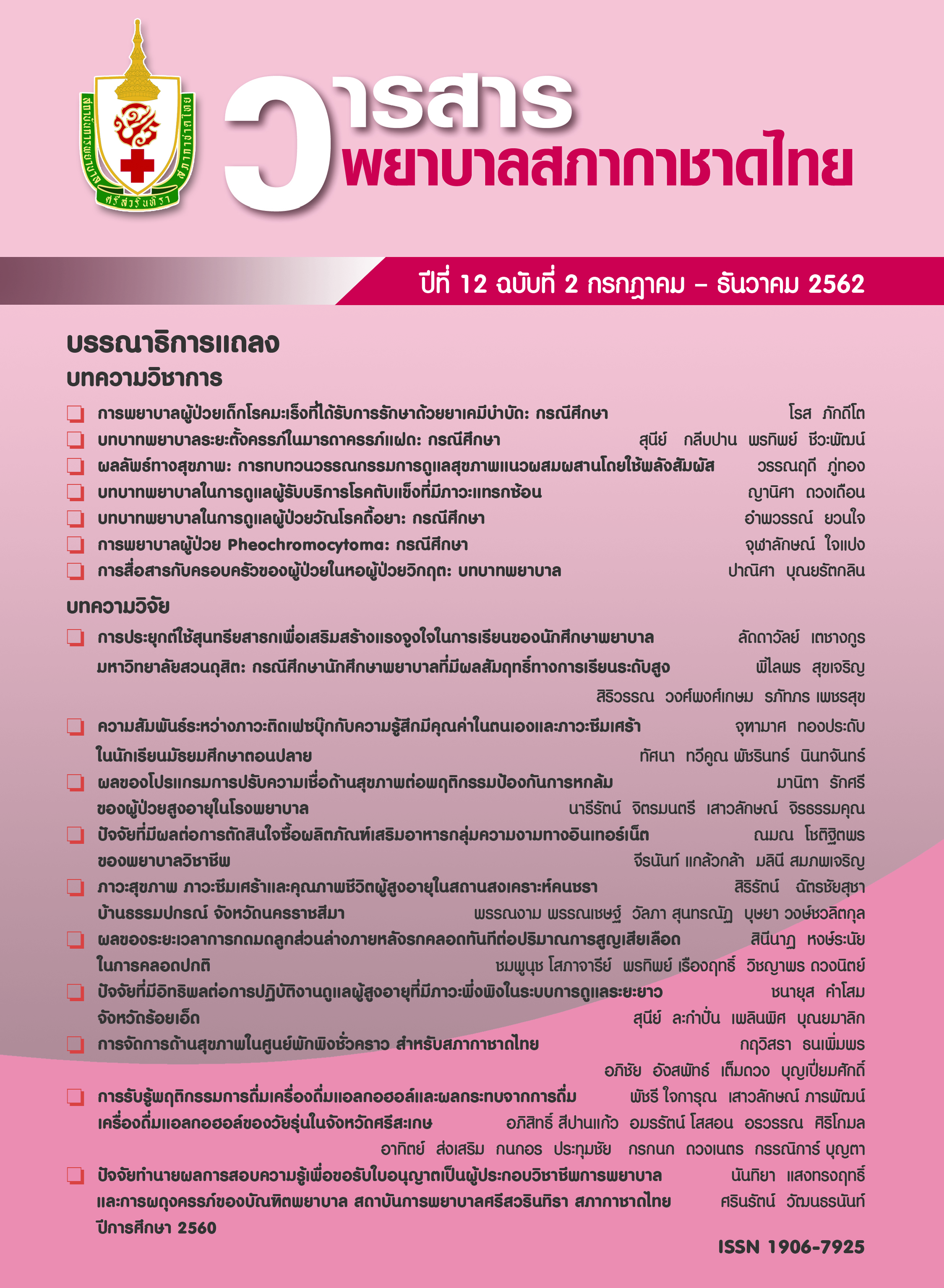
ผลของโปรแกรมการปรับความเชื่อด้านสุขภาพต่อพฤติกรรม ป้องกันการหกล้มของผู้ป่วยสูงอายุในโรงพยาบาล
คำสำคัญ:
โปรแกรมการปรับความเชื่อด้านสุขภาพ, พฤติกรรมป้องกันการหกล้ม, ผู้ป่วยสูงอายุใน โรงพยาบาล, แนวคิดแบบแผนความเชื่อด้านสุขภาพบทคัดย่อ
การวิจัยครั้งนี้มีเป็นการศึกษากึ่งทดลองชนิดสองกลุ่มวัดผลหลังการทดลอง เพื่อศึกษาผลของโปรแกรมการปรับความเชื่อด้านสุขภาพต่อพฤติกรรมป้องกันการหกล้มของผู้ป่วยสูงอายุในหอผู้ป่วยศัลยกรรม โรงพยาบาลจุฬาลงกรณ์ ระหว่างเดือนพฤษภาคม พ.ศ.2559 ถึง กุมภาพันธ์ พ.ศ.2561 กลุ่มตัวอย่างเป็นผู้สูงอายุ จำนวน 62 คน คัดเลือกกลุ่มตัวอย่างตามเกณฑ์ แบ่งเป็นกลุ่มควบคุมและกลุ่มทดลอง กลุ่มละ 31 คน กลุ่มควบคุมได้รับการดูแลตามปกติ กลุ่มทดลองได้รับโปรแกรมการปรับความเชื่อด้านสุขภาพที่พัฒนาตามแนวคิด Health Belief Model ประกอบด้วย การประเมินโอกาสและปัจจัยเสี่ยงต่อการหกล้ม การให้ความรู้โดยใช้สื่อมัลติมีเดีย การสาธิตและการฝึก การติดป้ายเตือน เครื่องมือที่ใช้ในการเก็บรวบรวมข้อมูลประกอบด้วย แบบสัมภาษณ์ข้อมูลส่วนบุคคล แบบประเมินพฤติกรรมป้องกันการหกล้มของผู้ป่วยสูงอายุในโรงพยาบาล วิเคราะห์ข้อมูลโดยใช้สถิติเชิงพรรณนาและ Chi-square เปรียบเทียบความแตกต่างของค่าเฉลี่ยคะแนนพฤติกรรมป้องกันการหกล้มของกลุ่มทดลองและกลุ่มควบคุมด้วยสถิติ Independent t-test
ผลการวิจัย พบว่า กลุ่มทดลองที่ได้รับโปรแกรมการปรับความเชื่อด้านสุขภาพ มีคะแนนเฉลี่ยสูงกว่ากลุ่มควบคุมอย่างมีนัยสำคัญทางสถิติ ( t = 10.42, p < .001 ) ผลการศึกษานี้แสดงให้เห็นว่าผู้ป่วยสูงอายุที่ได้รับโปรแกรมฯ มีพฤติกรรมการป้องกันการหกล้มดีกว่าผู้ป่วยสูงอายุที่ไม่ได้รับโปรแกรม ดังนั้นหอผู้ป่วยศัลยกรรมควรนำโปรแกรมนี้ไปใช้เพื่อป้องกันการหกล้มในผู้ป่วยสูงอายุ
Downloads
เอกสารอ้างอิง
2. Spoelstra SL, Given BA, Given CW. Fall prevention in hospitals: an integrative review. Clin Nurs Res 2012;21(1):92-112.
3. Choi YS, Lawler E, Boenecke CA, Ponatoski ER, Zimring CM. Developing a multi-systemic fall prevention model, incorporating the physical environment, the care process and technology: a systematic review. J Adv Nurs 2011;67(12):2501-24.
4. The Institute of Medicine and the Elderly Department of Medicine The Ministry of Public Health. Patterns of falling prevention in the elderly [Internet]. 2012 [cited 2015 jan 15]. Available from: www.agingthai.org. (in Thai)
5. Haines TP, Hill AM, Hill KD, McPhail S, Oliver D, Brauer S, et al. Patient education to prevent falls among older hospital inpatients a randomized controlled trial. Arch Intern Med 2011;171(6):516-24.
6. Ungar A, Rafanelli M, Iacomelli I, Brunetti MA, Ceccofiglio A, Tesi F, et al. Fall prevention in the elderly. Clin Cases Miner Bone Metab 2013;10(2):91-5.
7. Tzeng HM, Yin CY. Toileting-related inpatient falls in adult acute care settings. Medsurg Nurs 2012;21(6):372-7.
8. The Institute of Medicine and the Elderly Department of Medicine, The Ministry of Public Health. Medical practice guidelines prevention / assessment falls in the elderly [Internet]. 2008 [cited 2014 Dec 12]. Available from: http://agingthai.dms.moph.go.th/agingthai/download/book
9. Hong HJ, Kim NC, Jin Y, Piao J, Lee SM. Trigger factors and outcomes of falls among Korean hospitalized patients: analysis of electronic medical records. Clin Nurs Res 2015;24(1):51-72.
10. Tasuwanin T, Tappakit K. Effects of a falling prevention program for elderly. Journal of Nursing and Health Care 2017;35(3):186-95. (in Thai)
11. Nassar N, Helou N, Madi C. Predicting falls using two instruments (the Hendrich Fall Risk Model and the Morse Fall Scale) in an acute care setting in Lebanon. J Clin Nurs 2014;23(11-12):1620-9.
12. Rowe RJ. Preventing patient falls: what are the factors in hospital settings that help reduce and prevent inpatient falls? 2012. Home Health Care Manag Pract 2013;25(3)3:98-103.
13. Sheth HS, Faust-Smith K, Sanders JL, Palmer RM. Screening for injurious falls in acute care hospitals. J Patient Saf 2013;9(1):24-8.
14. Trepanier S, Hilsenbeck J. A hospital system approach at decreasing falls with injuries and cost. Nurs Econ 2014;32(3):135-41.
15. Cahill S, Stancliffe RJ, Clemson L, Durvasula S. Reconstructing the fall: individual, behavioural and contextual factors associated with falls in individuals with intellectual disability. J Intellect Disabil Res 2014;58(4):321-32.
16. Yau S. Analysis on the high risk factors for elderly fall in hospital settings [Internet]. 2017 [cited 2018 May 28]. Available from: http://www3.ha.org.hk/haconvention/hac2017/proceedings/downloads/F8.7.pdf2017.
17. Cameron ID, Gillespie LD, Robertson MC, Murray GR, Hill KD, Cumming RG, Kerse N. Interventions for preventing falls in older people in care facilities and hospitals. Cochrane Database Syst Rev 2012;12:CD005465.
18. Hempel S, Newberry S, Wang Z, Booth M, Shanman R, Johnsen B, et al. Hospital fall prevention: a systematic review of implementation, components, adherence, and effectiveness. J Am Geriatr Soc 2013;61(4):483-94.
19. Muangsiri M, Maharachpong N, Rodjarkpai Y. Factors relating the behavior of fall prevention among elderly in Chonburi province. Naresuan University Journal: Science and Technology. 2017;4(25):23-33. (in Thai)
20. Pongpaew S. Predictive factors of fall prevention behaviors among older adults, Nontaburi province [dissertation]. Bangkok: Mahidol University; 2013. (in Thai)
21. Maipimai W. The relationships between perceived susceptibility, perceived severity, fear of falling, and fall preventive behaviors in older fallers [dissertation]. Bangkok: Mahidol University; 2013. (in Thai)
22. Sarapun A, Sirisopon N, Kainaka P, Onsiri S, Outayanik B, Threrawachjareanchai S, Sukomol N. Factors ralated to a fall prevention behaviors of elderly. Journal of The Royal Thai Army Nurses 2017;18:215-22. (in Thai)
23. Rosenstock IM, Strecher VJ, Becker MH. Social learning theory and the Health Belief Model. Health Educ Q 1988;15(2):175-83.
24. Thiya N. Fall prevention related behavior among elder patients seeking treatment at female trauma ward of Pramongkutkloa hospital [dissertation]. Bangkok: Kasetsart University; 2008.
(in Thai)
25. CDC. Talking about fall prevention with your patients [Internet]. 2017 [cited 2018 Jun 15]. Available from: https://www.cdc.gov/steadi/pdf/Talking_about_Fall_Prevention_with_Your_Patients-print.pdf.
26. Wayo W. The effect of multifactorial fall prevention program on fall prevention behavior among community-dwelling older adults [dissertation]. Bangkok: Mahidol University; 2016.
27. Lee DC, McDermott F, Hoffmann T, Haines TP. 'They will tell me if there is a problem': limited discussion between health professionals, older adults and their caregivers on falls prevention during and after hospitalization. Health Educ Res 2013;28(6):1051-66.
28. Hill AM, McPhail SM, Francis-Coad J, Waldron N, Etherton-Beer C, Flicker L, et al. Educators' perspectives about how older hospital patients can engage in a falls prevention education programme: a qualitative process evaluation. BMJ Open 2015;5(12):e009780.
29. Hill AM, Waldron N, Francis-Coad J, Haines T, Etherton-Beer C, Flicker L, et al. 'It promoted a positive culture around falls prevention': staff response to a patient education programme-a qualitative evaluation. BMJ Open 2016;6(12):e013414.
30. Moura LA, Araújo JNdM, Fernandes APNdL, Araújo MGd, Silva ABd, Olímpio JdA, et al. Fall prevention behavior among hospitalized elderly patients. Int Arch Med 2016;9(57):1-9.
31. Masawang S, Chanthapasa K. Patient rights: meaning in lay’s perspective under local culture context. Isan Journal of Pharmaceutical Sciences 2014;9(Suppl):122-6. (in Thai)
ดาวน์โหลด
เผยแพร่แล้ว
รูปแบบการอ้างอิง
ฉบับ
ประเภทบทความ
สัญญาอนุญาต
เนื้อหาบทความหรือข้อคิดเห็นต่างๆ ในวารสารพยาบาลสภากาชาดไทยนี้ เป็นความคิดเห็นของผู้เขียนบทความ ไม่ใช่ความเห็นของกองบรรณาธิการ หรือสถาบันการพยาบาลศรีสวรินทิรา สภากาชาดไทย


