
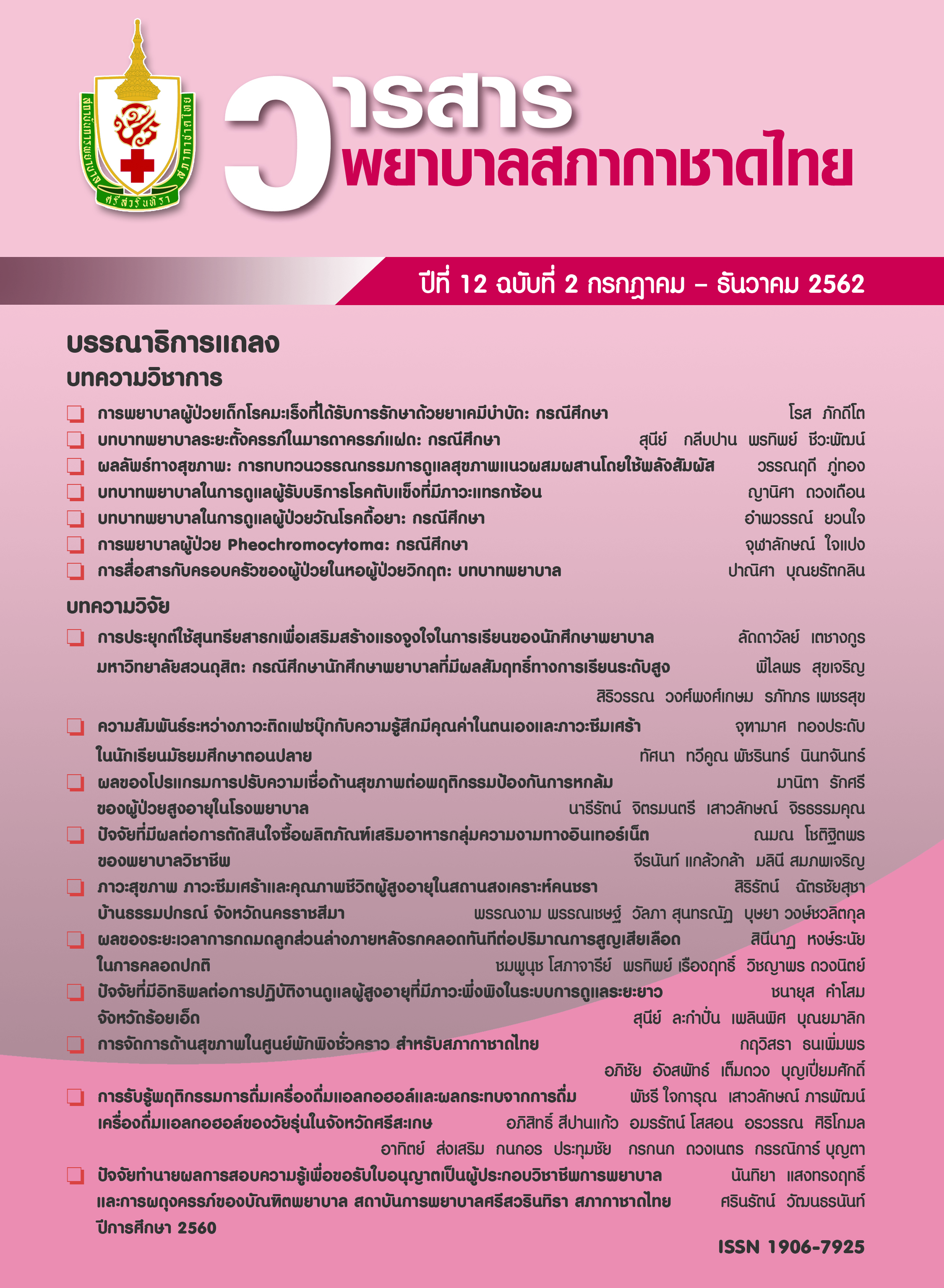
ปัจจัยที่มีอิทธิพลต่อการปฏิบัติงานดูแลผู้สูงอายุที่มีภาวะพึ่งพิง ในระบบการดูแลระยะยาว จังหวัดร้อยเอ็ด
คำสำคัญ:
ผู้ดูแลผู้สูงอายุ, การดูแลผู้สูงอายุ, ผู้สูงอายุที่มีภาวะพึ่งพิง, ระบบการดูแลระยะยาวบทคัดย่อ
ผู้สูงอายุที่มีภาวะพึ่งพิงในประเทศไทยมีจำนวนเพิ่มขึ้น ส่งผลให้มีการพัฒนาระบบการดูแลระยะยาวโดยผู้ดูแลผู้สูงอายุในชุมชน การวิจัยเชิงพรรณนานี้ วัตถุประสงค์เพื่อศึกษาการปฏิบัติงานดูแลผู้สูงอายุที่มีภาวะพึ่งพิงของผู้ดูแลในระบบการดูแลระยะยาว และปัจจัยที่มีอิทธิพล กลุ่มตัวอย่างคือผู้ดูแลผู้สูงอายุที่มีภาวะพึ่งพิง 180 คน ที่สุ่มจากพื้นที่นำร่อง 23 แห่งของจังหวัดร้อยเอ็ด เก็บรวบรวมข้อมูลลักษณะทั่วไปและตัวแปรที่ศึกษา ด้วยการสัมภาษณ์ตามโครงสร้างคำถามที่ผู้วิจัยพัฒนาโดยประยุกต์กรอบแนวคิดเชิงนิเวศน์ของ McLeroy วิเคราะห์ข้อมูลด้วยสถิติพรรณนา Eta สัมประสิทธิ์สหสัมพันธ์ของเพียร์สัน และการวิเคราะห์ถดถอยพหุคูณแบบขั้นตอน
ผลการวิจัยพบว่า ผู้ดูแลผู้สูงอายุที่มีภาวะพึ่งพิงในจังหวัดร้อยเอ็ด ส่วนใหญ่ปฏิบัติงานดูแลผู้สูงอายุที่มีภาวะพึ่งพิงในระดับที่ดี (ร้อยละ 98.33) ด้านที่ปฏิบัติมากที่สุดคือ ด้านการป้องกันอุบัติเหตุ
(= 9.03, S.D. = 0.85) และด้านที่ปฏิบัติน้อยที่สุด คือ ด้านสุขภาพจิต (
= 7.97, S.D. = 1.37) ปัจจัยที่มีอิทธิพลต่อการปฏิบัติงานดูแลผู้สูงอายุที่มีภาวะพึ่งพิงในระบบการดูแลระยะยาว ได้แก่ การสนับสนุนจากครอบครัว อาชีพเกษตรกรรม การได้รับการยอมรับจากชุมชน เพศหญิง อายุ การติดตามงานจากผู้จัดการระบบการดูแลระยะยาวด้านสาธารณสุข เจตคติ และความรู้ในการดูแลผู้สูงอายุที่มีภาวะพึ่งพิง สามารถอธิบายความผันแปรของการปฏิบัติงานดูแลผู้สูงอายุที่มีภาวะพึ่งพิงได้ร้อยละ 64.8 (p < .001)
ผลการศึกษาเสนอแนะว่า ผู้จัดการระบบการดูแลระยะยาว หรือพยาบาลวิชาชีพที่รับผิดชอบงานดูแลผู้สูงอายุ ควรพิจารณาและประยุกต์ปัจจัยที่มีอิทธิพลเหล่านี้ในการเสริมสร้างสมรรถนะในการปฏิบัติงานดูแลผู้สูงอายุที่มาภาวะพึ่งพิง เพื่อให้ผู้ดูแลสามารถปฏิบัติงานดูแลผู้สูงอายุที่มีภาวะพึ่งพิงให้มีประสิทธิภาพต่อไป
Downloads
เอกสารอ้างอิง
2. United Nations, Department of Economic and Social Affairs. World population ageing 2015. New York: United Nations, Department of Economic and Social Affairs, Population Division; 2015.
3. Foundation of Thai Gerontology Research and Development Institute. Situation of the Thai elderly 2015 [Internet]. 2016 [cited 2017 Apr 5]. Avilable from: https://www.m-society.go.th/article_attach/16057/19114.pdf (in Thai)
4. Roi Et Provincial Public Health Office. Report of 2nd health government evaluation 2016 Health Area 7. Roi Et: Roi Et Provincial Public Health Office, Depaetment of Stragetegy; 2016. (In Thai)
5. He W, Goodkind D, Kowal P. An aging world: 2015: international population reports. Washington: U.S. Government Publishing Office; 2016.
6. National Academies of Sciences Engineering and Medicine. Families caring for an aging America [Internet]. Washington, DC: The National Academies Press; 2016 [cited 2017 Mar 21 ]. Available from: http://www.johnahartford.org/images/uploads/reports/Family_Caregiving_Report_National_Academy_of_Medicine_IOM.pdf
7. The National Alliance for Caregiving AARP Public Policy Institute. Caregiving in the U.S. 2015 - focused look at caregivers of adults age 50+. n.p.: The National Alliance for Caregiving (NAC) and AARP Public Policy Institute; 2015.
8. Nation Health Security Office. Manual of long term care management in nation health system [Internet]. Bangkok: NHSO; 2016 [cited 2017 Apr 5]. Available from: www.nhso.go.th (in Thai)
9. Tepin W. Bio-social factors associated with geriatric health care behavior by geriatric caregivers. Bangkok: Graduate school of Srinakarinwirot University; 2010. (in Thai)
10. Suwanrada W, Pothisiri W, Siriboon S, Bangkaew B, Milintangul C. Evaluation of the replication project of the elderly home care volunteers. Bangkok: College of Population Studies, Chulalongkorn University; 2014. (in Thai)
11. Muenhor C, Poonpol S. Factors associated with the caregivers, role in caring for the elderly in Nakhon Phanom Province Nakhon Phanom University Journal [Internet]. 2016 [cited 2017 Apr 5];6(1):79-86. Available form: https://www.tci-thaijo.org/index.php/npuj/article/download/53359/44293 (in Thai)
12. Ruejanjob S. Predictors of health care behaviors for the elderly among caregivers in warinchamrap district, ubonratchathani province. Journal of Nursing, Public Health and Education [Internet]. 2016 [cited 2017 Mar 21];17(2):71-84. Available from: https://www.tci-thaijo.org/index.php/bcnpy/article/view/70354 (in Thai)
13. McLeroy K, Daniel B, Allan S, Glanz K. An ecological perspective on health promotion programs. Health Education Quarterly [Internet]. 1988 [cited 2017 Mar 21];15(4):351-77. Available from: https://www.academia.edu/170661/An_Ecological_Perspective_on_Health_Promotion_Programs
14. Bureau of Health Promotion. Manual of 70 hours training for elderly caregiver [Internet]. Bangkok: National Buddha Press; 2013 [cited 2017 Mar 21]; Available form:
http://hp.anamai.moph.go.th/ewt_dl_link.php?nid=419. (in Thai)
15. Srisatitnarakool B. Nursing research methodology. Bangkok: U & I Inter Media Press; 2007. (in Thai)
16. Jang S-N, Avendano M, Kawachi I. Informal Caregiving Patterns in Korea and European Countries: A Cross-National Comparison. Asian Nursing Research 2012;6:19-26.
17. Kroda S. Work-Life conflict in the intermediate age bracket: trends in working hours and time spent caring for elderly family members. Japan Labor Review [Internet]. 2016 [cited Apr 5];33(1):55-72. Available from: http://www.jil.go.jp/english/JLR/documents/2016/JLR49_kuroda.pdf.
18. Lagaé M, Tanguay A, Lavallée M-L, Laplante J, Robichaud S. The silent impact of ageist communication in long term care facilities: elders' perspectives on quality of life and coping strategies. J Aging Stud 2012;26(3):335-42.
19. Izal M, Montorio I, Marquez M, Losada A. Caregivers' expectations and care receivers' competence Lawton's ecological model of adaptation and aging revisited. Arch Gerontol Geriatr 2005;41(2):129-40.
20. Pankong O, Khampeng S. Effects of community-based health promotion program on health-promotion program on health promoting behavior of older persons and satisfaction with the participation of older persons’ caregivers. Rama Nurs J [Internet]. 2553 [cited 2017 Apr 5];16(1):1-13. Available from: https://www.tci-thaijo.org
/index.php/RNJ/article/view/8885 (in Thai)
ดาวน์โหลด
เผยแพร่แล้ว
รูปแบบการอ้างอิง
ฉบับ
ประเภทบทความ
สัญญาอนุญาต
เนื้อหาบทความหรือข้อคิดเห็นต่างๆ ในวารสารพยาบาลสภากาชาดไทยนี้ เป็นความคิดเห็นของผู้เขียนบทความ ไม่ใช่ความเห็นของกองบรรณาธิการ หรือสถาบันการพยาบาลศรีสวรินทิรา สภากาชาดไทย


