
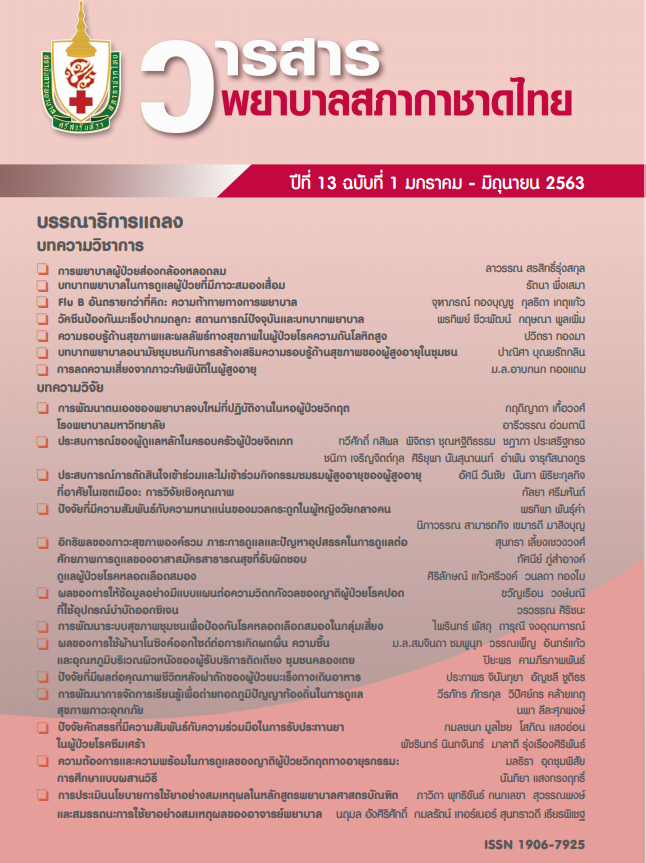
ประสบการณ์ของผู้ดูแลหลักในครอบครัวผู้ป่วยจิตเภท
คำสำคัญ:
ประสบการณ์, โรคจิตเภท, ผู้ดูแลหลักบทคัดย่อ
การวิจัยนี้มีวัตถุประสงค์เพื่อศึกษาประสบการณ์ของผู้ดูแลหลักในครอบครัวผู้ป่วยจิตเภท ด้านการรับรู้ต่อการเจ็บป่วย การสื่อสารภายในครอบครัว โดยใช้ทฤษฎีสัมพันธภาพระหว่างบุคคลของเพบพลาว และการแสวงหาการให้บริการด้านสุขภาพจิต ใช้การวิจัยเชิงปรากฏการณ์วิทยาเชิงพรรณนา โดยวิธีการสัมภาษณ์เชิงลึกร่วมกับการสังเกตอย่างมีส่วนร่วมในผู้ดูแลหลักในครอบครัวผู้ป่วยที่ได้รับการวินิจฉัยว่าเป็นโรคจิตเภทชนิดหวาดระแวง ที่รับการรักษาในโรงพยาบาลจิตเวชแห่งหนึ่ง จำนวน 13 คน ส่วนใหญ่มีอายุเฉลี่ย 51.62 (±16.63) ปี เป็นเพศชาย 5 คน เพศหญิง 8 คน มีความสัมพันธ์เป็นพ่อแม่มากสุด 9 คนและไม่ได้ประกอบอาชีพ มีระยะเวลาดูแลผู้ป่วยจิตเภทโดยเฉลี่ย 11.58 ปี ผลการวิเคราะห์เชิงเนื้อหาสามารถจำแนกได้เป็น 3 ประเด็นหลัก ได้แก่ 1) ประสบการณ์ของผู้ดูแลหลักต่อการรับรู้ว่าสมาชิกในครอบครัวป่วยเป็นโรคจิตเภทครั้งแรกจะรู้สึกกังวลใจในระดับสูง เนื่องจากขาดความรู้เกี่ยวกับโรคจิตเภท 2) วิธีการสื่อสารในครอบครัวระยะแรกมีการแสดงออกทางอารมณ์สูง 3) การจัดเตรียมผู้ดูแลและสถานที่ดูแลผู้ป่วยจิตเภทในระยะยาวเป็นสิ่งสำคัญสำหรับผู้ดูแลในวัยสูงอายุ ดังนั้นพยาบาลจิตเวชจะต้องลดความวิตกกังวลของผู้ดูแล โดยการสร้างสัมพันธภาพระหว่างบุคคล และเน้นการเข้าถึงการให้บริการจิตเวชในครอบครัวผู้ป่วยอย่างต่อเนื่อง
Downloads
เอกสารอ้างอิง
2. Valencia M, Fresán A, Barak Y, Juárez F, Escamilla R, Saracco R. Predicting functional remission in patients with schizophrenia: a cross-sectional study of symptomatic remission, psychosocial remission, functioning and clinical outcome. Neuropsychiatr Dis Treat 2015;11:2339-48.
3. Trangkasombat U. Family counselling and psychotherapy. 6th ed. Bangkok: Sunta Printing; 2011. (in Thai)
4. Saunders JC. Families living with severe mental illness: a literature review. Issues Ment Health Nurs 2003;24(2):175-98.
5. Ferriter M, Huband N. Experiences of parents with a son or daughter suffering from schizophrenia. J Psychiatr Ment Health Nurs 2003;10(5): 552-60.
6. Jungbauer J, Wittmund B, Dietrich S, Angermeyer MC. The disregarded caregivers: subjective burden in spouses of schizophrenia patients. Schizophr Bull 2004;30(3):665-75.
7. Mizuno E, Iwasaki M, Sakai I. Subjective experiences of husbands of spouses with schizophrenia: an analysis of the husbands’ descriptions of their experiences. Arch Psychiatr Nurs 2011;25(5):366-75.
8. Angermeyer MC, Schuleze B, Dietrich S. Courtesy stigma - a focus group study of relatives of schizophrenia patients. Soc Psychiatry Psychiatr Epidemiol 2003;38(10): 593-602.
9. Smith GC. Patterns and predictors of service use and unmet needs among aging families of adults with severe mental illness. Psychiatr Serv 2003;54(6):871-7.
10. Keltner NL, Steele D, editors. Psychiatric Nursing. 7th ed. St. Louis Missouri: Elsevier Mosby; 2015.
11. Walsh F. New perspectives on schizophrenia and families. In: Walsh F, Anderson C., editors. Chronic disorders and the family. New York: Haworth Press; 1988. p.19-32.
12. Smoyak SA. The construction of reality or the deconstruction of the self. J Psychosoc Nurs Ment Health Serv 2004;42(11):6-7.
13. Asher L, De Silva M, Hanlon C, Weiss HA, Birhane R, Ejigu DA, et al. Community-based rehabilitation intervention for people with schizophrenia in Ethiopia (RISE): a study protocol for a cluster randomized controlled trial. Trials 2016;17(1):299.
14. Oumtanee A. Qualitative research in nursing. 3rd ed. Bangkok: Chulalongkorn University Printing House; 2016. (in Thai)
15. Mizunoa E, Takatayab K, Kamizawaa N, Sakaia I, Yamazakic Y. Female families' experiences of caring for persons with schizophrenia. Arch Psychiatr Nurs 2013;27(2): 72-7.
16. Chantavanich S. Qualitative research methods. 15th ed. Bangkok: Chulalongkorn University Press; 2007. (in Thai)
17. Kanungpiarn T. Experience of caregivers in caring for people with schizophrenia in community. Journal of Nursing Division 2013; 40(1):57-66. (in Thai)
18. Peplau HE. Interpersonal relations in nursing. New York: GP Putnam’s Sons; 1952.
19. Saunder JC, Byrne MM. A thematic analysis of families living with schizophrenia. Arch Psychiatr Nurs 2002;16(5):217-23.
20. Venkatesh BT, Andrews T, Parsekar SS, Singh MM, Menon N. Stigma and mental health-caregivers’ perspective: a qualitative analysis. Clin Epidemiol Glob Health 2016;4(1):23-7.
21. Arboleda–Florez J, Stuart H. From sin to science: fighting the stigmatization of mental illness. Can J Psychiatry 2012; 57(8): 457-63.
22. Suwannaboon W. Effects of interpersonal group therapy on quality of life among schizophrenia patients. [dissertation]. Chonburi: Burapha University; 2014. (in Thai)
23. Huttapanom W. Handbook of therapeutic relationship. Khon Kaen: Phra Thammakun; 2005. (in Thai)
24. Lohacheewa S. Stress and effect of stress on family members with a relative with first-episode schizophrenia: the nursing role. Thai Red Cross Nursing Journal 2018;11(1):60-7. (in Thai)
25. Olwit C, Musisi S, Leshabari S, Sanyu I. Chronic sorrow: lived experiences of caregivers of patients diagnosed with schizophrenia in Butabika Mental Hospital, Kampala, Uganda. Arch Psychiatr Nurs 2015;29(1):43-8.
ดาวน์โหลด
เผยแพร่แล้ว
รูปแบบการอ้างอิง
ฉบับ
ประเภทบทความ
สัญญาอนุญาต
เนื้อหาบทความหรือข้อคิดเห็นต่างๆ ในวารสารพยาบาลสภากาชาดไทยนี้ เป็นความคิดเห็นของผู้เขียนบทความ ไม่ใช่ความเห็นของกองบรรณาธิการ หรือสถาบันการพยาบาลศรีสวรินทิรา สภากาชาดไทย


