
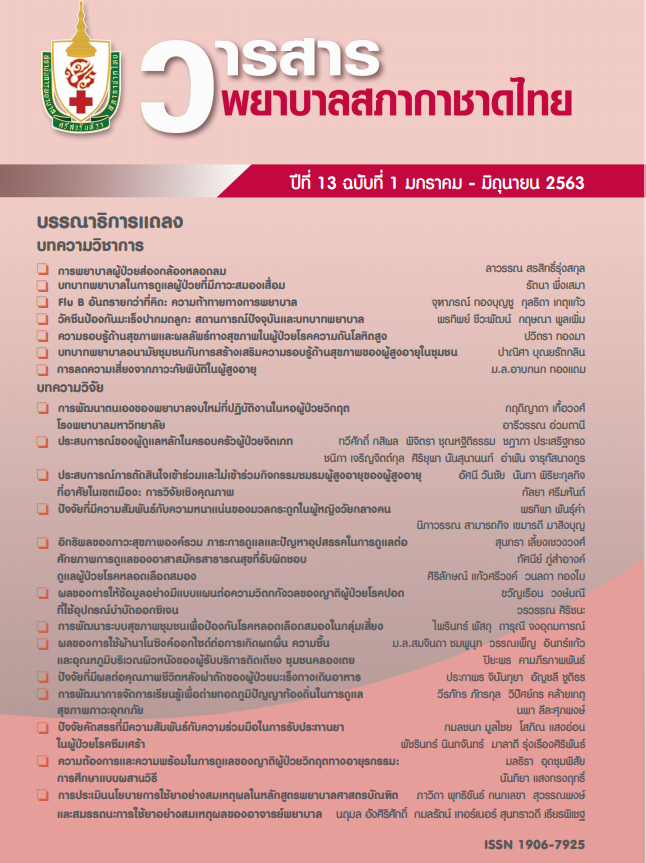
การพัฒนาระบบสุขภาพชุมชนเพื่อป้องกันโรคหลอดเลือดสมองในกลุ่มเสี่ยง
คำสำคัญ:
ระบบสุขภาพชุมชน, ป้องกัน, โรคหลอดเลือดสมอง, กลุ่มเสี่ยงบทคัดย่อ
การศึกษาวิจัยเชิงปฏิบัติการ (action research) ครั้งนี้เพื่อพัฒนาระบบสุขภาพชุมชนในการป้องกันโรคหลอดเลือดสมองของกลุ่มเสี่ยงใน 2 ตำบลของอำเภอท่าเรือ จังหวัดพระนครศรีอยุธยา โดยผู้ร่วมวิจัยเป็นกลุ่มเสี่ยงโรคหลอดเลือดสมอง มีค่าคะแนนความเสี่ยง Thai CV risk score ตั้งแต่ระดับปานกลางขึ้นไป และผู้เกี่ยวข้องในชุมชน ได้แก่ สมาชิกครอบครัว ผู้นำชุมชน และเจ้าหน้าที่ทางสุขภาพ โดยใช้วิธีการเก็บข้อมูลด้วยการสัมภาษณ์เชิงโครงสร้าง (structured interviews) การสนทนากลุ่ม (semi-structured interviews) และสัมภาษณ์เชิงลึก (In-depth interviews) สังเกตอย่างมีส่วนร่วม (participant observation) และบันทึกภาคสนาม (field notes) ใช้การวิเคราะห์ข้อมูลเชิงปริมาณสำหรับข้อมูลทั่วไปด้วยสถิติเชิงพรรณนา และวิเคราะห์ข้อมูลเชิงคุณภาพโดยการวิเคราะห์เนื้อหา (content analysis)
ดำเนินการวิจัยตั้งแต่เดือนมกราคม พ.ศ. 2561–เดือนกันยายน พ.ศ. 2561 โดยเริ่มจากการศึกษาสถานการณ์ บริบท วัฒนธรรม พฤติกรรมป้องกันโรคหลอดเลือดสมองของกลุ่มเสี่ยง ข้อจำกัด กิจกรรมการป้องกันโรค นโยบายแผนงาน ระบบสนับสนุน ปัญหา อุปสรรค บทบาทหน้าที่บุคคล และองค์กรที่เกี่ยวข้อง จุดอ่อนจุดแข็งภายในชุมชน คัดเลือกปัญหา และร่วมกันวางแผน ปฏิบัติตามแผนงาน รวมทั้งประเมินผลการเปลี่ยนแปลง โดยผู้วิจัยเข้าไปกระตุ้นให้เกิดการเปลี่ยนแปลงในชุมชน ทำให้กลุ่มเสี่ยง สมาชิกครอบครัว และผู้เกี่ยวข้องในชุมชน ได้แก่ อาสาสมัครสาธารณสุข ผู้ใหญ่บ้าน กำนัน องค์การปกครองส่วนท้องถิ่น เจ้าหน้าที่สาธารณสุข และพยาบาลวิชาชีพ เกิดความร่วมมือในการพัฒนาระบบสุขภาพชุมชนร่วมกันเพื่อแก้ปัญหาของกลุ่มที่เกิดขึ้นในทุกขั้นตอนของการวิจัย ผลการวิจัยพบว่าเกิดการเปลี่ยนแปลงใน 2 ระดับ คือ 1) การเปลี่ยนแปลงของระบบสุขภาพชุมชนเพื่อป้องกันโรคหลอดเลือดสมอง ได้แก่ การเปลี่ยนแปลงในด้านต่าง ๆ ได้แก่ ระบบข้อมูลสะสมในชุมชน เป็นระบบข้อมูลการดำเนินงานในการป้องกันโรคฯ ระบบการสื่อสารแก่ประชาชนในชุมชน เป็นระบบการเผยแพร่สื่อสารแลกเปลี่ยนข้อมูลที่เกี่ยวข้องที่จำเป็นต่อการป้องกันโรคฯ ระบบเฝ้าระวังและติดตามผล เป็นการวางระบบผู้เฝ้าระวังและติดตามรายงานข้อมูลซึ่งมีบุคลกรสุขภาพเป็นพี่เลี้ยง และ ระบบการจัดสิ่งแวดล้อมและนโยบายที่เอื้อต่อการป้องกันโรค 2) การเปลี่ยนแปลงด้านการรับรู้ การจัดการและพฤติกรรมของกลุ่มผู้เกี่ยวข้องในระบบสุขภาพชุมชน ได้แก่ การเกิดผู้รับผิดชอบต่อการป้องกันโรคฯ การสร้างความตระหนักรู้ต่อภยันตรายของโรคและกลวิธีป้องกันโรคฯ การสร้างบุคคลต้นแบบ และการสร้างวาทกรรมนำความคิดรณรงค์ในการป้องกันโรคฯในชุมชน “ตีบ แตก ตัน อันตราย”
จากการศึกษาครั้งนี้ได้แนวทางในพัฒนาระบบสุขภาพชุมชนเพื่อป้องกันโรคหลอดเลือดสมองของกลุ่มเสี่ยง ควรนำกระบวนการวิจัยนี้ไปใช้ในการศึกษาในพื้นที่อื่นต่อไป เพื่อยืนยันผลการศึกษา และนำไปทดลองใช้ในกลุ่มตัวอย่างที่มากขึ้น เพื่อให้เกิดเป็นทฤษฎีต่อไป
Downloads
เอกสารอ้างอิง
2. Office for the Prevention and Control of NCDs (NCD Office). Guide to assessing and managing risks for cardiovascular disease. Nonthaburi: Agricultural Cooperative Federation of Thailand; 2016 (in Thai)
3. Academic promotion and promotion group Bureau of Non-Communicable Diseases. The situation of chronic non-communicable diseases and injuries (country overview) [Internet]. 2011 [cited 2012 May 30]. Available from thaincd.com/ information.../ non-communicable-disease-data.php. (in Thai)
4. Ministry of Public Health Faculty of Tropical Medicine. Public health statistics [Internet]. 2013 [cited 2016 Sep 4]. Available from http://bps.ops.moph.go.th/ Health information/ill-in42-48.htm (in Thai)
5. Kaewanuchit C. Health determinants and social determinants of health under global and Thai health system. Journal of Nursing Science and Health: 2013;36(1):123-31. (in Thai)
6. Duangjuntui J, Munkhetvit P. The Survey of stroke risk level in taxi drivers of Nakorn Lanna Transport Cooperation, Chiang Mai Province. Bull Chiang Mai Assoc Med Sci 2013;46(1):40-8. (in Thai)
7. Wauters Y, Oupra R, Tanasuwan P. Development of a teaching model for prevention of stroke among people at risk in the Northern Thai Community. The Southern College Network Journal of Nursing and Public Health 2016;3(2):100-106. (in Thai)
8. Chamnarnpong P, Piyabunditkul L. Stroke Prevention in Hypertensive Patients in Suburban Community. Community Health Development Quarterly Khon Kaen University 2016;4(3):325-40.
9. Moule P, Goodman M. Nursing research: an introduction. 2nd ed. London: Sage Publications; 2014.
10. Faculty of Medicine. Ramathibodi Hospital. Thai CVD Risk Score [Internet]. 2017 [cited 2017 May 30]. Available from http://med.mahidol.ac.th/cvmc/thaicv/ (in Thai)
11. Fitzpatrick AL, Quang Van Ngo, Kiet A Ly, Thanh G N Ton, Longstreth W T, Tung T Vo, et al. Symptoms and risk factors for stroke in a community-based observational sample in Viet Nam. J Epidemiol Glob Health 2012;2(3): 155-63.
12. Goldstein LB, Adams R, Alberts MJ, Appel LJ, Brass LM, Bushnell CD, et al. Primary prevention of ischemic stroke. Stroke 2006;37(6):1583-633.
13. Sriwanichkarn S. Develop community health systems to be strong and self-reliant communities. Thai Post 2012 November 11; 2012. (in Thai)
14. Boehme AK, Esenwa C, Elkind MSV. Stroke risk factors, genetics, and prevention. Circ Res 2017;120(3):472-95.
15. Ruangmee W, Khupantavee N. Health care situation of stroke patients in the community of Khao-Yai subdistrict, Sribunpot district, Phatthalung province. ASJ-PSU 2016;27(3): 64-72.
16. Strong K, Mathers C, Bonita R. Preventing stroke: saving lives around the world. Lancet Neurol 2007;6(2):182 – 7.
17. Copstein L, Fernandes JG, Bastos GAN. Prevalence and risk factors for stroke in a population of Southern Brazil. Arq Neuropsiquiatr 2013;71(5):294-300.
18. Office for the Prevention and Control of NCDs (NCD Office). Guide to assessing and managing risks for cardiovascular disease. Nonthaburi: The Agricultural Cooperative Federation of Thailand; 2016. (in Thai)
19. Office for the Prevention and Control of NCDs (NCD Office). UN General Assembly High-Level Meeting on Prevention and Control of Non Communicable Diseases. Nonthaburi: Owit (Thailand); 2012. (in Thai)
20. Legge SD, Koch G, Diomedi M, Stanzione P, Sallustio F. Stroke prevention: managing modifiable risk factors. Stroke Res Treat 2012;2012:391538.
21. Demaerschalk BM, Hwang HM, Leung G. US cost burden of ischemic stroke: a systematic literature review. Am J Manag Care 2010;16(7):525-33.
22. Nantsupawat R, Junmahasathien S, Phumvitchuvate L, Charuwatcharapaniskul U, Chareonsanti J, Keitlertnapha P, Sunthorn S. Development of community health system by the people for the people: case study of Chisathan District. Nursing Journal 2012; 39(2):144-54. (in Thai)
23. Thippayanet N, Chanabuth W. Knowledge of stroke risk factors and warning signs: a case study of the Stroke education program in Mahasarakham factory. National Institute for Emergency Medicine; 2016.
24. Onpai K. The application of pender's health promotion model for improving behavior to reduce the risk of cerebro vascular disease among risk patients at Bantaen Sub-District, Bantaen District, Chaiyapum Province. [dissertation]. Khon Kaen: Khon Kaen University; 2008. (in Thai)
ดาวน์โหลด
เผยแพร่แล้ว
รูปแบบการอ้างอิง
ฉบับ
ประเภทบทความ
สัญญาอนุญาต
เนื้อหาบทความหรือข้อคิดเห็นต่างๆ ในวารสารพยาบาลสภากาชาดไทยนี้ เป็นความคิดเห็นของผู้เขียนบทความ ไม่ใช่ความเห็นของกองบรรณาธิการ หรือสถาบันการพยาบาลศรีสวรินทิรา สภากาชาดไทย


