
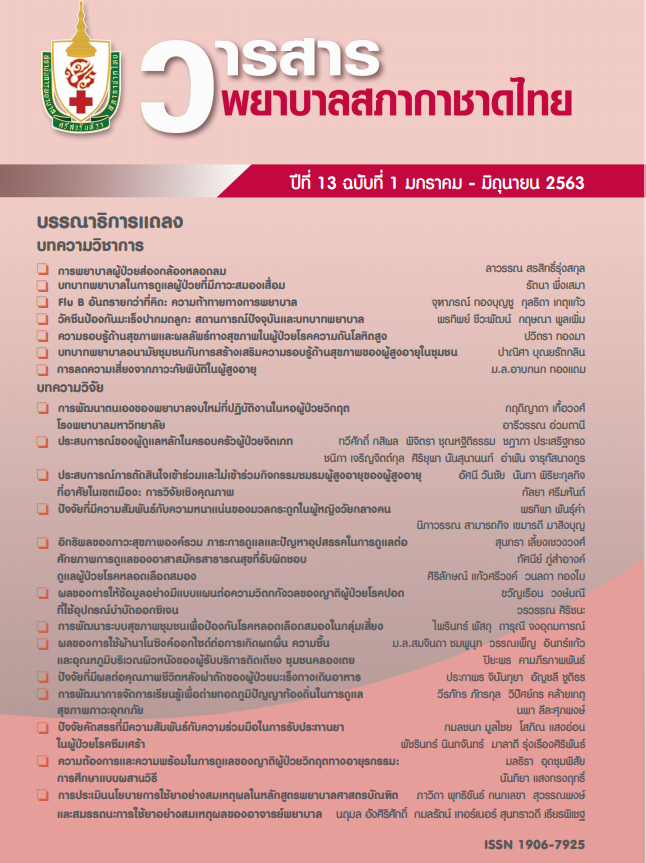
การประเมินนโยบายการใช้ยาอย่างสมเหตุผลในหลักสูตรพยาบาลศาสตรบัณฑิต และสมรรถนะการใช้ยาอย่างสมเหตุผลของอาจารย์พยาบาล
คำสำคัญ:
การใช้ยาอย่างสมเหตุผล, นโยบาย, สมรรถนะ, หลักสูตรพยาบาลศาสตรบัณฑิตบทคัดย่อ
การวิจัยนี้มีวัตถุประสงค์เพื่อประเมินนโยบายการใช้ยาอย่างสมเหตุผลในหลักสูตรพยาบาลศาสตรบัณฑิต และสมรรถนะการใช้ยาอย่างสมเหตุผลของอาจารย์พยาบาล เก็บรวบรวมข้อมูลโดยใช้แบบสอบถามออนไลน์ กลุ่มตัวอย่างเป็นผู้บริหารและอาจารย์พยาบาลของสถาบันการศึกษาพยาบาล 86 สถาบัน จำนวน 1,052 คนวิเคราะห์ข้อมูลโดยหาความถี่ ร้อยละ ค่าเฉลี่ย และส่วนเบี่ยงเบนมาตรฐาน
ผลการวิจัยพบว่า กลุ่มตัวอย่างส่วนใหญ่รับทราบนโยบายของสภาการพยาบาลเรื่องการบูรณาการหลักสูตรการใช้ยาอย่างสมเหตุผลในหลักสูตรพยาบาลศาสตรบัณฑิต คิดเป็นร้อยละ 98.76 และสถาบันการศึกษามีนโยบายการบูรณาการหลักสูตรการใช้ยาอย่างสมเหตุผลในหลักสูตรพยาบาลศาสตรบัณฑิตที่ชัดเจนเป็นลายลักษณ์อักษรและมีการดำเนินการในระดับปฏิบัติ คิดเป็นร้อยละ 53.52 มีการกำหนดผลลัพธ์การเรียนรู้ที่คาดหวังในเรื่องสมรรถนะการใช้ยาอย่างสมเหตุผลในหลักสูตร/วัตถุประสงค์ของหลักสูตร คิดเป็นร้อยละ 75.67 และอาจารย์พยาบาลมีสมรรถนะการใช้ยาสมเหตุผลโดยรวมอยู่ในระดับมาก (Mean = 4.25, SD = 0.82) และเมื่อพิจารณารายด้านพบว่า สมรรถนะด้านการประเมินปัญหาผู้ป่วยที่เกี่ยวกับการใช้ยาก่อนที่จะใช้ยากับผู้ป่วย มีคะแนนเฉลี่ยสูงที่สุด (Mean = 4.40, SD = 0.73) รองลงมาได้แก่ ด้านบริหารยาตามการสั่งใช้ยาได้อย่างถูกต้อง (Mean = 4.34, SD = 0.76) และด้านพัฒนาความรู้ความสามารถในการใช้ยาได้อย่างต่อเนื่องมีค่าเฉลี่ยน้อยสุด (Mean = 4.11, SD = 0.83)
Downloads
เอกสารอ้างอิง
2. The ASEAN Secretariat. Rational use of medicines in the ASEAN region [Internet]. 2017 [cited 2020 Apr 21]. Available from: https://asean.org/wp-content/uploads/2017/04/4.-March-2017-Rational-Use-of-Medicines-in-the-ASEAN-Region.pdf
3. Pumart P, Phodha T, Thamlikitkul V, Riewpaiboon A, Prakongsai P, Limwattananon S. Health and economic impacts of antimicrobial resistance in Thailand: a preliminary study. Journal of Health Systems Research 2012;6(3):352-60 (in Thai).
4. Health Systems Research Institute and Coordination and Integration Committee on Antimicrobial Resistance. Thailand national strategic plan on antimicrobial resistance 2017-2021 [Internet]. 2017 [cited 2020 Apr 30]. Available from: https://kb.hsri.or.th/dspace/handle/11228/4807?show=full
5. World Health Organization. Rational use of medicines. Fact sheet no.38 [Internet]. 2010 [cited 2010 Mar 20]. Available from: www.who.int/mediacentre/factsheets/fs338/en
6. Rational Use of Drug Subcommittee. Teacher’s guide for promoting rational drug use. Nonthaburi: Food and Drug Administration, Ministry of Public Health; 2017. (in Thai)
7. National Drug System Development Committee. National drug policy A.D. 2011 and National drug system development strategy A.D. 2012-2016. (2nded.). Bangkok: Aksorn Graphic and Design Publication. (in Thai)
8. Thailand Nursing and Midwifery Council. Conclusion integrating the rational drug use curriculum into the bachelor of nursing science program, 2018 [Internet]. 2018 [cited 2019 Mar 29]. Available from: https://www. tnmc.or.th/news/110 (in Thai)
9. Thailand Nursing and Midwifery Council. The handbook of learning and teaching management on the rational drug use into the Bachelor of Nursing Science Program. Chonburi: Danext Intercoperation; 2019. (in Thai).
10. Stufflebeam DL. The CIPP model for evaluation. In: Kellaghan T, Stufflebeam DL, editors. International handbook of educational evaluation. Dordrecht: Kluwer International Handbooks of Education; 2003. p. 31-56.
11. Panakul S. Curriculum evaluation 6th ed. Bangkok: Ramkhamhaeng University; 2010.
12. Rattanamanee N, Phasunon P. Response rate in qualitative research. Journal of Humanities and Social Sciences Thonburi University 2019;13(3):181-88. (in Thai)
13. Srisa-ard B. Preliminary research. (9th ed.). Bangkok: Suviriyasarn; 2011. (in Thai)
14. Aziz S, Mahmood M, Rehman Z. Implementation of CIPP model for quality evaluation at school level: a case study. JoEED 2018;5(1):189-206.
15. Bullock S, Manias E. The educational preparation of undergraduate nursing students in pharmacology: a survey of lecturers’ perceptions and experiences. J Adv Nurs 2002;40(1):7-16.
16. Thirawanutpong PH, Bunprom PU. The Development of Lecturer’s Potential in higher education institutions. SKRU Academic Journal 2018;8(1):33-40. (in Thai)
17. Intahphuak S. Medication errors reduction: appling nursing process in drug administration. Journal of Nursing Science & Health 2014;37(4):139-46. (in Thai)
18. Tipkanajanaraykha K, Saleekul S. Role of nurses in prevention and management of inappropriate medication use in older adults. Journal of The Royal Thai Army Nurses 2019;20(1):31-9. (in Thai)
19. Sornkrasetrin A, Rungnoei N, Thongma N, Klinchat R, Rajataramya B, Nitirat P. Factors predicting the rational antibiotic use among nursing students. The Journal of Baromarajonani College of Nursing, Nakhonratchasima 2019;25(1):43-59. (in Thai)
20. Jongpantanimit P. Risk management in high alert drug use among nursing students.Journal of Phrapokklao Nursing College 2018;29(1):204-14. (in Thai)
21. Talordpong P, Pibanwong P. Roles of nursing practitioner in the use of drugs in elderly patients. Vajira Medical Journal: Journal of Urban Medicine 2018;62(6):473-82. (in Thai)
22. Driessnack M. Interprofessional Practice and Education (IPE): a primer. J Nurs Sci 2018;36(3):4-8. (in Thai)
23. Hermann CP, Head BA, Black K, Singleton K. Preparing nursing students for interprofessional practice: the interdisciplinary curriculum for oncology palliative care education. J Prof Nurs 2016;32(1):62–71.
24. Sarakshetrin A, Sriyasak A,Ketin V,Rongmuang D. A development of interprofessional education learning model for health promotion among the elderly in the community. Journal of Health and
Nursing Research 2019;35(2):140-52. (in Thai)
25. Sethasathien S. A model of interprofessional education (IPE) in Department of Physical Medicine and Rehabilitation, Udonthani Hospital. J Thai Rehabil Med 2015;25(2):65-70.
doi:10.14456/jtrm.2015.12
26. Sulosaari V, Kajander S, Hupli M, Huupponen R, Leino-Kilpi H. Nurse students’ medication competence- an integrative review of the association factors. Nurse Educ Today 2012;32(4):399-405.
27. Powell B, Conrad E. Utilizing the CIPP model as a means to develop an integrated service-learning component in a university health course. J Health Educ Teach 2015;6(1):21-32.
ดาวน์โหลด
เผยแพร่แล้ว
รูปแบบการอ้างอิง
ฉบับ
ประเภทบทความ
สัญญาอนุญาต
เนื้อหาบทความหรือข้อคิดเห็นต่างๆ ในวารสารพยาบาลสภากาชาดไทยนี้ เป็นความคิดเห็นของผู้เขียนบทความ ไม่ใช่ความเห็นของกองบรรณาธิการ หรือสถาบันการพยาบาลศรีสวรินทิรา สภากาชาดไทย


