
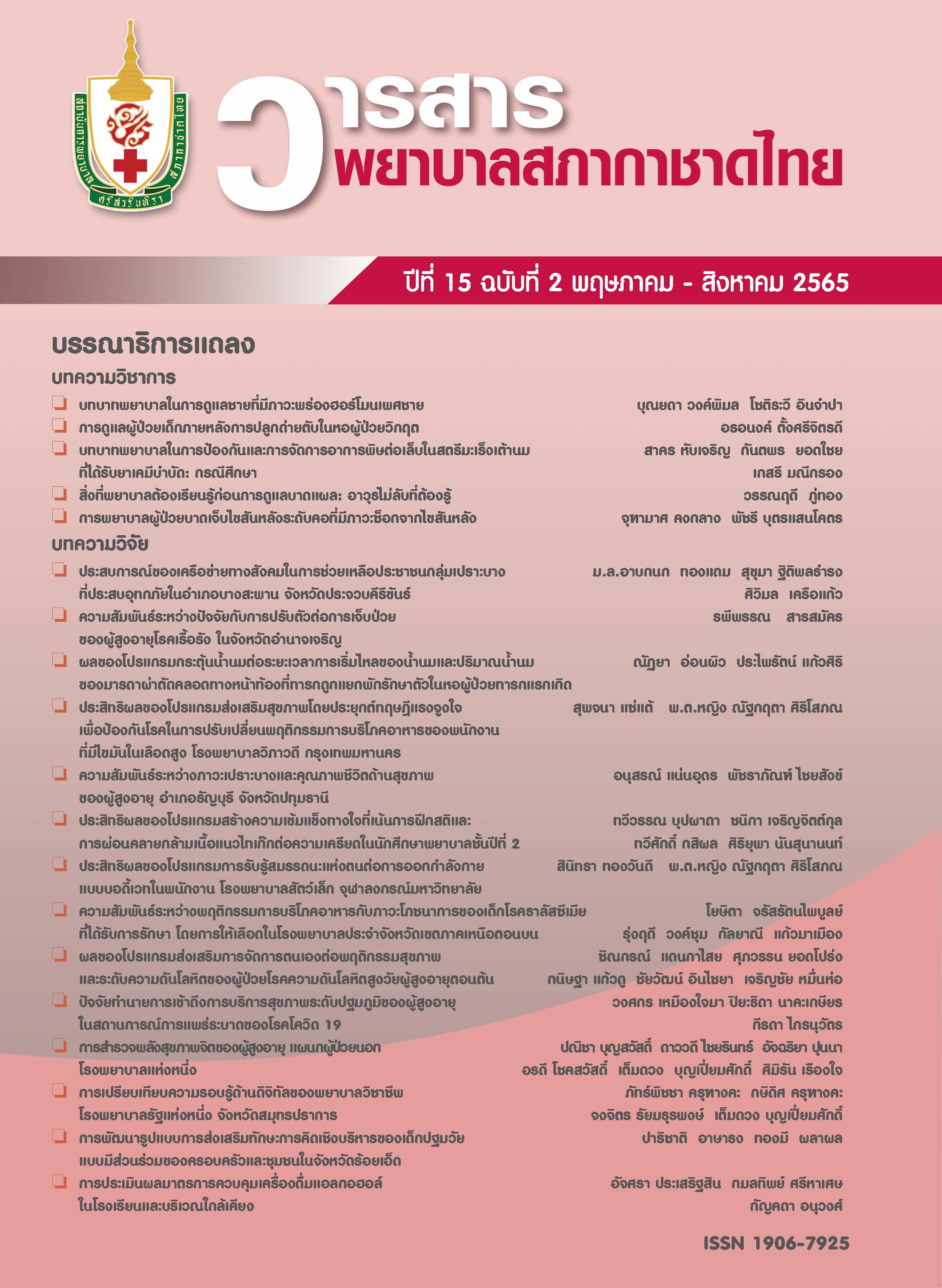
ผลของโปรแกรมกระตุ้นน้ำนมต่อระยะเวลาการเริ่มไหลของน้ำนม และปริมาณน้ำนมของมารดาผ่าตัดคลอดทางหน้าท้องที่ทารกถูกแยกพักรักษาตัวในหอผู้ป่วยทารกแรกเกิด
คำสำคัญ:
โปรแกรมกระตุ้นน้ำนม, มารดาผ่าตัดคลอดทางหน้าท้อง, ทารกรักษาตัวในหอผู้ป่วย ทารกแรกเกิดบทคัดย่อ
การวิจัยครั้งนี้เป็นงานวิจัยกึ่งทดลอง มีวัตถุประสงค์เพื่อเปรียบเทียบระยะเวลาการเริ่มไหลของน้ำนมและปริมาณน้ำนมในมารดาผ่าตัดคลอดทางหน้าท้องที่ทารกถูกแยกพักรักษาตัวในหอผู้ป่วย ทารกแรกเกิด กลุ่มตัวอย่างคือ มารดาผ่าตัดคลอดทางหน้าท้องที่ทารกถูกแยกพักรักษาตัวในหอผู้ป่วยทารกแรกเกิดระหว่างกลุ่มได้รับโปรแกรมกระตุ้นน้ำนมกับกลุ่มได้รับการพยาบาลตามปกติ ซึ่งมารดาพักรักษาตัว ณ แผนกสูตินรีเวชกรรม โรงพยาบาลนครพนม จังหวัดนครพนม จำนวน 52 ราย โดยศึกษาระหว่างเดือนกุมภาพันธ์ถึงเดือนตุลาคม พ.ศ. 2563 เครื่องมือที่ใช้ในการวิจัย ได้แก่ โปรแกรมกระตุ้นน้ำนม แบบบันทึกข้อมูลส่วนบุคคลและข้อมูลทางสูติศาสตร์ แบบบันทึกระยะเวลาการเริ่มไหลของน้ำนมและปริมาณน้ำนม และแบบประเมินความรู้เกี่ยวกับการกระตุ้นการหลั่งน้ำนม วิเคราะห์ข้อมูลโดยใช้สถิติเชิงพรรณนาและสถิติ Independent t-test
ผลการวิจัยพบว่า มารดากลุ่มทดลองมีระยะเวลาการเริ่มไหลของน้ำนมเร็วกว่ากลุ่มควบคุมอย่างมีนัยสำคัญทางสถิติ (t = -2.22, p < .01) มารดากลุ่มทดลองมีปริมาณน้ำนมในวันที่ 3 หลังคลอด มากกว่ากลุ่มควบคุมอย่างมีนัยสำคัญทางสถิติ (t = 2.32, p < .01)
ผลการวิจัยแสดงให้เห็นว่าโปรแกรมกระตุ้นน้ำนมสามารถนำไปใช้ส่งเสริมการเลี้ยงลูกด้วยนมแม่ให้มารดาผ่าตัดคลอดทางหน้าท้องที่ทารกถูกแยกพักรักษาตัวในหอผู้ป่วยทารกแรกเกิดมีอัตราการเลี้ยงลูกด้วยนมแม่เพิ่มมากขึ้น
Downloads
เอกสารอ้างอิง
Kengsakun K. The Royal College of Obstetricians identified cesarean section without indication increases the risk of birth [Internet]. 2019 [cited 2020 Jul 23]. Available from: https://www.hfocus.org/content/2019/08/17586 (in Thai)
Lumphikanon P. Unnecessary caesarean sections [Internet]. 2017 [cited 2020 Jul 23]. Available from: https://www.hfocus.org/content/2019/04/17049 (in Thai)
Mirahmadizadeh A, Moradi F, Zahmatkesh S, Abasi A, Salari A, Hassanipour S, et al. Evaluation of breastfeeding patterns in the first 24 hour of life and associated factors in South of Iran: a cross-sectional study. Clin Epidemiol Glob Health 2020;8(1):33-7.
Sinsuksai N, Nuampa S, Chanprapaph P. Factors predicting 6-month-exclusive breastfeeding in mothers with cesarean section. J Nurs Sci 2017;35(1):14-22. (in Thai)
Bureau of Health Promotion. Protecting, promoting and supporting breastfeeding [Internet]. 2022 [cited 2022 Aug 15]. Available from: https://hp.anamai.moph.go.th (in Thai)
Khotsang K, Sangin S, Chuahorm U. The effects of lactational program on milk secretion time, onset of lactation and breastfeeding self-efficacy in mothers after cesarean section. The Journal of Faculty of Nursing Burapha University 2016;24(1): 13-26. (in Thai)
Isik Y, Dag ZO, Tulmac OB, Eren P. Early postpartum lactation effects of cesarean and vaginal birth. Ginekol Pol 2016;87(6):426-30. doi: 10.5603/GP.2016.0020.
Chaikongkiat P, Bunlap P, Harnnarong A. Factors related to breastfeeding self-efficacy of mothers after cesarean section. Nursing Public Health and Education Journal 2020;21(1):16-27. (in Thai)
Kala S, Khaonark R. Breastfeeding in postpartum mothers of sick newborns. Songklanagarind Journal of Nursing 2016;36(Suppl):196-208. (in Thai)
Ratanasongkram P. Milk collection behavior in mothers of premature infants. Thai Science and Technology Journal 2012;20(5 Suppl):406-13. (in Thai)
Pruksasri S, Kongsapad S. Nursing outcome of lactation stimulating technique in view of milk production and satisfaction of mother after delivery and neonatal in nursery. The Southern College Network Journal of Nursing and Public Health 2016;3(2):179-94. (in Thai)
Baimonta L, Nirattharadorn M, Kamolwarin S. The effect of promoting breast feeding program on maternal breastfeeding and milk flow among women experiencing cesarean section. Nursing Journal 2015;42(4):65-75. (in Thai)
Budsaengdee B, Kantaruks K, Jareonsanti J. Effects of self-efficacy promotion on success in exclusive breastfeeding among cesarean section mothers. Nursing Journal 2013;40(3):1-10. (in Thai)
Jirapait V, Jirapait K. Strategies for successful breastfeeding. Bangkok: Tammada-press; 2020. (in Thai)
Auaareekul K, Sangperm P, Payakkaraung S. The effects of a breast milk establishing program on milk volume and time of sufficient milk supply among cesarean section mothers of premature infants. J Nurs Sci 2018;36(3):71-82. (in Thai)
Phongsakchat V. Calculating the sample size for research [Internet]. 2022 [cited 2022 Aug 15 Available from:http://thaimed.buu.ac.th/public/backend/upload/thaimed.buu. ac.th (in Thai)
Burns N, Susan K, Grove SK. The practice of nursing research: conduct, critique, and utilization. 5th ed. St. Louis: Elsevier; 2005.
Chaichanawirote U, Vantum C. Evaluation of content validity for research instrument. Journal of Nursing and Health Sciences 2017;11(2):105-11. (in Thai)
Meehanpong P, Chatdokmaiprai K. Assessing quality of research instrument in nursing research. J Royal Thai Army Nurses 2018;19(1):9-15. (in Thai)
Masae M, Kala S, Chatchawet W. Effect of self-breast massage program on milk ejection of first-time mothers. Princess of Naradhiwas University Journal 2019;11(3): 1-14. (in Thai)
Skontharat P, Phakdeechot S. Comparison of the results of using herbal compress with warm water-moistened cloth to stimulate maternal lactation after delivery at Sakonnakhon Hospital. Journal of Sakonnakhon Hospital 2012;15(3):1-11. (in Thai)
Pitiphon S. Galactagogue: herbs, cookies etc. In: Sawatdhiwon S, Withyasuphon J, editors. 7th National Breastfeeding Conference: Scaling up & Learning more; 2020 Aug 5-7; Bangkok. Thai Breastfeeding Center; 2020. p. 178-88. (in Thai)
Yimyam S. Galactagogue herbs. Nursing Journal 2018;45(1):133-40. (in Thai)
ดาวน์โหลด
เผยแพร่แล้ว
รูปแบบการอ้างอิง
ฉบับ
ประเภทบทความ
สัญญาอนุญาต
ลิขสิทธิ์ (c) 2022 สถาบันการพยาบาลศรีสวรินทิรา สภากาชาดไทย

อนุญาตภายใต้เงื่อนไข Creative Commons Attribution-NonCommercial-NoDerivatives 4.0 International License.
เนื้อหาบทความหรือข้อคิดเห็นต่างๆ ในวารสารพยาบาลสภากาชาดไทยนี้ เป็นความคิดเห็นของผู้เขียนบทความ ไม่ใช่ความเห็นของกองบรรณาธิการ หรือสถาบันการพยาบาลศรีสวรินทิรา สภากาชาดไทย


