
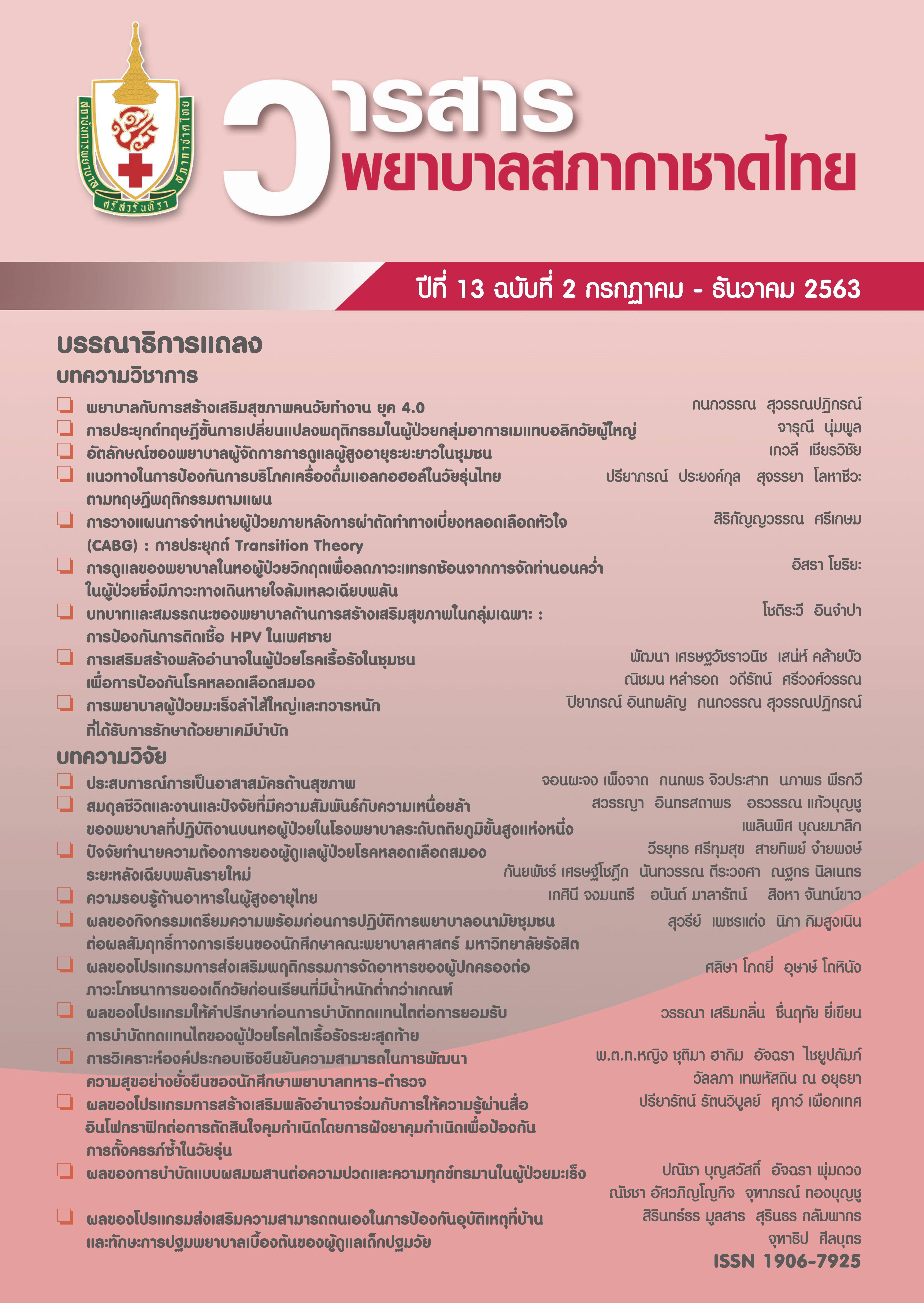
พยาบาลกับการสร้างเสริมสุขภาพคนวัยทำงาน ยุค 4.0
บทคัดย่อ
ในยุค 4.0 ซึ่งเป็นยุคที่เทคโนโลยีสารสนเทศเข้ามามีอิทธิพลต่อชีวิตประจำวัน การทำงานและสุขภาพ วัยทำงานมีความสำคัญต่อประเทศเนื่องจากวัยนี้สร้างผลผลิตของสังคมและรับภาระในการดูแลความเป็นอยู่และสุขภาพของบุคคลวัยอื่น ๆ จึงจำเป็นที่คนวัยทำงานต้องแสวงหาความรู้ทั้งจากสื่อต่าง ๆ และผ่านเทคโนโลยีสารสนเทศเพื่อนำมาใช้ในการดูแลสุขภาพตนเองและคนในครอบครัว จากการสำรวจภาวะสุขภาพ พบว่าคนวัยทำงานมีความเสี่ยงต่อการเจ็บป่วยด้วยโรคไม่ติดต่อเรื้อรังเพิ่มมากขึ้น เช่น โรคความดันโลหิตสูง เบาหวาน ภาวะไขมันในเลือดสูง การสร้างเสริมสุขภาพคนวัยทำงาน จึงเป็นเรื่องที่พยาบาลควรให้ความสำคัญไม่น้อยกว่าคนวัยอื่น ๆ ในบทความนี้จะได้กล่าวถึงการสร้างเสริมสุขภาพคนวัยทำงานตามแนวทางของกฎบัตรออตตาวา ประกอบด้วย นโยบายสาธารณะเพื่อสุขภาพ การสร้างสิ่งแวดล้อมที่เอื้อต่อการมีสุขภาพดี การเสริมสร้างความเข้มแข็งให้แก่ชุมชน การพัฒนาทักษะส่วนบุคคล และการปฏิรูประบบบริการสาธารณสุข รวมทั้งการประยุกต์ใช้แนวคิดการสร้างเสริมสุขภาพของเพนเดอร์ในยุคเทคโนโลยีสุขภาพดิจิตอล
Downloads
เอกสารอ้างอิง
2. Electronic Transaction Development Agency, Ministry of Digital Economy and Society. Thailand and internet user profile 2018. Bangkok: Electronic Transaction Development Agency, Ministry of Digital Economy and Society; 2019. (in Thai)
3. Strategy and Planning Division, Ministry of Public Health. Strategic plan of MOPH in 2017-2021. Nonthaburi: Strategy and Planning Division, Ministry of Public Health; 2017. (in Thai)
4. Thai Hypertension Society. Guidelines in the treatment of hypertension 2019. Chiang Mai: Trick Think; 2019. (in Thai)
5. The Royal College of Physicians of Thailand, Diabetes Association of Thailand, The Endocrine Society of Thailand, Institute of Medical Research & Technology Assessment, National Health Security Office. Clinical Practice Guideline for Diabetes 2017. Bangkok: Romyen media; 2017. (in Thai)
6. National Health Act B.E. 2550 (A.D. 2007). Published in the Government Gazette Vol. 124, Part 16 a, dated 19th March B.E. 2550 (A.D. 2007). (in Thai)
7. Simpson C, Allegra JC, Ezeamama AE, Elkins J, Miles T. The impact of mid- and late-life loss on insomnia: findings from the health and retirement study, 2010 cohort. Fam Community Health 2014;37(4):317-26.
8. Gathecha E, Rios R, Buenaver LF, Landis R, Howell E, Wright S. Pilot study aiming to support sleep quality and duration during hospitalizations. J Hosp Med 2016;11(7):467-72.
9. Boese ML, Ransom RK, Roadfuss RJ, Todd A, McGuire JM. Utility of the Berlin questionnaire to screen for obstructive sleep apnea among patients receiving intravenous sedation for colonoscopy. AANA J 2014;82(1):38-45.
10. Jaffe SE, Engelke Z. Patient education: teaching adult patients good sleep hygiene (sleep habits) techniques [Internet]. 2018 [cited 2020 Mar 23]. Available from: http://web.b.ebscohost.com/nup/detail
11. Pender NJ. Health promotion model manual [Internet]. 2011 [cited 2018 Jun 13]. Available from: http://deepblue.lib.umich.edu/bitstream/2027.42/85350/1/HEALTH_PROMOTION_MANUAL_Rev_5-2011.pdf (G)
12. McCullagh MC. Health promotion. In: Peterson SJ, Bredow TS, editors. Middle range theories: application to nursing research. 3rd ed. Philadelphia: Wolters Kluwer Health/Lippincott Williams & Wilkins; 2013. p. 224-34.
13. Schub E, Cabrera G. Pender’s health promotion model: integration into practice [Internet]. 2018 [cited 2020 Mar 23]. Available from: http://web.b.ebscohost.com/nup/detail/detail?vid
14. Ho AY, Berggren I, Dahlborg-Lyckhage E. Diabetes empowerment related to Pender's Health Promotion Model: a meta-synthesis. Nurs Health Sci 2010;12(2):259-67.
15. Khodaveisi M, Omidi A, Farokhi S, Soltanian AR. The effect of Pender's health promotion model in improving the nutritional behavior of overweight and obese women. Int J Community Based Nurs Midwifery 2017;5(2):165-74.
16. Kamran A, Azadbakht L, Sharifirad G, Mahaki B, Mohebi S. The relationship between blood pressure and the structures of Pender's health promotion model in rural hypertensive patients. J Educ Health Promot 2015;4:29. doi: 10.4103/2277-9531.
17. Mohamadian H, Eftekhar H, Rahimi A, Mohamad HT, Shojaiezade D, Montazeri A. Predicting health-related quality of life by using a health promotion model among Iranian adolescent girls: a structural equation modeling approach. Nurs Health Sci 2011;13(2):141-8. doi:10.1111/j.1442-2018.2011.00591.x
18. Wetsiri, W. Digital health in 4.0 era section 2 digital health devices [Internet]. 2019 [cited 2020 March 15]. Available from: https://medium.com/arincare-com/เทคโนโลยีสุขภาพในยุค-4-0-ตอนที่-2-615aa7807718
ดาวน์โหลด
เผยแพร่แล้ว
รูปแบบการอ้างอิง
ฉบับ
ประเภทบทความ
สัญญาอนุญาต
เนื้อหาบทความหรือข้อคิดเห็นต่างๆ ในวารสารพยาบาลสภากาชาดไทยนี้ เป็นความคิดเห็นของผู้เขียนบทความ ไม่ใช่ความเห็นของกองบรรณาธิการ หรือสถาบันการพยาบาลศรีสวรินทิรา สภากาชาดไทย


