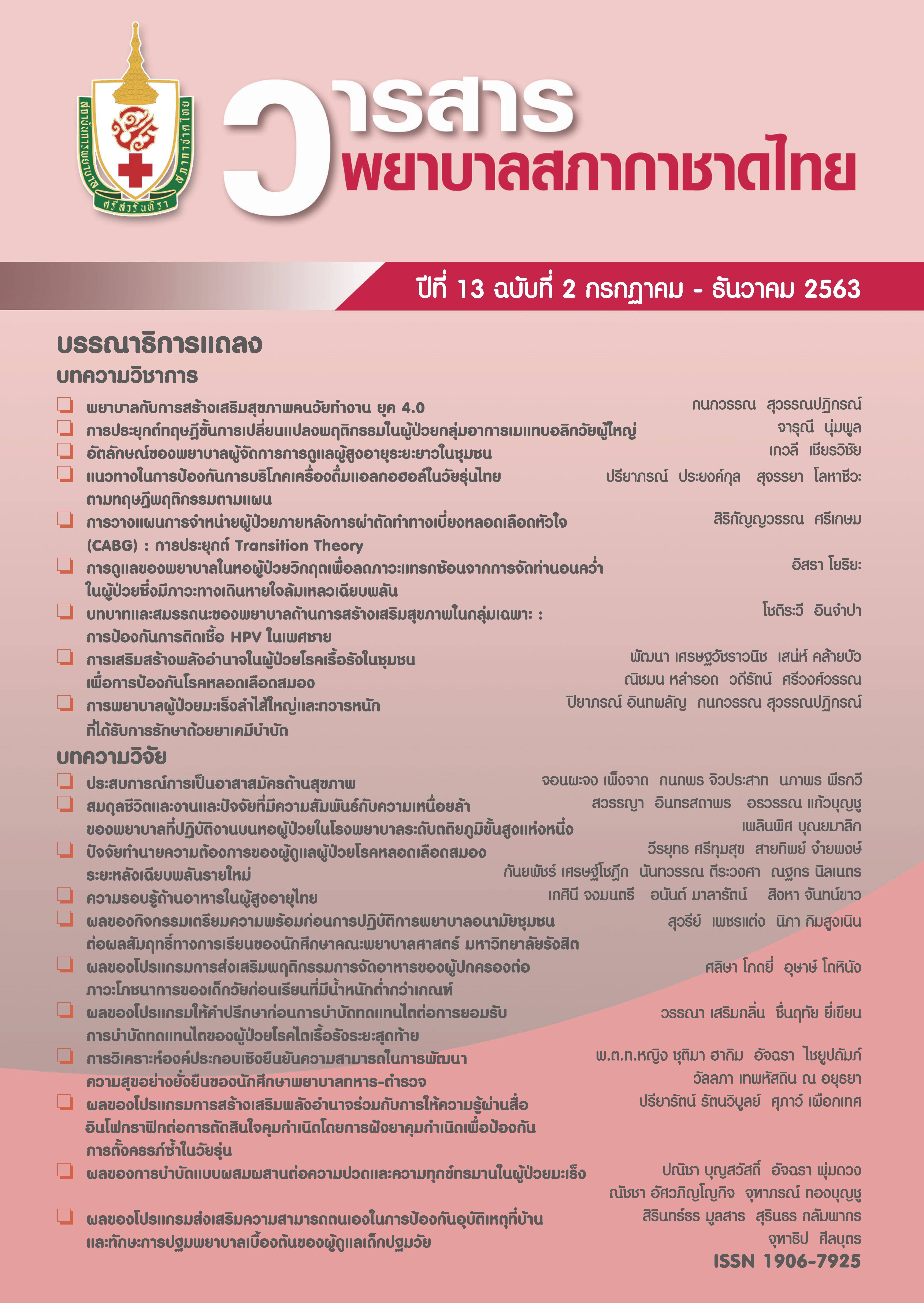
การวิเคราะห์องค์ประกอบเชิงยืนยันความสามารถในการพัฒนาความสุขอย่างยั่งยืนของนักศึกษาพยาบาลทหาร-ตำรวจ
คำสำคัญ:
การวิเคราะห์องค์ประกอบเชิงยืนยัน, ความสุขอย่างยั่งยืน, นักศึกษาพยาบาลทหาร-ตำรวจบทคัดย่อ
การวิจัยนี้มีวัตถุประสงค์เพื่อวิเคราะห์องค์ประกอบเชิงยืนยันความสามารถในการพัฒนาความสุขอย่างยั่งยืนของนักศึกษาพยาบาลทหาร-ตำรวจ กลุ่มตัวอย่าง ได้แก่ นักศึกษาพยาบาล ชั้นปีที่ 1-4 หลักสูตรพยาบาลศาสตรบัณฑิต ปีการศึกษา 2561 ของวิทยาลัยพยาบาลในสังกัดกระทรวงกลาโหมและสำนักงานตำรวจแห่งชาติ รวม 4 แห่ง จำนวน 294 คน เก็บรวบรวมข้อมูลจากแบบวัดความสามารถในการพัฒนาความสุขอย่างยั่งยืนของนักศึกษาพยาบาลทหาร-ตำรวจ แบบ 5 ระดับ ประกอบด้วย 5 องค์ประกอบ 16 ตัวชี้วัด รวมข้อคำถาม 62 ข้อ ผลการวิเคราะห์องค์ประกอบเชิงยืนยัน พบว่า โมเดลการวัดความสามารถในการพัฒนาความสุขอย่างยั่งยืนของนักศึกษาพยาบาลทหาร-ตำรวจสอดคล้องกลมกลืนกับข้อมูลเชิงประจักษ์ โดยไค-สแควร์ ( ) = 96.503, p =.115 df = 81 ค่าสถิติไคสแควร์สัมพัทธ์ ( ) = 1.191, GFI = .960, AGFI = .934, CFI = .997, SRMR = .034, RMSEA = .025 องค์ประกอบความสามารถในการพัฒนาความสุขอย่างยั่งยืนของนักศึกษาพยาบาลทหาร-ตำรวจ ประกอบด้วย 5 องค์ประกอบ ได้แก่ การทำดี (0.923) การมีความเข้มแข็งทางจิตใจ (0.918) การคิดดี (0.906) การมีสัมพันธภาพที่ดี (0.840) และการเสริมพลังอำนาจในตนเอง (0.736)
Downloads
เอกสารอ้างอิง
2. Kittiprapas S, Sawangfa O, Nitnithipruk K, Liamcharatsakun N. Development of concepts on happiness related to “Prayodsuk” and sufficiency economy. Bangkok: International Research Associates for Happy Societies (IRAH); 2010. (in Thai)
3. Wangdi K. Sustainable happiness and sustainable development. International forum on occasion of the UN International Day of Happiness; 2015 Mar 20; Bangkok: International Research Associates for Happy Societies; 2015. (in Thai)
4. Cummins RA, Eckersley R, Pallant J, Van Vugt J, Misajon R. Developing a national index of subjective wellbeing: the Australian unity wellbeing index. Soc Indic Res 2003;64(2):159-90.
5. Kittiprapas S. New paradigm for development: to happiness society. King Prajadhipok’s Institute Journal 2012;10(1):99-116. (in Thai)
6. United Nation foundation. International day of happiness [Internet]. 2015 [cited 2016 Feb 20]. Available from: https://www.un.org/sustainabledevelopment/events/international-day-of-happiness/
7. National Statistical Office. Key summary of Thai mental health (happiness) survey, August 2014. Bangkok: National Statistical Office; 2012. (in Thai)
8. Thairath Online. Female student of faculty of sciences killed herself by jumping to Ping river, may stress from learning [Internet]. 2018 [cited 2019 Jun 15]. Available from: https://www.thairath.co.th/content/1438843 (in Thai)
9. Bukhari SR, Khanam SJ. Prevalence of depression in university students belonging to different socioeconomic status. JPMI 2015;29(3):156-9.
10. Ruangpermpoon K, Rongmuang S, Nintachan P. Characteristics of social adjustment in nursing students. Rama Nurs J 2011;17(3):478-92. (in Thai)
11. Suttharangsee W, Petcharat B, Inthanon T. The stress management behavior and related factors of nursing students, Faculty of Nursing, Prince of Songkla University [Research Report]. Songkla: Prince of Songkla University; 2004. (in Thai)
12. Labrague LJ. Stress, stressors, and stress responses of student nurses in government nursing school. Health Sci J 2013;7(4):424-35.
13. Graham MM, Lindo J, Bryan VD, Weaver S. Factors associated with stress among second year student nurses during clinical training in Jamaica. J Prof Nurs. In press 2016.
14. Rukkhajeekul S. Depression and suicidal behaviors among Naresuan University students. J Psychiatr Assoc Thailand 2013;58(4):359-70. (in Thai)
15. Phraphrombandit (Prayoon Thammachitto). Wisdom brings life to happiness. Bangkok: Suanaksorn Printing; 2017. (in Thai)
16. Dallas JC, Puapan S, Vatanasin D. Factors influencing mental health status among nursing students. The Journal of Faculty of Nursing Burapha University 2016;23(3):1-13. (in Thai)
17. Coget A. Sustainable happiness five stage process model [Internet]. 2018 [cited 2018 Jun 15]. Available from: http://sustainablehappinessdoctor.blogspot.com/2014/ 06/vision-for-dynamic-spread-of-happiness.html
18. Department of Mental Health, Ministry of public Health. The handbook for emotional intelligence. 9th ed. Nonthaburi: The Agricultural Cooperative Federation of Thailand; 2003. (in Thai)
19. Seligman M. Exploring the three types of happiness [Internet]. 2018 [cited 2018 Jun 15]. Available from: http://www.derekstockley.com.au/newsletters-06/085-happiness-types.html
20. Ryff CD. Happiness is everything, or is it? explorations on the meaning of psychological well-being. J Pers Soc Psychol 1989;57(6):1069-81.
21. Nagvajara W. The happiness guide. 2nd ed. Bangkok: Amarin Printing & Publishing; 2007. (in Thai)
22. Diener E. Subjective well-being. Psychol Bull 1984;95(3):542-75.
23. Yamane T. Statistics: an introductory analysis. 3rd ed. New York: Harper & Row; 1973.
24. Schumacker RE, Lomax RG. A beginner’s guide to structural equation modeling: SEM. New York: Routledge; 2010.
25. Hair JF, Black WC, Babin BJ, Anderson RE. Multivariate data analysis: a global perspective. 7th ed. New Jersey: Pearson Education; 2010.
26. Kaemkate W. Research methodology in behavioral sciences. 2nd ed. Bangkok: Amarin Printing & Publishing; 2008. (in Thai)
27. Wiratchai N. LISREL model: statistics for research. 3rd ed. Bangkok: Chulalongkorn University Printing House; 1999. (in Thai)
ดาวน์โหลด
เผยแพร่แล้ว
รูปแบบการอ้างอิง
ฉบับ
ประเภทบทความ
สัญญาอนุญาต
เนื้อหาบทความหรือข้อคิดเห็นต่างๆ ในวารสารพยาบาลสภากาชาดไทยนี้ เป็นความคิดเห็นของผู้เขียนบทความ ไม่ใช่ความเห็นของกองบรรณาธิการ หรือสถาบันการพยาบาลศรีสวรินทิรา สภากาชาดไทย


