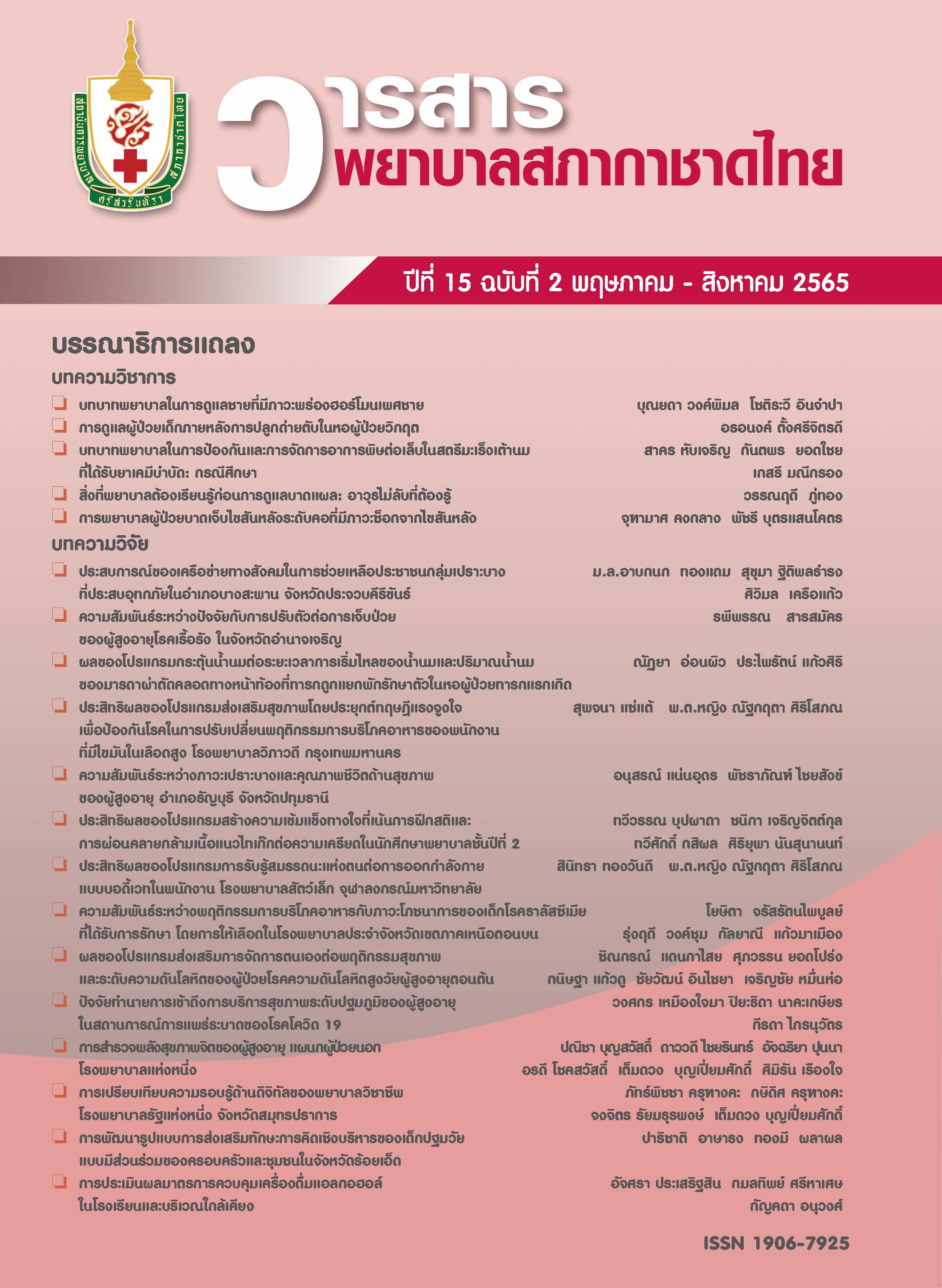
ประสิทธิผลของโปรแกรมสร้างความเข้มแข็งทางใจที่เน้นการฝึกสติ และการผ่อนคลายกล้ามเนื้อแนวไทเก๊กต่อความเครียดใน นักศึกษาพยาบาลชั้นปีที่ 2
คำสำคัญ:
ความเข้มแข็งทางใจ, การฝึกสติ , ไทเก๊ก , ความเครียด, นักศึกษาพยาบาลบทคัดย่อ
การวิจัยนี้เป็นการวิจัยกึ่งทดลองมีวัตถุประสงค์เพื่อเปรียบเทียบ 1) ความเครียดของนักศึกษาพยาบาลก่อนและหลังได้รับโปรแกรมสร้างความเข้มแข็งทางใจที่เน้นการฝึกสติและการผ่อนคลายกล้ามเนื้อแนวไทเก๊ก 2) ความเครียดของนักศึกษาพยาบาลระหว่างกลุ่มที่ได้รับโปรแกรมฯ กับกลุ่มที่ดำาเนินกิจกรรมต่าง ๆ ตามปกติ กลุ่มตัวอย่างเป็นนักศึกษาพยาบาลชั้นปีที่ 2 มหาวิทยาลัยแห่งหนึ่ง ที่มีคะแนนความเครียดในระดับสูงถึงรุนแรง จำนวน 46 คน สุ่มเข้ากลุ่มทดลองและกลุ่มควบคุมกลุ่มละ 23 คน เครื่องมือที่ใช้ในการเก็บข้อมูลประกอบด้วย โปรแกรมการสร้างความเข้มแข็งทางใจที่เน้นการฝึกสติและการผ่อนคลายกล้ามเนื้อแนวไทเก๊ก แบบประเมินความเครียดของสวนปรุง กรมสุขภาพจิต วิเคราะห์ข้อมูลด้วยสถิตเชิงพรรณนาและสถิติเชิงอ้างอิง ผลการศึกษาพบว่า หลังการทดลองนักศึกษาในกลุ่มทดลองมีค่าคะแนนเฉลี่ยความเครียดต่ำกว่าก่อนเข้าร่วมโปรแกรมฯ อย่างมีนัยสำคัญทางสถิติ (p < .01) และมีคะแนนเฉลี่ยความเครียดต่ำกว่ากลุ่มควบคุมอย่างมีนัยสำคัญทางสถิติ (p < .01)
สรุปโปรแกรมสร้างความเข้มแข็งทางใจที่เน้นการฝึกสติและการผ่อนคลายกล้ามเนื้อแนวไทเก๊กเป็นทางเลือกของการบำบัดวิธีหนึ่งที่สามารถนำไปใช้ผ่อนคลายความเครียดของนักศึกษาพยาบาลได้ด้วยการมีสติ ตระหนักรู้ และสร้างความเข้มแข็งทางใจ เมื่อเผชิญกับสถานการณ์ความเครียดในปัจจุบัน
Downloads
เอกสารอ้างอิง
Alsaqri SH. Stressors and coping strategies of the Saudi nursing students in the clinical training: a cross-sectional study. Educ Res Int [Internet]. 2017 [cited 2021 Aug 23];4018470 Available from: https://downloads.hindawi.com/journals/edri/2017/ 4018470.pdf
Lazarus RS, Folkman S. Transactional theory and research on emotions and coping. Eur J Pers 1987;1(3):141-69.
Pulido-Martos M, Augusto-Landa JM, Lopez-Zafra E. Sources of stress in nursing students: a systematic review of quantitative studies. Int Nurs Rev 2011;59(1):15–25.
Labrague LJ, McEnroe-Petitle DM, De Los Santos JAA, Edet OB. Examining stress perceptions and coping strategies among Saudi nursing students: a systematic review. Nurse Educ Today 2018;65:192-200.
Buppata T. An annual report: a survey of the 2nd years nursing students experiences of stress in Huachiew Chalermprakiet University. Samut Prakarn: Huachiew Chalermprakiet University; 2018. (in Thai)
Limthongkul M, Aree-Ue S. Sources of stress, coping strategies, and outcomes among nursing students during their initial practice. Rama Nurs J 2009;15(2):193-205. (in Thai)
Klainin-Yobas P, Keawkerd O, Pumpuang W, Thunyadee C, Thanoi W, He HG. The mediating effects of coping on the stress and health relationships among nursing students: a structural equation modelling approach. J Adv Nurs 2014;70(6):1287-98.
Luthans F, Youssef CM.Emerging positive organizational behavior.J Manag 2007;33(3):321-49. doi: 10.1177/0149206307300814
Grotberg EH. Resilience for tomorrow [Internet]. 2005 [cited 2019 Aug 10]. Available from: http://resilnet.uiuc.edu/ library/grotberg2005_resilience-for-tomorrow-brazil.pdf.
Kabat-Zinn J. Full catastrophe living how to cope with stress, pain and illness using mindfulness meditation. London: Little, Brown Book Group; 2013.
Kabiri DS, Mehrabi T. Sadeghi R. The effect of Tai Chi exercise on stress, anxiety, depression, and self confidence of nursing students. Jundishapur J Chronic Dis Care [Internet]. 2019 [cited 2021 Jan 21];8:e92854. Available from: https://sites.kowsarpub. com/jjcdc/articles/92854.html
Polit DF. Data analysis & statistics for nursing research. New York: Appleton & Lange; 1996.
Mahatnirunkul S, Pumpaisanchai W, Tapanya P. The construction of Suan Prung Stress Test for Thai population. Journal of Suanprung Psychiatric Hospital 1997;13(3):1-20. (in Thai)
Kang YS, Choi SY, Ryu E. The effectiveness of a stress coping program based on mindfulness meditation on the stress, anxiety, and depression experienced by nursing students in Korea. Nurse Educ Today 2009;29(5):538-43.
Chiangkuntod S. The development of stress management program following Buddhist psychology for nursing students at Faculty of Nursing, Siam University. Journal of Graduate Studies Review 2017;15(1):184-95. (in Thai)
Centeno RPR, Fernandez KTG. Effect of mindfulness on empathy and self-compassion: an adapted MBCT program on Filipino college students. Behav Sci 2020;10(3):61. doi: 10.3390/bs10030061.
Galante J, Dufour G, Vainre M, Wagner AP, Stochl J, Benton A, et al. A mindfulnessbased intervention to increase resilience to stress in university students (the Mindful Student Study): a pragmatic randomised controlled trial. Lancet Public Health 2018;3(2):e72-e81. doi: 10.1016/S2468-2667(17)30231-1.
ดาวน์โหลด
เผยแพร่แล้ว
รูปแบบการอ้างอิง
ฉบับ
ประเภทบทความ
สัญญาอนุญาต
ลิขสิทธิ์ (c) 2022 สถาบันการพยาบาลศรีสวรินทิรา สภากาชาดไทย

อนุญาตภายใต้เงื่อนไข Creative Commons Attribution-NonCommercial-NoDerivatives 4.0 International License.
เนื้อหาบทความหรือข้อคิดเห็นต่างๆ ในวารสารพยาบาลสภากาชาดไทยนี้ เป็นความคิดเห็นของผู้เขียนบทความ ไม่ใช่ความเห็นของกองบรรณาธิการ หรือสถาบันการพยาบาลศรีสวรินทิรา สภากาชาดไทย


