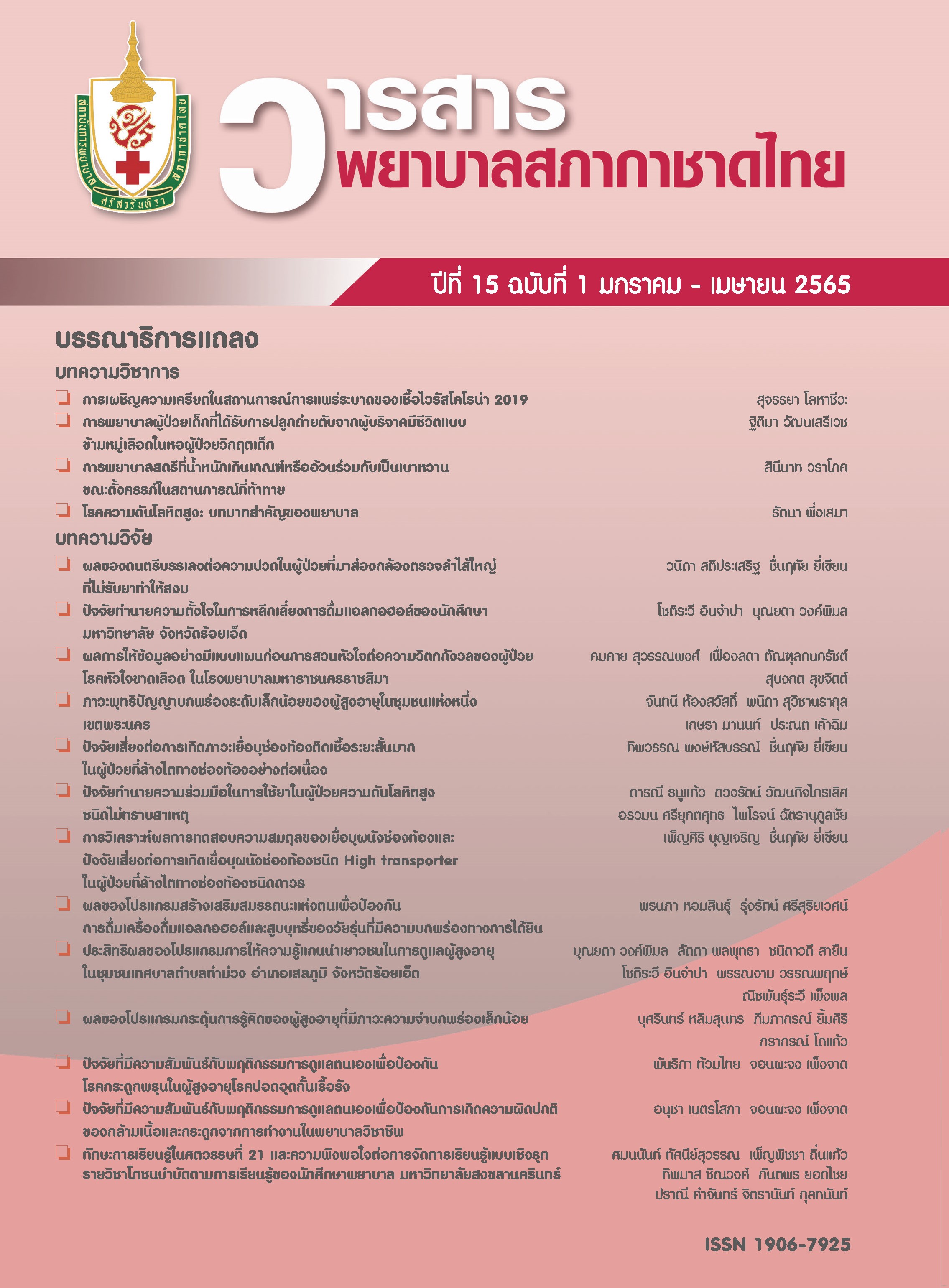
ผลของโปรแกรมสร้างเสริมสมรรถนะแห่งตนเพื่อป้องกันการดื่มเครื่องดื่มแอลกอฮอล์และสูบบุหรี่ของวัยรุ่นที่มีความบกพร่องทางการได้ยิน
คำสำคัญ:
สมรรถนะแห่งตน , พฤติกรรมเสี่ยง, วัยรุ่นที่มีความบกพร่องทางการได้ยินบทคัดย่อ
การวิจัยนี้เป็นการวิจัยกึ่งทดลอง เพื่อศึกษาผลของโปรแกรมการเสริมสร้างสมรรถนะแห่งตนเพื่อป้องกันการดื่มเครื่องดื่มแอลกอฮอล์และสูบบุหรี่ กลุ่มตัวอย่างที่ศึกษาเป็นวัยรุ่นที่มีความบกพร่องทางการได้ยินที่กำลังศึกษาอยู่ในโรงเรียนโสตศึกษา สังกัดสำนักงานบริหารงานการศึกษาพิเศษ 2 แห่ง แบ่งเป็นกลุ่มทดลองและกลุ่มเปรียบเทียบกลุ่มละ 40 คน โดยกลุ่มทดลองได้รับโปรแกรมการเสริมสร้างสมรรถนะแห่งตนซึ่งพัฒนาขึ้นตามแนวคิดทฤษฎีการรับรู้ความสามารถตนเองเพื่อเสริมสร้างสมรรถนะภายในตนจากทั้ง 4 แหล่งกำเนิด ได้แก่ 1) การกระทำที่บรรลุผลสำเร็จ 2) การเรียนรู้จากประสบการณ์ของผู้อื่น 3) การชักจูงด้วยคำพูด และ 4) ภาวะทางกายและอารมณ์ เป็นระยะเวลา 5 สัปดาห์ และติดตามประเมินผลการเปลี่ยนแปลงภายหลัง 4 สัปดาห์ กลุ่มเปรียบเทียบได้รับการเรียนการสอนตามหลักสูตรแกนกลางการศึกษาขั้นพื้นฐานตามปกติ วิเคราะห์ข้อมูลด้วยสถิติเชิงพรรณนา ได้แก่ ร้อยละ ค่าเฉลี่ย ส่วนเบี่ยงเบนมาตรฐาน และการวิเคราะห์ค่าที (t-test) ที่ระดับนัยสำคัญสถิติ .05
ผลการศึกษา พบว่า กลุ่มทดลองที่เข้าร่วมโปรแกรมฯ มีความมั่นใจในการไม่ดื่มเครื่องดื่มแอลกอฮอล์ (t=2.561, p value=.012) ความมั่นใจในการไม่สูบบุหรี่ (t = 2.950, p value = .004) ความตั้งใจในการไม่ดื่มเครื่องดื่มแอลกอฮอล์ (t = 1.884, p value = .032) ความตั้งใจในการไม่สูบบุหรี่ (t = 1.836, p value = .035) และความสามารถในการเผยแพร่ข้อมูลสุขภาพ (t = 6.004, p value < .001) สูงกว่าวัยรุ่นฯ กลุ่มเปรียบเทียบที่ไม่ได้เข้าร่วมโปรแกรมฯ อย่างมีนัยสำคัญทางสถิติ
Downloads
เอกสารอ้างอิง
The National committee on the promotion and development of quality of life of persons with disabilities. The 5th National Development Plan for the Quality of Life of Persons with Disabilities, 2017-2021 [Internet]. 2021 [cited 2021 Jan 14]. Available from: http://web1.dep.go.th (in Thai)
Homsin P, Srisuriyawet R. Alcohol drinking and cigarette smoking among Thai hearing impaired
adolescents. Journal of Ratchasuda College for Research and Development of Persons with Disabilities 2020;16(2): 65-80. (in Thai)
Jarrett T, Pignataro RM. Cigarette smoking among college students with disabilities: national college
health assessment II, Fall 2008-Spring 2009. Disabil Health J 2013;6(3):204-212.
Nagarajan VD, Okoli CT. A systematic review of tobacco use among adolescents with physical disabilities. Public Health 2016;133:107-115.
Glanz K, Rimer BK, Viswanath K. Health behavior and health education: theory, research, and practice. 4th ed. San Francisco: Jossey-Bass; 2008.
Tonpornkrang R, Homsin P, Srisuriyawet R. Factors related to binge drinking among male vocational students in Surin province. Journal of Public Health Nursing 2015;29(1):29-42. (in Thai)
Maggs JL, Staff J, Patrick ME, Wray-Lake L, Schulenberg JE. Alcohol use at the cusp of adolescence:
a prospective national birth cohort study of prevalence and risk factors. J Adolesc Health 2015;56(5):
-45.
Mahasuan S, Homsin P, Srisuriyawet R. Factors related to smoking initiation among female vocational
students in Chachoengsao province. Journal of Public Health Nursing 2018;32(1):15-43. (in Thai)
Hung CC, Chiang YC, Chang HY, Yen LL. Path of socialization and cognitive factors’ effects on adolescents’ alcohol use in Taiwan. Addict Behav 2011; 36(8): 807-13.
Bandura A. Self-efficacy: the exercise of control. New York: Freeman; 1997.
Chomekhunthod S, Homsin P, Srisuriyawet R. Effects of self- efficacy enhancement and family
participation on smoking refusal self- efficacy and intention to not smoking of male primary school
students. The Public Health Journal of Burapha University 2014;9(1):91-103. (in Thai)
Kamonpornmongkol J, Homsin P, Srisuriyawet R. Effects of self-efficacy enhancement on drinking
refusal self-efficacy, outcome expectancy and skills among male primary school students. The Public
Health Journal of Burapha University 2012;7(2):84-99. (in Thai)
Khongphat A, Tantirattanawong K. The effect of self-efficacy reinforce program for smoking
prevention of junior high school education at Koh Sri Bo Ya, Education Centre, Nua Klong district,
Krabi Province. Community Health Development Quarterly Khon Kaen University 2015;3(3):409-26.
(in Thai)
Pusuwun S, Wongyai K, Leekuan P. Effects of skill development for prevention of sexual risk
behavior on perceived self-efficacy and sexual risk behavior among female adolescent. Nursing
Journal 2013;40(4):68-79. (in Thai)
Chudjuajeen S, Singhasame P, Wuttisukpaisan S. Effects of a perceived self-efficacy promoting
program for life skill enhancement on sexual health behavior of students. The Southern College
Network Journal of Nursing and Public Health 2017;4(2):268-80. (in Thai)
Fishbein M. Emerging theories in health promotion practice and research. In: DiClemente RJ, Crosby
RA, Kegler MC, editors. An integrative model for behavioral prediction and its application to health
promotion. 2nd ed. San Francisco: Jossey-Bass; 2009. p. 215-34.
Srisuriyawet R, Homsin P. Effects of school-based smoking initiation prevention program on
tried smoking among early adolescents. Journal of Nursing Science Chulalongkorn University 2015;
(3):50-67. (in Thai)
Intarakamhang U. Health literacy: measurement and development. Bangkok: Sukhumvit Printing;
(in Thai)
Ishikawa H, Kiuchi T. Health literacy and health communication. Biopsychosocial Med [Internet]. 2010 [cited 2021 Jan 14];4:18. Available from: http://www.bpsmedicine.com/content/4/1/18
ดาวน์โหลด
เผยแพร่แล้ว
รูปแบบการอ้างอิง
ฉบับ
ประเภทบทความ
สัญญาอนุญาต
ลิขสิทธิ์ (c) 2022 สถาบันการพยาบาลศรีสวรินทิรา สภากาชาดไทย

อนุญาตภายใต้เงื่อนไข Creative Commons Attribution-NonCommercial-NoDerivatives 4.0 International License.
เนื้อหาบทความหรือข้อคิดเห็นต่างๆ ในวารสารพยาบาลสภากาชาดไทยนี้ เป็นความคิดเห็นของผู้เขียนบทความ ไม่ใช่ความเห็นของกองบรรณาธิการ หรือสถาบันการพยาบาลศรีสวรินทิรา สภากาชาดไทย


