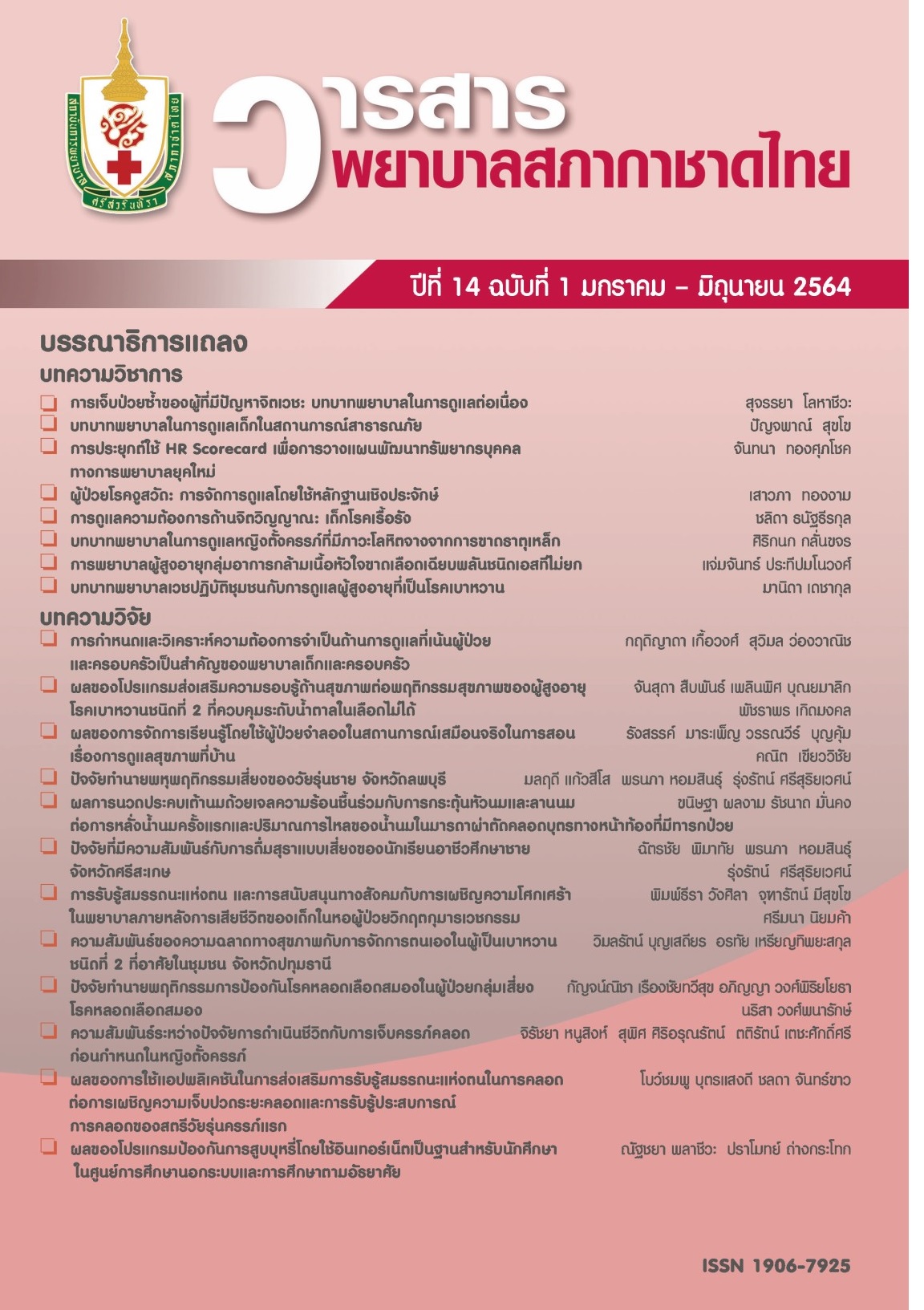
การรับรู้สมถรรนะแห่งตน และการสนับสนุนทางสังคมกับการเผชิญความโศกเศร้าในพยาบาลภายหลังการเสียชีวิตของเด็กในหอผู้ป่วยวิกฤตกุมารเวชกรรม
คำสำคัญ:
การเผชิญความโศกเศร้า, ความโศกเศร้าในพยาบาล, หอผู้ป่วยวิกฤตกุมารเวชกรรมบทคัดย่อ
การวิจัยครั้งนี้มีวัตถุประสงค์เพื่อศึกษาการรับรู้สมรรถนะแห่งตน และการสนับสนุนทางสังคมกับการเผชิญความโศกเศร้าของพยาบาลภายหลังการเสียชีวิตของเด็กในหอผู้ป่วยวิกฤตกุมารเวชกรรม กลุ่มตัวอย่างเป็นพยาบาลที่ปฏิบัติงานในหอผู้ป่วยวิกฤตกุมารเวชกรรม ที่ได้รับการขึ้นทะเบียนและใบอนุญาตประกอบวิชาชีพการพยาบาลและผดุงครรภ์ชั้น 1 จากสภาการพยาบาลในโรงพยาบาลตติยภูมิ จำนวน 92 ราย โดยเครื่องมือประกอบด้วยแบบสอบถามข้อมูลทั่วไป แบบสอบถามการรับรู้สมรรถนะแห่งตน แบบสอบถามการสนับสนุนทางสังคม และแบบสอบถามการเผชิญความโศกเศร้า โดยมีการวิเคราะห์ข้อมูลด้วยสถิติพรรณนา และสถิติสัมประสิทธิ์สหสัมพันธ์แบบเพียร์สัน
ผลการวิจัย พบว่า พยาบาลเผชิญความโศกเศร้าของพยาบาลจากการเสียชีวิตของเด็กในหอผู้ป่วยวิกฤตกุมารเวชกรรม ร้อยละ 63 พยาบาลมีการเผชิญความโศกเศร้าอยู่ในระดับต่ำ และความสัมพันธ์ระหว่างการรับรู้สมรรถนะแห่งตนกับการเผชิญความโศกเศร้ามีความสัมพันธ์ทางบวกในระดับต่ำอย่างมีนัยสำคัญทางสถิติ ( r = 0.244, p< .05) และการสนับสนุนทางสังคมกับการเผชิญความโศกเศร้ามีความสัมพันธ์ทางบวกในระดับปานกลางอย่างมีนัยสำคัญทางสถิติ (r = 0.348, p< .01)จากผลการศึกษาครั้งนี้ทำให้ได้ข้อมูลสำคัญเพื่อใช้เป็นแนวทางในการสนับสนุนพยาบาลในการเผชิญความโศกเศร้าจากการเสียชีวิตของผู้ป่วยเด็กในหอผู้ป่วยวิกฤตกุมารเวชกรรม
Downloads
เอกสารอ้างอิง
2. Ibiebele I, Algert CS, Bowen JR, Roberts CL. Pediatric admissions that include intensive care: a population-based study. BMC Health Serv Res 2018;18(1):264-72.
3. Bryant CR. From the top down: assisting critical care nurses in coping with job stresses [Thesis]. Lynchburg: Liberty University; 2017.
4. Stayer D, Lockhart JS. Living with dying in the pediatric intensive care unit: a nursing perspective. Am J Crit Care 2016;25(4):350-6.
5. Roseline A, Tasner C, Aichetou E. Coping strategies used by nurses in dealing with patient death and dying [Thesis]. Jyväskylän, Finland: JAMK University of Applied Sciences; 2016.
6. Zheng R, Lee SF, Bloomer MJ. How nurses cope with patient death: A systematic review and qualitative meta-synthesis. J Clin Nurs 2018;27(1-2):e39-e49.
7. Rodríguez-Rey R, Palacios A, Alonso-Tapia J, Pérez E, Álvarez E, Coca A, et al. Burnout and posttraumatic stress in pediatric critical care personnel: Prediction from resilience and coping styles. Aust Crit Care 2019;32(1):46-53.
8. Crowe S. Disenfranchised grief in the PICU: crying for attention. Pediatr Crit Care Med. 2017;18(8):e367-e9.
9. Jalowiec A, Murphy SP, Powers MJ. Psychometric assessment of the Jalowiec Coping Scale. Nurs Res 1989;33(3):157-61.
10. Lazarus R, Folkman S. Stress, appraisal and coping. New York: Springer Publishing; 1984.
11. Elkazaz RH, Berma AE. Stress and self efficacy among nurses in neonatal intensive care units. International Journal of Research-Granthaalayah 2017;5(2):237-51.
12. Wahlberg L, Nirenberg A, Capezuti E. Distress and coping self-efficacy in inpatient oncology nurses. Oncol Nurs Forum 2016;43(6):738-46.
13. Vaezfar SS, Azadi MM, Akbari BA, Rahimi M. The role of coping styles and self-efficacy in nurses job stress in hospital. IJPN 2014;2(2):22-32.
14. Jacobson DE. Types and timing of social support. J Health Soc Behav 1986;27(3):250-64.
15. Lobb EA, Oldham L, Vojkovic S, Kristjanson LJ, Smith J, Brown JM, et al. Frontline grief: The workplace support needs of community palliative care nurses after the death of a patient. JHPN 2010;12(4):225-33.
16. Krejcie RV, Morgan DW. Determining sample size for research activities. Educ Psycholo Measu 1970;30(3):607-10.
17. Bunjai S. Research methodology in nursing. Bangkok: U&I Intermedia; 2011. (in Thai)
18. Sawasdipanich N, Tiansawad S. Translation of tools for cross-cultural research: techniques and issues to be consider. Journal of Nursing 2012; 26(1):19-28. (in Thai)
19. Ratta N. Principles of creating psychological and education tests. Bangkok: Charoenwitayakanpim; 1990. (in Thai)
20. Meller N, Parker D, Hatcher D, Sheehan A. Grief experiences of nurses after the death of an adult patient in an acute hospital setting: An integrative review of literature. Collegian 2019;26(2):302-10.
21. Plante J, Cyr C. Health care professionals’ grief after the death of a child. Pediatr Child Health 2011;16(4):213-6.
22. Forster E, Hafiz A. Pediatric death and dying: exploring coping strategies of health professionals and perceptions of support provision. Int J Palliat Nurs 2015;21(6):294-301.
23. Strote J, Schrorder E, Lemos J, Paganelli R, Solberg J, Hutson HR. Academic emergency physicians’ experiences with patient death. Acad Emerg Med 2011;18(3):255-60.
24. Shimoinada K, O’Conner M, Lee S, Kissane D. Losses experienced by Japanese nurses and the way they grieve. Journal Hosp Palliat Nurs 2014;16(4):224-30.
25. Mojoyinola JK. Social support and recovery from bereavement: A study among bereaved persons in Oyo and Oke-Ogun Areas of Oyo State, Nigeria. An International Multi-Disciplinary Journal 2010;4(4):223-35.
ดาวน์โหลด
เผยแพร่แล้ว
รูปแบบการอ้างอิง
ฉบับ
ประเภทบทความ
สัญญาอนุญาต
เนื้อหาบทความหรือข้อคิดเห็นต่างๆ ในวารสารพยาบาลสภากาชาดไทยนี้ เป็นความคิดเห็นของผู้เขียนบทความ ไม่ใช่ความเห็นของกองบรรณาธิการ หรือสถาบันการพยาบาลศรีสวรินทิรา สภากาชาดไทย


