
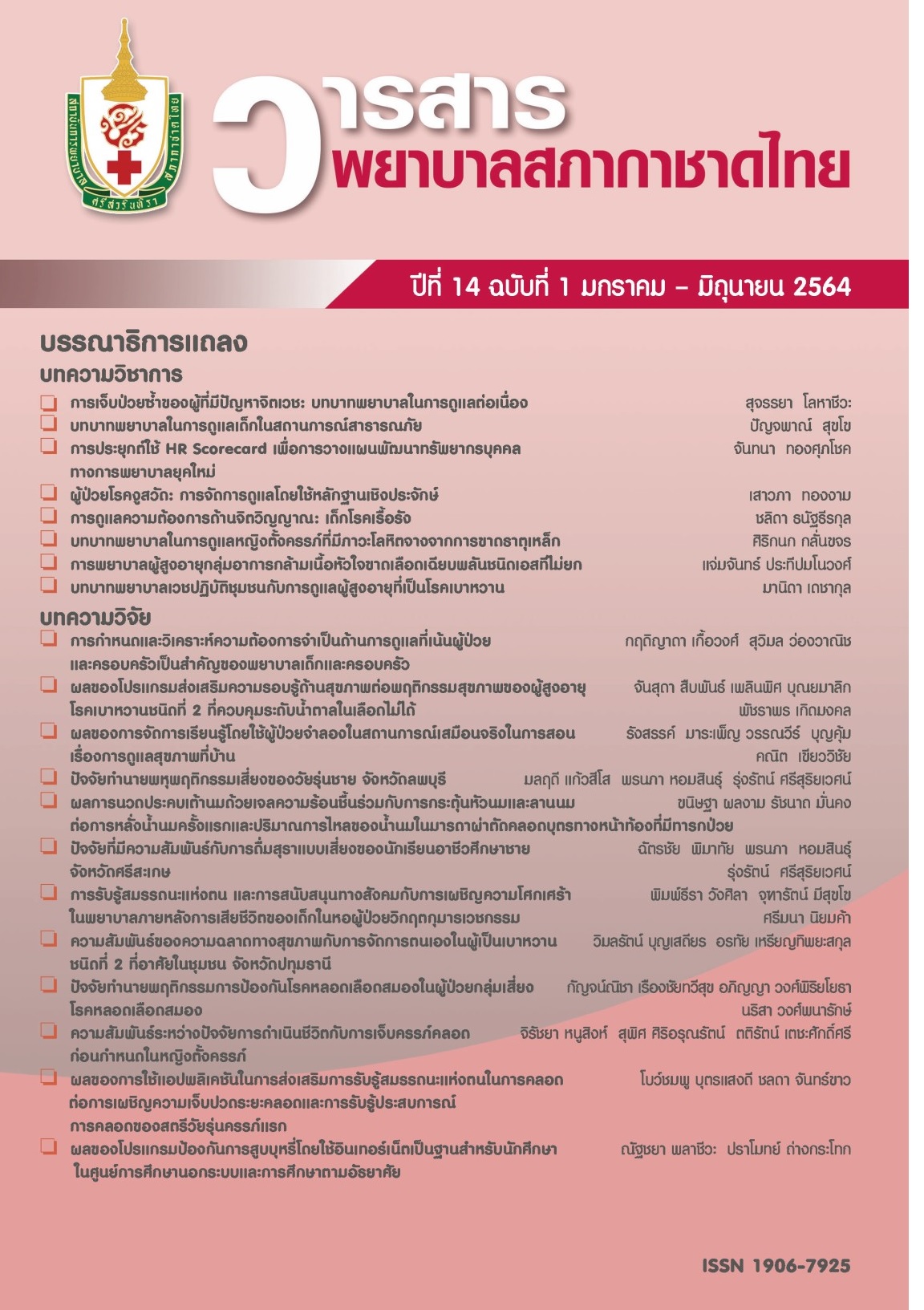
ผลของโปรแกรมป้องกันการสูบบุหรี่โดยใช้อินเทอร์เน็ตเป็นฐานสำหรับนักศึกษาในศูนย์การศึกษานอกระบบและการศึกษาตามอัธยาศัย
บทคัดย่อ
การวิจัยนี้เป็นการวิจัยเชิงทดลอง แบบ 2 กลุ่มวัดซ้ำ มีวัตถุประสงค์เพื่อศึกษาผลของโปรแกรมป้องกันการสูบบุหรี่โดยใช้อินเทอร์เน็ตเป็นฐานสำหรับนักศึกษาในศูนย์การศึกษานอกระบบและการศึกษาตามอัธยาศัย กลุ่มตัวอย่างแบ่งเป็นกลุ่มทดลองและกลุ่มควบคุม กลุ่มละ 32 ราย เครื่องมือที่ใช้ในการวิจัย ได้แก่ 1) โปรแกรมป้องกันการสูบบุหรี่โดยใช้อินเทอร์เน็ตเป็นฐาน และ 2) เครื่องมือที่ใช้ในการเก็บรวบรวมข้อมูล ประกอบด้วย (1) แบบวัดความรู้เกี่ยวกับการสูบบุหรี่ (2) แบบประเมินทัศนคติต่อการสูบบุหรี่ (3) แบบประเมินทักษะการตัดสินใจในการปฏิเสธการสูบบุหรี่ (4) แบบประเมินทักษะการปฏิเสธการสูบบุหรี่ และ (5) แบบประเมินการรับรู้ความสามารถของตนเองในการปฏิเสธการสูบบุหรี่ วิเคราะห์ข้อมูลด้วยสถิติเชิงพรรณนา และ Repeated Measures ANOVA
ผลการวิจัย ภายหลังการทดลองทันทีและในระยะติดตามผล 3 เดือน กลุ่มทดลองมีคะแนนเฉลี่ยความรู้เกี่ยวกับการสูบบุหรี่และการรับรู้ความสามารถของตนเองในการปฏิเสธการสูบบุหรี่เพิ่มขึ้นอย่างมีนัยสำคัญทางสถิติ (p < .05) กลุ่มทดลองและกลุ่มควบคุมมีคะแนนเฉลี่ยความรู้เกี่ยวกับการสูบบุหรี่และการรับรู้ความสามารถของตนเองในการปฏิเสธการสูบบุหรี่แตกต่างกันอย่างมีนัยสำคัญทางสถิติ (p < .05)
พยาบาลชุมชนหรือครูสามารถนำโปรแกรมไปพัฒนาความรู้ในการป้องกันการสูบบุหรี่และการรับรู้ความสามารถของตนเองในการปฏิเสธการสูบบุหรี่ได้
Downloads
เอกสารอ้างอิง
2. Suvamat J, Thiammok M. The review of activities on smoking prevention for adolescents. Journal of Boromarajonani College of Nursing, Bangkok 2018;34(1):141-9. (in Thai)
3. Thangkratok P, Chaimo E, Yingyoud P, Trainattawan W. Prevalence of tobacco smoking among nursing students: a systematic review. Journal of Health Science 2019;28(4):601-9. (in Thai)
4. National Center for Chronic Disease Prevention and Health Promotion (U.S.) Office on Smoking and Health. Preventing tobacco use among youth and young adults: a report of the Surgeon General. Atlanta, GA: Centers for Disease Control and Prevention (US); 2012.
5. Pichai P, Rungchamrus J. Alternative approaches to development of a program for smoking cessation among adolescents. Journal of Humanities and Social Sciences Thonburi University 2015;9(19):158-69. (in Thai)
6. Santano-Mogena E, Franco-Antonio C, Chimento-Díaz S, Rico-Martín S, Cordovilla-Guardia S. Factors associated with smoking susceptibility among high school students in western Spain. Sci Rep 2021;11(1):1988. https://doi.org/10.1038/s41598-021-81723-5
7. Gwaltney CJ, Metrik J, Kahler CW, Shiffman S. Self-efficacy and smoking cessation: a meta-analysis. Psychol Addict Behav 2009;23(1):56-66.
8. Bandura A. Self-efficacy: the exercise of control. New York: W.H. Freeman; 1997.
9. Elshatarat RA, Yacoub MI, Khraim FM, Saleh ZT, Afaneh TR. Self-efficacy in treating tobacco use: a review article. Proceedings of Singapore Healthcare 2016;25(4):243-8.
10. Janz NK, Becker MH. The health belief model: a decade later. Health Educ Q 1984;11(1):1-47.
11. Fishbein M, Ajzen I, Flanders NA. Belief, attitude, intention, and behavior: an introduction to theory and research. Massachusetts: Addison-Wesley; 1975.
12. Bandura A. Self-efficacy: toward a unifying theory of behavioral change. Psychol Rev 1977;84(2):191-215.
13. Palacheewa N, Thangkratok P. Digital technology: innovation for smoking prevention among children and adolescents in the twenty-first century. Thai Journal of Cardio-Thoracic Nursing 2019;30(2):15-25. (in Thai)
14. Palacheewa N, Tiansawad S, Srisuphan W, Whattananarong K, Duffy SA. Development of an internet-based smoking prevention program for young male adolescents in Thailand. Pacific Rim Int J Nurs Res 2014;18(3):228-43. (in Thai)
15. Hwang MS, Yeagley KL, Petosa R. A meta-analysis of adolescent psychosocial smoking prevention programs published between 1978 and 1997 in the United States. Health Educ Behav 2004;31(6):702-19.
16. Jantachum W. Development of smoking-prevention strategies among students through participation process: a case study of an expansion school in Kalasin Province. Journal of Behavioral Science 2006:23(1);94-109. (in Thai)
17. Homsin P. Concepts and theories for practice: smoking and alcohol drinking prevention among adolescents. Chonburi: Faculty of Nursing Burapha University; 2015. (in Thai)
18. Ongiem A, Vichitvejpaisal P. Validation of the tests. Thai J Anesthesiol 2018;44(1):36-42. (in Thai)
19. Taber KS. The use of Cronbach’s alpha when developing and reporting research instruments in acience education. Res Sci Educ 2018;48(6):1273-96.
20. Park E, Drake E. Systematic review: internet-based program for youth smoking prevention and cessation. J Nurs Scholarshi 2015;47(1):43-50.
ดาวน์โหลด
เผยแพร่แล้ว
รูปแบบการอ้างอิง
ฉบับ
ประเภทบทความ
สัญญาอนุญาต
เนื้อหาบทความหรือข้อคิดเห็นต่างๆ ในวารสารพยาบาลสภากาชาดไทยนี้ เป็นความคิดเห็นของผู้เขียนบทความ ไม่ใช่ความเห็นของกองบรรณาธิการ หรือสถาบันการพยาบาลศรีสวรินทิรา สภากาชาดไทย


