
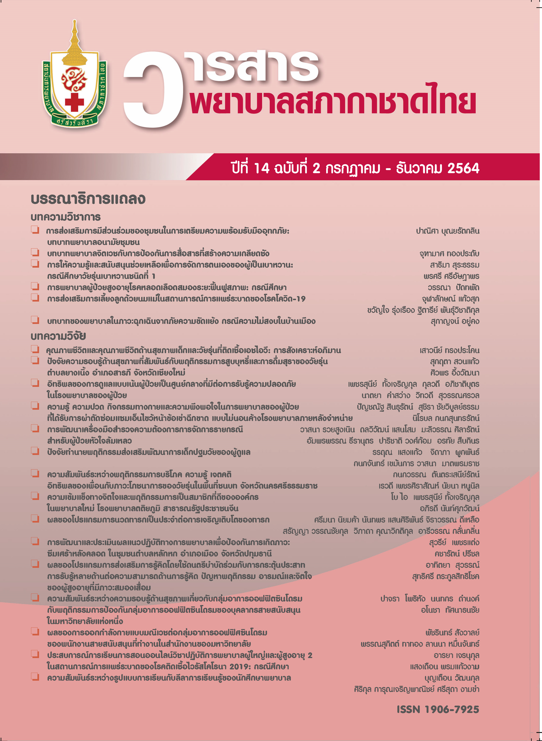
ความเข้มแข็งทางจิตใจและพฤติกรรมการเป็นสมาชิกที่ดีขององค์กรในพยาบาลใหม่ โรงพยาบาลตติยภูมิ สาธารณรัฐประชาชนจีน
คำสำคัญ:
ความเข้มแข็งภายใน, พฤติกรรมการเป็นสมาชิกที่ดีขององค์กร, พยาบาลใหม่, โรงพยาบาลตติยภูมิบทคัดย่อ
การเสริมสร้างความเข้มแข็งทางจิตใจช่วยให้พยาบาลเกิดพฤติกรรมการเป็นสมาชิกที่ดีขององค์กร การศึกษาเชิงพรรณนาแบบสหสัมพันธ์นี้มีวัตถุประสงค์เพื่อศึกษาระดับความเข้มแข็งและพฤติกรรมการเป็นสมาชิกที่ดีขององค์กรในพยาบาลใหม่ สาธารณรัฐประชาชนจีน รวมทั้งหาความสัมพันธ์ของทั้งสอง กลุ่มตัวอย่างประกอบด้วยพยาบาลใหม่จำนวน 162 คน ที่ทำงานในโรงพยาบาลตติยภูมิสองแห่งในเขตปกครองตนเองสิบสองปันนา สาธารณรัฐประชาชนจีน และสุ่มตัวอย่างโดยใช้การสุ่มแบบแบ่งชั้น เครื่องมือวิจัยประกอบด้วย แบบวัดความเข้มแข็งภายในฉบับภาษาจีนที่พัฒนาโดยฟางและคณะ (2015) และแบบวัดพฤติกรรมการเป็นสมาชิกที่ดีขององค์กร ประเทศไต้หวัน ที่พัฒนาโดยฟาร์และคณะ (1997) ซึ่งแบบวัดความเข้มแข็งภายในมีค่าสัมประสิทธิ์แอลฟาของครอนบาร์คเท่ากับ .86 และแบบวัดพฤติกรรมการเป็นสมาชิกที่ดีขององค์กรประเทศไต้หวันโดยรวมทั้งฉบับมีสัมประสิทธิ์แอลฟาของครอนบาร์คเท่ากับ 0.88 วิเคราะห์ข้อมูลโดยใช้สถิติเชิงพรรณนาและการหาสัมประสิทธิ์สหสัมพันธ์แบบสเปียร์แมน
ผลการวิจัยพบว่าพยาบาลใหม่มีความเข้มแข็งภายในอยู่ในระดับปานกลาง (M = 135.14, SD = 19.47) และพฤติกรรมการเป็นสมาชิกที่ดีขององค์กรอยู่ในระดับสูง ( M =6.33, SD = 0.46) ความเข้มแข็งภายในมีความสัมพันธ์กับพฤติกรรมการเป็นสมาชิกที่ดีขององค์กรอย่างมีนัยสำคัญทางสถิติ (rs = .521, p-value =.001)
ผลการศึกษานี้แสดงให้เห็นว่าความสำคัญของความเข้มแข็งภายในที่มีต่อพฤติกรรมการเป็นสมาชิกที่ดีขององค์กรและชี้ให้เห็นความจำเป็นที่ผู้บริหารการพยาบาลจะต้องหาวิธีในการเพิ่มพฤติกรรมความเข้มแข็งภายในของพยาบาลใหม่ โดยอาจใช้การฝึกอบรมเพื่อสร้างความเข้มแข็งภายในของพยาบาลใหม่ การมีตัวแบบความเข้มแข็งภายในและการจัดให้มีระบบสนับสนุนพยาบาลใหม่
Downloads
เอกสารอ้างอิง
Kovner CT, Brewer CS, Fatehi F, Jun J. What does nurse turnover rate mean and what is the rate ?. Policy Politics Nurs Pract 2014;15(3-4): 64-71.
Laschinger HK, Cummings G, Leiter M, Wong C, MacPhee M, Ritchie J, et al. Starting out: a time-lagged study of new graduate nurses’ transition to practice. Int J Nurs Stud 2016;57:82-95.
Phillips C, Kenny A, Esterman A, Smith C. A secondary data analysis examining the needs of graduate nurses in their transition to a new role. Nurse Educ Pract 2014;14(2):106-111.
Organ DW, Podsakoff PM, MacKenzie SB. Organizational citizenship behavior: its nature, antecedents, and consequences. Thousand Oaks: Sage Publications; 2006.
Farh J-L, Earley PC, Lin S-C. Impetus for action: a cultural analysis of justice and organisational citizenship behavior in Chinese society. Adm Sci Q 1997;42(3):421-44.
Paul H, Bamel UK, Garg P. Employee resilience and OCB: mediating effects of organizational commitment. Vikalpa 2016; 41(4): 308-24.
Yang Q. Leader-member exchange and organizational citizenship behavior among nurses in Tertiary Hospitals, Yunnan Province, The people’s republic of China [Master thesis of Nursing]. Chiang Mai: Chiang Mai University; 2012. (in Thai)
Chu L-C. Mediating toxic emotions in the workplace - the impact of abusive supervision. J Nurs Manag 2014;22(8):953-63.
Wagnild GM, Young HM. Development and psychometric evaluation of the resilience scale. J Nurs Meas 1993;1(2):165-78.
Yang F, Bao JM, Huang XH, Guo Q, Smith GD. Measurement of resilience in Chinese older people. Int Nurs Rev 2015;62(1):130-9.
Paul H, Garg P. Elevating organizational consequences through employee resilience [Internet]. 2012 [cited 2020 Nov 2]. Available from:
Hatmi K, Esmaeili R M, Sajadi HS. Predict organizational citizenship behavior of the staff based on the factors of the psychological capital and staff of Ministry of Sport and Youth. Turk J Sport Exe 2017;19(2):162-8.
Li Q, He LX, Peng H. Study on influence of “one-to-one” tutorial system on occupational self-efficacy of new nurses in intensive care unit and emergency department. Chin Nurs Res 2014;1:110-3.
Zhang YP, Huang X, Xu SV, Xu CJ, Feng XQ, Jin JF. Can a one-on-one mentorship program reduce the turnover rate of new graduate nurses in China? A longitudinal study. Nurse Educ Pract 2019;40:102616. doi: 10.1016/j.nepr.2019.08.010.
Guo YF, Cross W, Plummer V, Lam L, Luo YH, Zhang JP. Exploring resilience in Chinese nurses: a cross-sectional study. J Nurs Manag 2017;25(3):223-30.
Shi Y, Guo H, Zhang S, Xie F, Wang J, Sun Z, et al. Impact of workplace incivility against new nurses on job burn-out: a cross sectional study in China. BMJ Open 2018;8:e020461. doi:10.1136/ bmjopen-2017-020461.
Krejcie RV, Morgan DW. Determination sample size for research activities. Educ Psychol Meas 1970;30(3):607-10.
Wang L, Tao H, Bowers BJ, Brown R, Zhang Y. Influence of social support and self-efficacy on resilience of early career registered nurses. West J Nurs Res 2018;40(5):648-64.
Horner DK. Mentoring: positively influencing job satisfaction and retention of new hire nurse practitioners. Plast Surg Nurs 2017;37(1):7–22.
Eddins EE, Hu J, Liu H. Baccalaureate nursing education in China: issues and challenges. Nurs Educ Perspect 2011;32(1):30-3.
ดาวน์โหลด
เผยแพร่แล้ว
รูปแบบการอ้างอิง
ฉบับ
ประเภทบทความ
สัญญาอนุญาต

อนุญาตภายใต้เงื่อนไข Creative Commons Attribution-NonCommercial-NoDerivatives 4.0 International License.
เนื้อหาบทความหรือข้อคิดเห็นต่างๆ ในวารสารพยาบาลสภากาชาดไทยนี้ เป็นความคิดเห็นของผู้เขียนบทความ ไม่ใช่ความเห็นของกองบรรณาธิการ หรือสถาบันการพยาบาลศรีสวรินทิรา สภากาชาดไทย


