
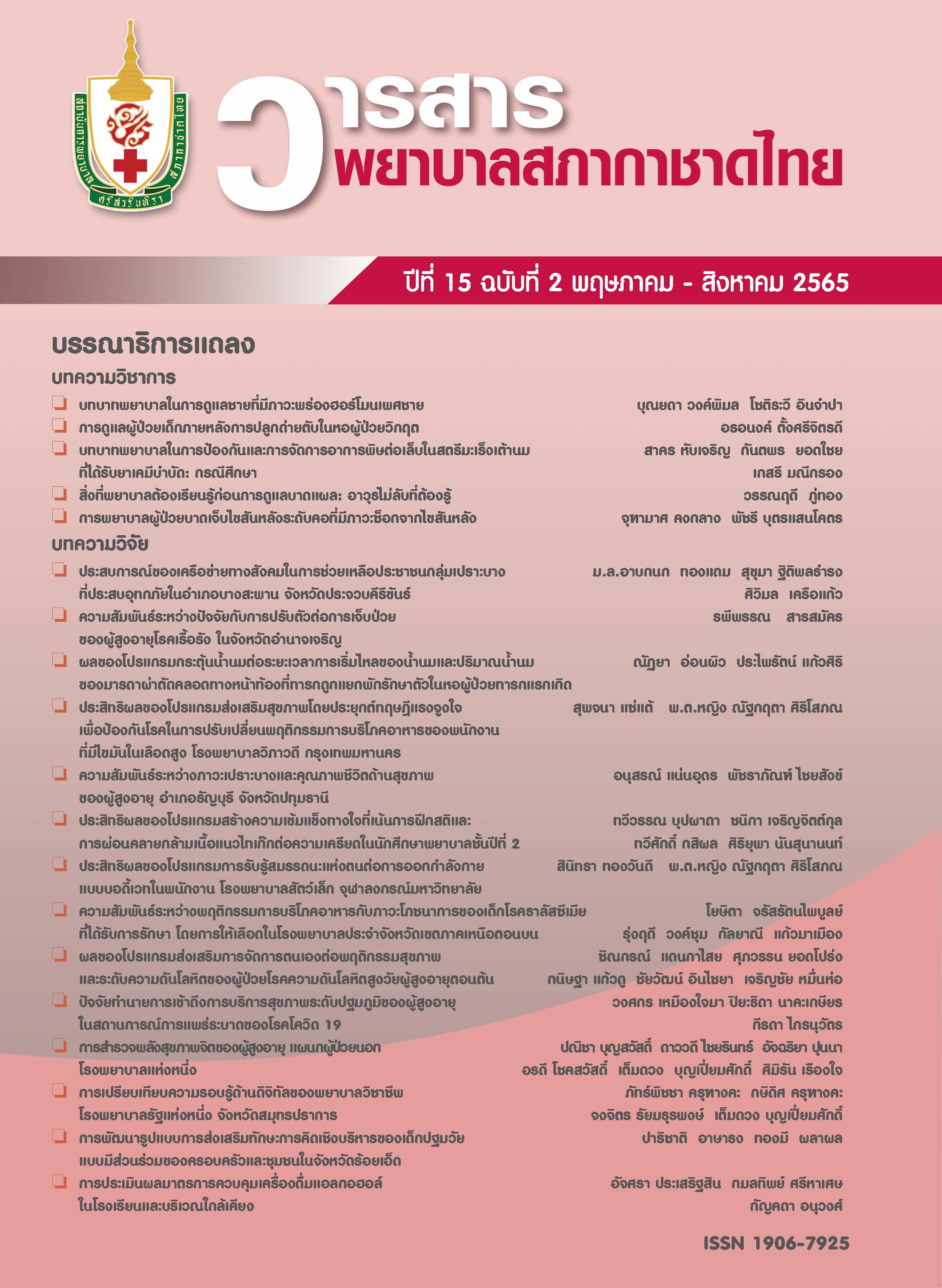
การเปรียบเทียบความรอบรู้ด้านดิจิทัลของพยาบาลวิชาชีพ โรงพยาบาลรัฐแห่งหนึ่ง จังหวัดสมุทรปราการ
คำสำคัญ:
ความรอบรู้ด้านดิจิทัล , พยาบาลวิชาชีพ , การเปรียบเทียบบทคัดย่อ
ความรอบรู้ด้านดิจิทัลเป็นความสามารถหนึ่งที่สำคัญของพยาบาลวิชาชีพ เพื่อให้สามารถใช้อุปกรณ์ เทคโนโลยีดิจิทัลในการดูแลสุขภาพได้อย่างเหมาะสมและมีประสิทธิภาพ การศึกษาครั้งนี้มีวัตถุประสงค์ เพื่อศึกษาระดับความรอบรู้ ด้านดิจิทัลและเปรียบเทียบความรอบรู้ด้านดิจิทัลจำแนกตามปัจจัยภูมิหลังของ พยาบาลวิชาชีพ ตัวอย่างเป็นพยาบาลวิชาชีพโรงพยาบาลรัฐแห่งหนึ่ง จังหวัดสมุทรปราการ จำนวน 260 คน เก็บรวบรวมข้อมูลด้วยแบบสอบถามความรอบรู้ด้านดิจิทัล ตรวจสอบความตรงเชิงเนื้อหาจากผู้ทรงคุณวุฒิจำนวน 3 คน ได้ค่าดัชนีความสอดคล้องของแต่ละข้อคำถามอยู่ ระหว่าง .67-1.00 และ วิเคราะห์ค่าความเชื่อมั่นโดยใช้สูตรสัมประสิทธิ์แอลฟาของครอนบาครายด้าน อยู่ระหว่าง .946-.979 และทั้งฉบับเท่ากับ .991 วิเคราะห์ข้อมูลโดยใช้สถิติเชิงพรรณนาและสถิติการวิเคราะห์เปรียบเทียบค่าเฉลี่ยของข้อมูลโดยใช้เทคนิคการวิเคราะห์ความแปรปรวนสามทิศทาง
ผลการศึกษา พบว่า ความรอบรู้ด้านดิจิทัลโดยรวมของพยาบาลวิชาชีพอยู่ในระดับปานกลาง เมื่อเปรียบเทียบความรอบรู้ด้านดิจิทัลจำแนกตามภูมิหลังของพยาบาลวิชาชีพ พบว่า ระดับความรอบรู้ด้านดิจิทัลของพยาบาลวิชาชีพที่มีอายุแตกต่างกัน ไม่ขึ้นอยู่กับความถี่ในการใช้เทคโนโลยีดิจิทัล และประสบการณ์การอบรมหรือการฝึกใช้เทคโนโลยีดิจิทัลอย่างมีนัยสำคัญทางสถิติที่ระดับ .05 แต่เมื่อเปรียบเทียบในแต่ละ ปัจจัยภูมิหลัง พบว่า อายุ และความถี่ในการใช้เทคโนโลยีดิจิทัลของพยาบาลวิชาชีพที่ต่างกันมีระดับความ รอบรู้ด้านดิจิทัลแตกต่างกันอย่างมีนัยสำคัญทางสถิติที่ระดับ .05 ส่วนประสบการณ์การอบรมหรือการฝึกใช้เทคโนโลยีดิจิทัลที่แตกต่างกันมีระดับความรอบรู้ด้านดิจิทัลไม่แตกต่างกันอย่างมีนัยสำคัญทางสถิติที่ระดับ .05 สารสนเทศที่ได้สามารถนำไปใช้เป็นแนวทางในการพัฒนาสร้างเสริมความรอบรู้ด้านดิจิทัลให้กับพยาบาลวิชาชีพในแต่ละด้านให้มีประสิทธิภาพมากยิ่งขึ้น
Downloads
เอกสารอ้างอิง
Hani U, Sonhaji S, Anggraini CN. Media digital literacy program in improving parental mediation efficacy with community nursing approach. STRADA Journal Ilmiah Kesehatan 2020;9(2):1779-87. doi.org/10.30994/sjik.v9i2.522
Ministry of Digital Economy and Society. Government action plan Ministry of Digital Economy and Society Fiscal Year 2021. Bangkok: Ministry of Digital Economy and Society; 2021. (in Thai)
Kruse CS, Beane A. Health information technology continues to show positive effect on medical outcomes: systematic review. J Med Internet Res 2018;20(2):e41. doi: 10.2196/jmir.8793.
Skiba DJ. Nursing informatics education: from automation to connected care. Stud Health Technol Inform 2017;232:9-19. https://doi.org/10.3233/978-1-61499-738-2-9.
De Leeuw JA, Woltjer H, Kool RB. Identification of factors influencing the adoption of health information technology by nurses who are digitally lagging: In-depth interview study. J Med Internet Res 2020;22(8):e15630. https://doi.org/10.2196/15630
Brown J, Pope N, Bosco AM, Mason J, Morgan A. Issues affecting nurses’ capability to use digital technology at work: an integrative review. J Clin Nurs 2020;29 (15-16):2801-19. https://doi.org/10.1111/jocn.15321
Law N, Woo D, Wong G. A global framework of reference on digital literacy skills for indicator 4.4.2 [Internet]. Montreal: UNESCO Institute for Statistics; 2018 [cited 2022 Feb 3 ]. Available from: http://uis.unesco.org/sites/default/files/documents/ip51-global-framework-reference-digital-literacy-skills-2018-en.pdf
Rahman T, Amalia A, Aziz Z. From digital literacy to digital intelligence a comparative study of digital literacy frameworks. Proceedings of the 4th International Conference on Sustainable Innovation 2020-Social, Humanity, and Education (ICoSIHESS 2020); 2021 Jan 21; Netherlands: Atlantis Press; 2021. p. 154-9. https://doi.org/10.2991/ assehr.k.210120.11N9
Hughes SA. The digital nurse: experimenting with open sourced multimedia. Research summary for the open university module H818 the networked practitioner [Internet]. 2017 [cited 2022 Feb 3]. Available from: http://oro.open.ac.uk/72144/
Staggers N, Elias BL, Makar E, Alexander GL. The imperative of solving nurses’usability problems with health information technology. J Nurs Adm 2018;48(4):191-6. doi: 10.1097/NNA.0000000000000598.
Khezri H, Abdekhoda M. Assessing nurses’ informatics competency and identifying its related factors. J Res Nurs 2019;24(7):529-38. doi: 10.1177/1744987119839453.
Kleib M, Nagle L. Factors associated with Canadian nurses’ informatics competency. CIN: Computers, Informatics, Nursing 2018;36(8):406-15. doi: 10.1097/ CIN.00000000 00000434
Krejcie RV, Morgan DW. Determining sample size for research activities. Educ Psychol Meas 1970;30(3):607-10. https://doi.org/10.1177/001316447003000308
Aguilera LS, Dickey EK, Guzman K. Using interdisciplinary dress rehearsal events to ensure staff readiness when opening a new healthcare facility. HERD 2020;13(1): 221-33. doi: 10.1177/1937586719861553.
Knippa S, Senecal PA. Using simulation to prepare nursing staff for the move to a new building. Journal for Nurses in Professional Development 2017;33(2):E1-5. https:// doi.org/10.1097/NND.0000000000000329
Health Education England. Improving digital literacy. Leeds: HEE; 2018
Brown J, Morgan A, Mason J, Pope N, Bosco AM. Student nurses’ digital literacy levels: Lessons for curricula. Comput Inform Nurs 2020;38(9):451-8. https://doi. org/10.1097/CIN.0000000000000615
Sharma A, Harrington RA, McClellan MB, Turakhia MP, Eapen ZJ, Steinhubl S, et al. Using digital health technology to better generate evidence and deliver evidence-based care. J Am Coll Cardiol 2018;71(23):2680-90. doi: 10.1016/j.jacc.2018.03.523.
Pholtana S, Hanprom N, et al. Factors related to information and communication technology behaviors of nursing student, Royal Thai Navy College of Nursing. Royal Thai Navy Medical Journal 2017;44(3):19-34. (in Thai)
Jouparinejad S, Foroughameri G, Khajouei R, Farokhzadian J. Improving the infor-matics competency of critical care nurses: results of an interventional study in the southeast of Iran. BMC Med Inform Decis Mak 2020;20(1):220. doi: 10.1186/s12911-020-01244-5
ดาวน์โหลด
เผยแพร่แล้ว
รูปแบบการอ้างอิง
ฉบับ
ประเภทบทความ
สัญญาอนุญาต
ลิขสิทธิ์ (c) 2022 สถาบันการพยาบาลศรีสวรินทิรา สภากาชาดไทย

อนุญาตภายใต้เงื่อนไข Creative Commons Attribution-NonCommercial-NoDerivatives 4.0 International License.
เนื้อหาบทความหรือข้อคิดเห็นต่างๆ ในวารสารพยาบาลสภากาชาดไทยนี้ เป็นความคิดเห็นของผู้เขียนบทความ ไม่ใช่ความเห็นของกองบรรณาธิการ หรือสถาบันการพยาบาลศรีสวรินทิรา สภากาชาดไทย


