
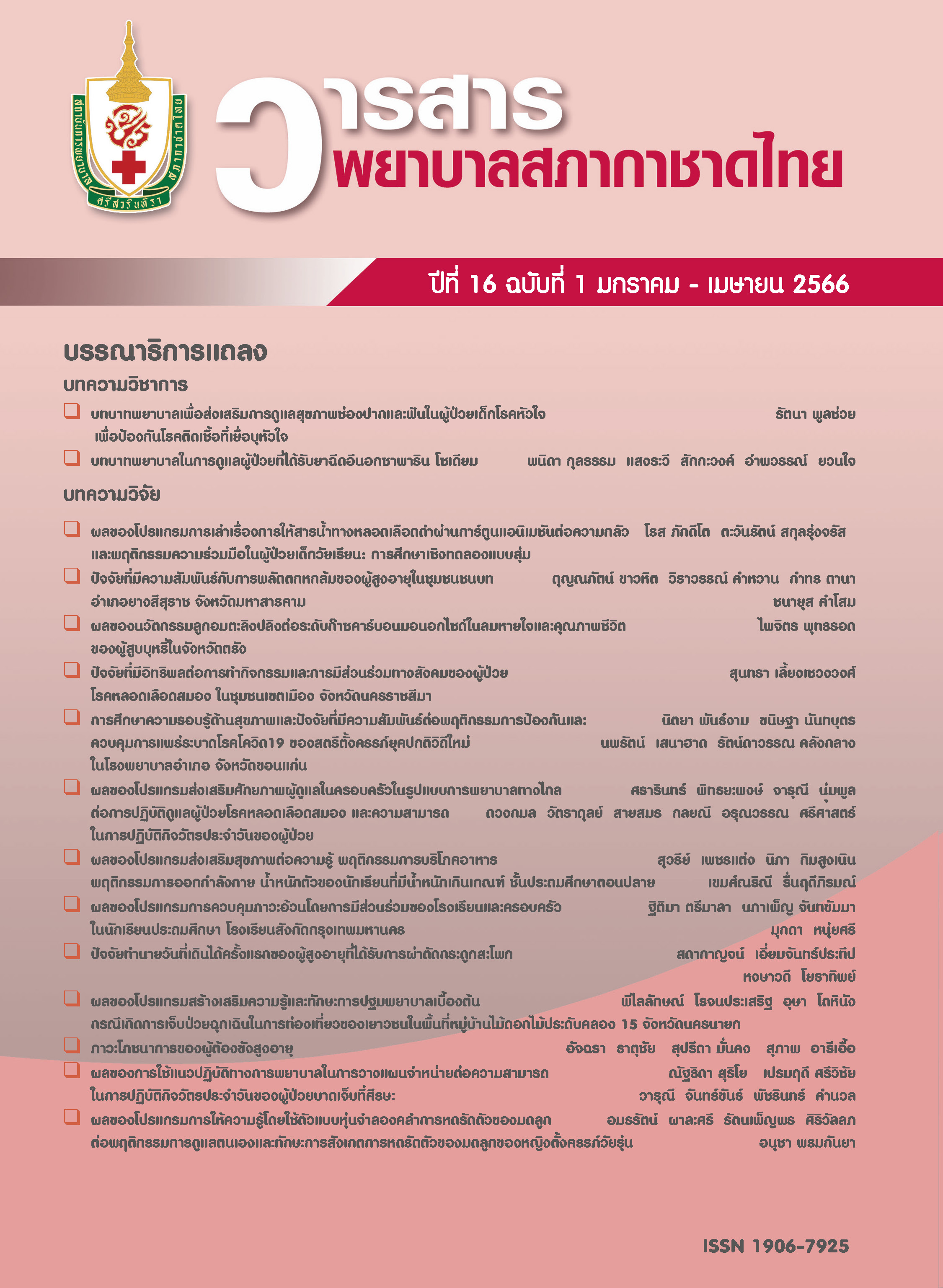
Effects of School and Family - Based Obesity Control Program on Primary School Students Under the Jurisdiction of the Bangkok Metropolitan Area
Keywords:
obesity control, primary school students, self-efficacy, school and family participationAbstract
This quasi-experimental study aimed to evaluate the effects of a school and family-based obesity control program. The sample consisted of grade 4 - 5 primary school students who were overweight or obese in Yannawa District, Bangkok Metropolitan Area. Participants were chosen through simple random sampling with inclusion criteria and were divided into experimental and control groups of 32 people each. The experimental group participated in the school and family - based obesity control program based on the concept of self - efficacy for a period of eight weeks. Data were collected using questionnaires consisting of five parts: 1) general information about the students, 2) general information about the parents, 3) self-efficacy perception, 4) outcome expectations, and 5) obesity control behaviors. The reliability coefficients of parts 3, 4, and 5 of the questionnaires were .88, .87, and .79, respectively. Data were analyzed using descriptive statistics and t-test.
The results showed that after participating in the program, the scores for self - efficacy perception, outcome expectations, and obesity control behaviors of the experimental group were all significantly higher than the both the pre - program scores and the control group (p < .05). Also, the body mass index and waist circumference, of the experimental group were significantly lower than before using the program (p < .05) but were not significantly lower than the control group. These findings are useful for those interested in applying the program and possibly suggest increasing the duration of the program to 12 weeks or more to examine changes in body mass index and waist circumference
Downloads
References
Bureau of Nutrition, Department of Health, Ministry of Public Health. Guidelines for prevention and control of obesity in school-aged children. 1. Bangkok: The War Veterans Organization; 2014. (in Thai)
Pulgaron ER. Childhood obesity: a review of increased risk for physical and psychological comorbidities. Clin Ther 2013;35(1):18-32.
Department of Health, Ministry of Public Health. School-age children are overweight and obese. DoH Dashboard [Internet]. 2022 Jun [cited 2022 Jun 23]. Available from: https://dashboard.anamai.moph.go.th/dashboard/overweightstudent/index?year=2022. (in Thai)
No-in K. Overweight and obesity among Thai school-aged children and adolescents. J Royal Thai Army Nurses 2017;18(suppl.):1-18. (in Thai).
Nutrition Division, Health Department, Bangkok Metropolitan Administration. Annual reports and key statistics [Internet]. 2021 [cited 2022 Jun 1]. Available from: https:// webportal bangkok.go.th /health/page/sub/13924/Annual%20 reports%20and%20 key%20 statistics. (in Thai)
Numpoon J. School age child with obesity: the role of community nurse practitioner for health promotion. Thai Red Cross Nursing Journal 2015;8(2):1-12. (in Thai)
Jantacumma N, Manachevakul S, Cheevakasemsook A, Kaewsan P, Sanboonsong P. Effects of a school-based overweight control program on primary school students in Nonthaburi Province. Royal Thai Navy Medical Journal 2020;47(2):301-16. (in Thai)
Jumrongpeng J, Kummabutr J, Buaboon N. Effects of a weight control program on eating, physical-activity behaviors, and bodyweight among overweight, late school-age children. Journal of Health Science Research 2019;13(1):1-10. (in Thai)
Tuntiakarat S, Khuneepong A. The effectiveness of health behavior modification program among overweight and obesity primary school students. Journal of Nursing and Education 2019;12(1):100-16. (in Thai)
Sanprik S. The effects of health education program applying self-efficacy theory towards weight control among grade 6 students at Kajonkietsuksa school, Phuket province. Community Health Development Quarterly Khon Kaen University 2017;5(2):297-314. (in Thai)
Chaisri J, Klungtumneim K, Buajarean H. Clinical nursing practice guideline for management of obesity in children: the synthesis of thesis. J Royal Thai Army Nurses 2014;15(2):360-7. (in Thai)
Bandura A. Self-efficacy: toward a unifying theory of behavioral change. Psychol Rev 1977;84(2):191-215. doi: 10.1037//0033-295x.84.2.191
Powwattana A, Kalampakorn S, Lagampan S, Rawiworrakul T. Health promotion and disease prevention in community: an application of concepts and theories to practice. 1. Chachoengsao: M N Compute Offset; 2018. (in Thai)
Suwanumpa N, Salawongluk T. The effect of dietary and exercise modification program for obesity prevention among primary schools in Nakhon Ratchasima muncpality. Ratchaphruek Journal 2019;17(1):111-20. (in Thai)
Tuntiakarat S, Thongbai W, Takviriyanun N. The effectiveness of obesity prevention program on eating and physical activity behaviors among overweight school-aged children. Journal of Boromarajonani College of Nursing, Bangkok 2015;31(3):47-61. (in Thai)
Kitchanapaibul S, Klunklin S, Klunklin A. The effectiveness of a health education program by applying the self efficacy theory on eating behavior of late primary school students with overweight condition at the basic education expansion in Chiang Kham, Phayao Province. Nursing Journal 2013;40(2):77-87. (in Thai)
Efthymiou V, Charmandari E, Vlachakis D, Tsitsika A, Patasz A, Chrousos G, et al. Adolescent self-efficacy for diet and exercise following a school-based multicomponent lifestyle intervention. Nutrients [Internet]. 2021 [cited 2022 Jun 1];14(1):97. Available from: https://doi.org/10.3390/nu14010097.
Chae SM, Yeo JY, Hwang JH, Kang HS. Effects of school based “We fit” weight control program in adolescents. Nurs Open 2022;9(1):721-32.
Liu Z, Wu Y, Niu WY, Feng X, Lin Y, Gao A, et al. A school-based, multi-faceted health promotion programme to prevent obesity among children: protocol of a cluster-randomised controlled trial (the DECIDE-Children study). BMJ Open 2019;9(11):e027902. doi: 10.1136/bmjopen-2018-027902
Downloads
Published
How to Cite
Issue
Section
License
Copyright (c) 2023 Srisavarindhira Thai Red Cross Institute of Nursing

This work is licensed under a Creative Commons Attribution-NonCommercial-NoDerivatives 4.0 International License.
เนื้อหาบทความหรือข้อคิดเห็นต่างๆ ในวารสารพยาบาลสภากาชาดไทยนี้ เป็นความคิดเห็นของผู้เขียนบทความ ไม่ใช่ความเห็นของกองบรรณาธิการ หรือสถาบันการพยาบาลศรีสวรินทิรา สภากาชาดไทย


