
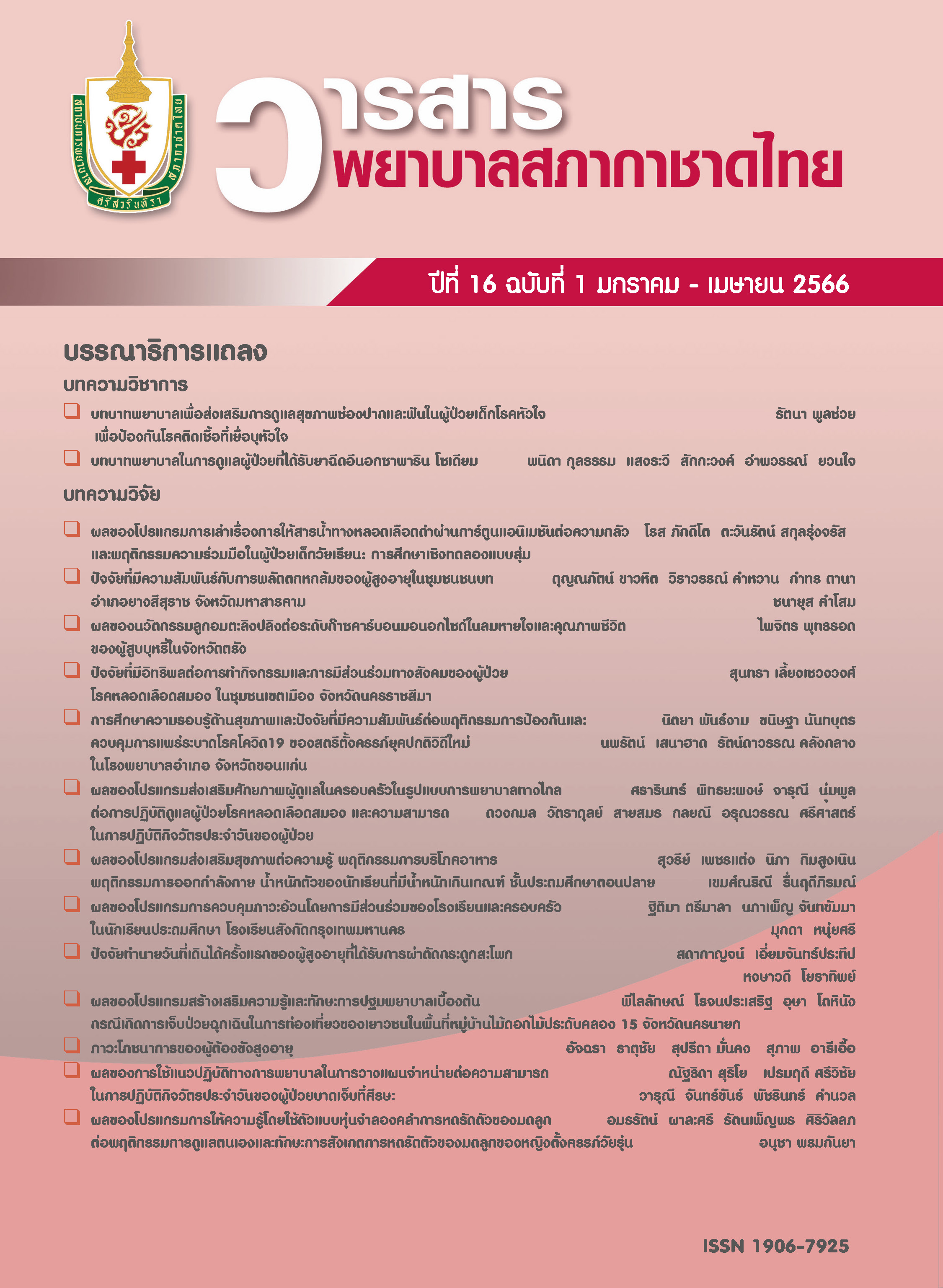
ผลของโปรแกรมการให้ความรู้โดยใช้ตัวแบบหุ่นจำลองคลำการหดรัดตัวของมดลูกต่อพฤติกรรมการดูแลตนเองและทักษะการสังเกตการหดรัดตัวของมดลูกของหญิงตั้งครรภ์วัยรุ่น
คำสำคัญ:
พฤติกรรมการดูแลตนเอง, หุ่นจำลองคลำการหดรัดตัวของมดลูก, การหดรัดตัวของมดลูก , หญิงตั้งครรภ์วัยรุ่นบทคัดย่อ
การวิจัยครั้งนี้มีวัตถุประสงค์ เพื่อศึกษาผลของโปรแกรมการให้ความรู้โดยใช้ตัวแบบหุ่นจำลอง คลำการหดรัดตัวของมดลูกต่อพฤติกรรมการดูแลตนเองและทักษะการสังเกตการหดรัดตัวของมดลูกของหญิงตั้งครรภ์วัยรุ่นที่เข้ารับบริการฝากครรภ์ในโรงพยาบาลทั่วไปแห่งหนึ่งในจังหวัดชัยภูมิ อายุครรภ์ระหว่าง 28 - 37 สัปดาห์ จำนวน 30 คน เครื่องมือที่ใช้ในการเก็บรวบรวมข้อมูล ได้แก่ แบบสอบถาม ข้อมูลทั่วไป แบบสอบถามพฤติกรรมการดูแลตนเองและแบบประเมินทักษะการสังเกตการหดรัดตัวมดลูก ตรวจสอบคุณภาพเครื่องมือโดยผู้ทรงคุณวุฒิ 3 ท่าน ได้ความตรงเชิงเนื้อหา .86 และตรวจสอบความเที่ยงของแบบสัมภาษณ์ได้ค่าสัมประสิทธิ์แอลฟาครอนบาค เท่ากับ .82 ทดสอบสมมติฐานโดยใช้สถิติ paired t - test ผลการวิจัยพบว่า คะแนนเฉลี่ยพฤติกรรมการดูแลตนเองของหญิงตั้งครรภ์วัยรุ่น หลังการทดลอง (M = 4.52, SD = 0.43) สูงกว่า ก่อนการทดลอง (M = 3.30, SD = 1.12) อย่างมีนัยสำคัญทางสถิติ (t = - 7.01, p = .001, d = 1.22) และคะแนนเฉลี่ยทักษะการสังเกตการหดรัดตัวของมดลูกของหญิงตั้งครรภ์วัยรุ่น หลังการทดลอง (M = 3.84, SD = 0.52) สูงกว่า ก่อนการทดลอง (M = 3.78, SD = 0.53) อย่างมีนัยสำคัญทางสถิติ (t = - 5.18, p = .00, d = 0.21)
Downloads
เอกสารอ้างอิง
World Health Organization. The selection and use of essential medicines: report of the WHO Expert Committee, 2013 (including the 18th WHO model list of essential medicines and the 4th WHO model list of essential medicines for children) [Internet]. 2014 [cited 2022 July 2]. Available from: https://apps.who.int/iris/handle/10665/112729.
Bearak J, Popinchalk A, Alkema L, Sedgh G. Global, regional, and subregional trends in unintended pregnancy and its outcomes from 1990 to 2014: estimates from a Bayesian hierarchical model. Lancet Glob Health 2018;6(4):e380 - e389. doi: 10.1016/ S2214 - 109X (18)30029 - 9.
Bureau of Reproductive Health. Annual Report 2018, Bureau of Reproductive Health [Internet]. 2018 [cited 2022 Jun 1]. Available from: https://rh.anamai.moph.go.th/en/ kpi - 65 - report2566 (in Thai).
Wall - Wieler E, Roos LL, Nickel NC. Teenage pregnancy: the impact of maternal adolescent childbearing and older sister's teenage pregnancy on a younger sister. BMC Pregnancy Childbirth 2016;16(1):120. doi: 10.1186/s12884 - 016 - 0911 - 2.
Christoffersen MN, Hussain MA. Teenage pregnancies: consequences of poverty, ethnic background and social conditions - a longitudinal study of motherhood and induced abortion among 14 to 19 year old women born in 1981 [Internet]. 2008 [cited 2022 Jun 1]. Available from: https://ec. europa.eu/migrant - integration/sites/default/files/2010 - 05/ docl_14043_177564206.pdf
Akella D, Jordan M. Impact of social and cultural factors on teenage pregnancy. J Health Dispar Res Pract [Internet]. 2014 [cited 2022 July 2];8(1):Article 3. Available from: https://digitalscholarship.unlv.edu/jhdrp/vol8/iss1/3
Strategy and Planning Division. Office of the Permanent Secretary. Ministry of Public Health. Revised edition no.2 (2018). Twenty - year National Strategic Plan for Public Health (2017 - 2036) [Internet]. 2018 [cited 2022 Jun 1]. Available from: http://dmsic.moph. go.th/index/detail/7602 (in Thai).
Teanchaithut C, Aumpram K, Gettong N, Somjai C. Predicting factors of preterm labor preventive behaviors among pregnant adolescents. Journal of Health Research and Innovation 2022;5(1):35 - 46. (in Thai)
Jaru A, Chatchawet W, Kritcharoen S. Factors predicting self - care behaviors among pregnant women with successful inhibition of preterm labor. Songklanagarind Journal of Nursing 2019;39(1):79 - 92. (in Thai)
Teanchaithut C, Aumpram K, Gettong N, Somjai C. Predicting factors of preterm labor preventive behaviors among pregnant adolescents. Journal of Research and Innovation in Health 2022;5(1):35 - 46. (in Thai)
Nunchai J, Saengnual S. Developing simulation model for fetal position assessment training skill. Nursing Journal 2018;45(4):37 - 46. (in Thai)
Bandura A. Self - efficacy: the exercise of control. New York: W.H. Freeman; 1997.
Rungsiriwattanakit T. The Development of Model to Promoting Self - Care behaviors of Adolescence pregnancy, Phetchaburi Province. The 14th Mahasarakham University Research Conference; 2018 Sep 6 - 7; Mahasarakham: Mahasarakham University; 2018. p. 600 - 9. (in Thai).
Chunarom N, Toyang S. Effects of childbirth on knowledge and practice preparation program in 3rd trimester first pregnant women, attending antenatal care in Chonburi Hospital. TUH Journal Online [Internet]. 2019 [cited 2022 July 2];4(3):11 - 26. Available from: https://he02.tci - thaijo.org/index.php/TUHJ/article/view/240371/163850 (in Thai)
ดาวน์โหลด
เผยแพร่แล้ว
รูปแบบการอ้างอิง
ฉบับ
ประเภทบทความ
สัญญาอนุญาต
ลิขสิทธิ์ (c) 2023 สถาบันการพยาบาลศรีสวรินทิรา สภากาชาดไทย

อนุญาตภายใต้เงื่อนไข Creative Commons Attribution-NonCommercial-NoDerivatives 4.0 International License.
เนื้อหาบทความหรือข้อคิดเห็นต่างๆ ในวารสารพยาบาลสภากาชาดไทยนี้ เป็นความคิดเห็นของผู้เขียนบทความ ไม่ใช่ความเห็นของกองบรรณาธิการ หรือสถาบันการพยาบาลศรีสวรินทิรา สภากาชาดไทย


