
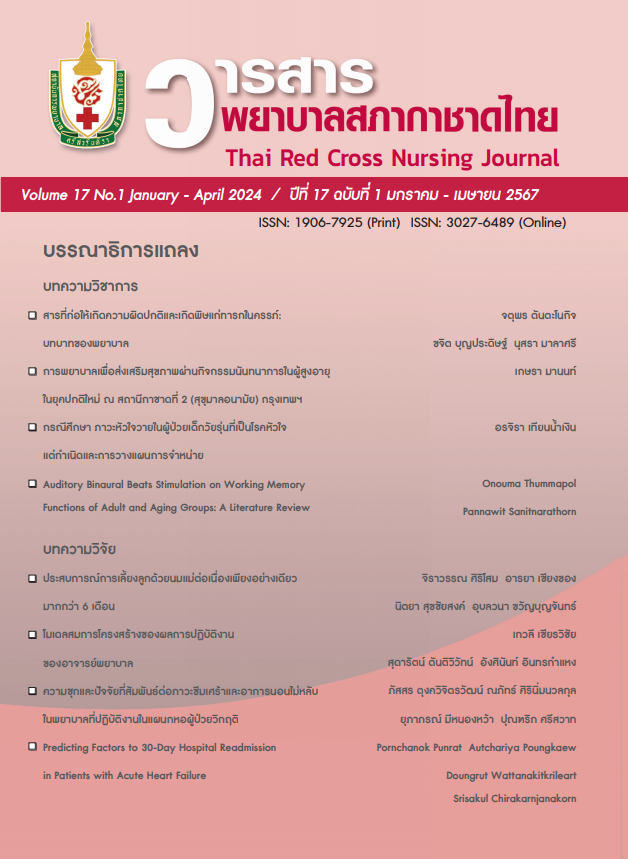
ประสบการณ์การเลี้ยงลูกด้วยนมแม่ต่อเนื่องเพียงอย่างเดียวมากกว่า 6 เดือน
คำสำคัญ:
การเลี้ยงลูกด้วยนมแม่เพียงอย่างเดียว, ประสบการณ์ของแม่, แม่ที่ทำงาน, การวิจัยเชิงคุณภาพแบบบรรยายบทคัดย่อ
การวิจัยนี้เป็นการวิจัยเชิงคุณภาพแบบพรรณนา มีวัตถุประสงค์เพื่อศึกษาประสบการณ์การเลี้ยงลูกด้วยนมแม่เพียงอย่างเดียวเกินระยะ 6 เดือน กลุ่มตัวอย่างเป็นแม่หลังคลอด คัดเลือกแบบเจาะจง กำหนดคุณสมบัติ เกณฑ์คัดเข้าคือ ทำงานเต็มเวลาและผ่านประสบการณ์การเลี้ยงลูกด้วยนมแม่อย่างต่อเนื่องเป็นเวลา 6 เดือนหรือมากกว่า จำนวน 15 ราย ทำการศึกษาที่ชุมชนบึงกาสาม อำเภอหนองเสือ จังหวัดปทุมธานี เก็บรวบรวมข้อมูลด้วยวิธีการสัมภาษณ์เชิงลึก วิเคราะห์ข้อมูลด้วยการวิเคราะห์เชิงเนื้อหา ความน่าเชื่อถือของข้อมูลวิจัยดำเนินการตามเกณฑ์ของลินคอนและกูบา
ผลการวิจัย พบว่าประสบการณ์การเลี้ยงลูกด้วยนมแม่จัดกลุ่มได้ 4 กลุ่มประสบการณ์ ดังนี้ 1) ความตั้งใจในการเลี้ยงลูกด้วยนมแม่ ประกอบด้วยการที่แม่มีความรู้เกี่ยวกับประโยชน์ของนมแม่ และนมแม่ช่วยประหยัดค่าใช้จ่าย 2) การฝ่าฟันอุปสรรค ประกอบด้วย ความยากในการเข้าเต้า การไม่มีน้ำนมหรือน้ำนมไม่พอ และการลดอุปสรรค 3) การได้รับการสนับสนุน ประกอบด้วย การสนับสนุนจากสมาชิกในครอบครัว นายจ้าง และเพื่อนร่วมงาน เพื่อนบ้าน 4) ผลลัพธ์ของการเลี้ยงลูกด้วยนมแม่ ประกอบด้วย ความผูกพันระหว่างแม่ลูก และความภาคภูมิใจ
ข้อเสนอแนะ แม่ที่ทำงานในขณะที่เลี้ยงลูกด้วยนมแม่เพียงอย่างเดียวต้องจัดการกับการเลี้ยงลูกด้วยนมแม่ในแต่ละวันในสถานการณ์ต่าง ๆ เพื่อให้บรรลุผลในการเลี้ยงลูกด้วยนมแม่เพียงอย่างเดียวในระยะเวลา 6 เดือน และต้องการการสนับสนุนจากหลายแหล่ง รวมทั้งการให้ความช่วยเหลือสนับสนุนจากหลายฝ่าย นำไปสู่ข้อเสนอแนะต่อทีมบุคลากรทางสุขภาพในการมีแผนการจัดการทั้งระยะสั้นและระยะยาว และโครงการเพื่อการส่งเสริมและสนับสนุนการเลี้ยงลูกด้วยนมแม่เพียงอย่างเดียวให้ประสบผลสำเร็จมากขึ้น
Downloads
เอกสารอ้างอิง
National Statistical Office. Project to survey the situation of children and women in Thailand 2019. Complete report. Bangkok: National Statistical Office; 2020. (in Thai)
Monteiro FR, Buccini GDS, Venâncio SI, da Costa THM. Influence of maternity leave on exclusive breastfeeding. J Pediatr 2017;93(5):475-81. doi:10.1016/j.jped.2016.11.016
Thepha T, Marais D, Bell J. Muangpin S. Perceptions of northeast Thai breastfeeding mothers regarding facilitators and barriers to six-month exclusive breastfeeding: focus group discussions. Int Breastfeed J 2018;13(14):1-10. doi:10.1186/s13006-018-0148-y
Prameswari GN, Kurnia AR. Qualitative study of exclusive breastfeeding succeeded among working mother. Advances in Health Science Research 2018;12:185-90. doi: 0.2991/isphe-18.2018.43
Phunpom C, Phahuwatanakorn W, Limruangrong P. Factors influencing a 6-month exclusive breastfeeding period in working mothers. Nursing Science Journal of Thailand 2020;38(1):47-59. (in Thai)
Rattasumpun S, Keawma B. Factors predicting successfulness in exclusive breastfeeding among working mothers. JRN-MHS 2018;38(4):14-24. (in Thai)
Abekah-Nkrumah G, Antwi MY, Nkrumah J, Gbagbo FY. Examining working mothers' experience of exclusive breastfeeding in Ghana. Int Breastfeed J 2020;15(1):56. doi: 10.1186/s13006-020-00300-0
Damchuti I, Kala S. Factors influencing the success of a 6-month exclusive breastfeeding period among working mothers. The Southern College Network Journal of Nursing and Public Health 2022;9(1):107-20. (in Thai)
Learkdumnearnkit P. Factors contributing to the success of exclusive breastfeeding for 6 months among: working mother in the lactation clinic health promotion center region 1 Chang Mai. Lanna Journal of Health Promotion and Environmental Health 2018;8(2):34-41. (in Thai)
Doyle L, McCabe C, Keogh B, Brady A, McCann M. An overview of the qualitative descriptive design within nursing research. J Res Nurs 2020;25(5):443-55. doi: 10.1177/ 1744987119880234
Lambert VA, Lambert CE. Qualitative descriptive research: an acceptable design. Pacific Rim Int J Nurs Res 2012;16(4):255-6.
Holloway I, Galvin K. Qualitative research in nursing and healthcare. 4thed. Chichester, West Sussex: John Wlley & Sons; 2017
Lincoln YS, Guba EG. Naturalistic inquiry. Newbury Park (CA): SAGE; 1985. doi:org/10.1016/0147-1767(85)90062-8.
Creswell JW. Research design: qualitative, quantitative and mixed methods approaches. 4th ed. London: Sage; 2014.
Ajzen I. The theory of planned behavior. Organ Behav Hum Decis Process 1991;50(2):179-211.
Sandelowski M. Whatever happened to qualitative description? Res Nurs Health 2000;23(4):334-40. doi:10.1002/1 098-240x(200008)23:43.0.co;2-g
Ritta W, Tachasuksri T, Suppasri P. Factors predicting exclusive breastfeeding intention for 6 months among working mothers in the industry. The Journal of Faculty of Nursing Burapha University 2020;28(3):66-78. (in Thai)
Pasuwan D. Success of exclusive breastfeeding for at least the first 6 months: a case study of Nakhon Pathom province. Kuakarun Journal of Nursing 2020;27(1):71-84. (in Thai)
Relaksana R, Akbar A, Sihaloho ED, Ferdian D, Siregar AY. The financial need of feeding infants for the first six months of life in West Java Province of Indonesia and the implications of socioeconomic and mental health factors. Int Breastfeed J 2023;18(1):26. doi: 10.1186/s13006-023-00561-5
Nutbeam D. Health literacy as a public health goal: a challenge for contemporary health education and communication strategies in to health 21st century. Health Promotion International 2000;15(3):259-67. doi: 10.1093/heapro/15.3.259
Office of the Surgeon General (US); Centers for Disease Control and Prevention (US); Office on Women's Health (US). The Surgeon General's Call to Action to Support Breastfeeding. Rockville (MD): Office of the Surgeon General (US). Barriers to breastfeeding in the United States [Internet]. 2011 [cited 2023 Jul 23] Available from: https://www.ncbi.nlm.nih.gov/books/NBK52688/
Quebu SR, Murray D, Okafor UB. Barriers to exclusive breastfeeding for mothers in Tswelopele municipality, free state province, South Africa: a qualitative study. Children (Basel) 2023;10(8):1380. doi:10.3390/children10081380
House JS. Social support and social structure. Sociol Forum 1987;2:135-46. doi:10.1007/BF01107897
Khaonark R, Kala S, Chatchawet W. Perception in breastfeeding of postpartum mothers with newborns hospitalized in neonatal intensive care unit. JRN-MHS 2020;40(1):30-44. (in Thai)
Lertsakornsiri M, Saibae S. The relationship between self-efficacy, self-esteem, attitude toward breastfeeding and breastfeeding behaviors in the first-time teenage postpartum mother
ดาวน์โหลด
เผยแพร่แล้ว
รูปแบบการอ้างอิง
ฉบับ
ประเภทบทความ
สัญญาอนุญาต
ลิขสิทธิ์ (c) 2024 สถาบันการพยาบาลศรีสวรินทิรา สภากาชาดไทย

อนุญาตภายใต้เงื่อนไข Creative Commons Attribution-NonCommercial-NoDerivatives 4.0 International License.
เนื้อหาบทความหรือข้อคิดเห็นต่างๆ ในวารสารพยาบาลสภากาชาดไทยนี้ เป็นความคิดเห็นของผู้เขียนบทความ ไม่ใช่ความเห็นของกองบรรณาธิการ หรือสถาบันการพยาบาลศรีสวรินทิรา สภากาชาดไทย


