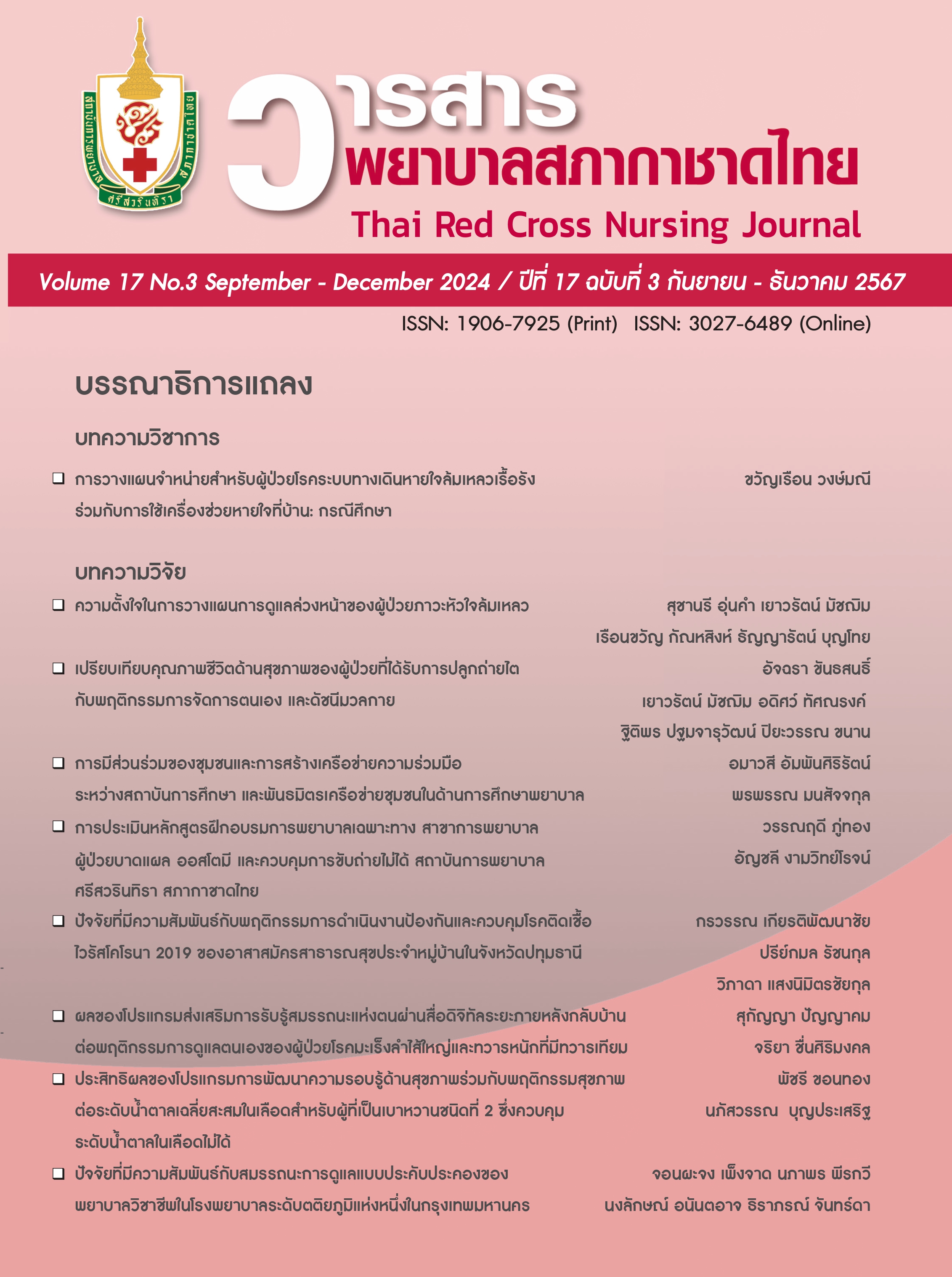
ผลของโปรแกรมส่งเสริมการรับรู้สมรรถนะแห่งตนผ่านสื่อดิจิทัล ระยะภายหลังกลับบ้านต่อพฤติกรรมการดูแลตนเองของผู้ป่วยโรคมะเร็งลำไส้ใหญ่และทวารหนักที่มีทวารเทียม
คำสำคัญ:
โปรแกรมส่งเสริมการรับรู้สมรรถนะแห่งตน, พฤติกรรมการดูแลตนเอง, มะเร็งลำไส้ใหญ่และทวารหนัก, ทวารเทียม, สื่อดิจิทัลบทคัดย่อ
การวิจัยแบบกึ่งทดลองครั้งนี้มีวัตถุประสงค์ เพื่อศึกษาผลของโปรแกรมส่งเสริมการรับรู้สมรรถนะแห่งตนผ่านสื่อดิจิทัลระยะภายหลังกลับบ้านต่อพฤติกรรมการดูแลตนเองของผู้ป่วยโรคมะเร็งลำไส้ใหญ่และทวารหนักที่มีทวารเทียม กลุ่มตัวอย่าง คือ ผู้ป่วยที่ได้รับการวินิจฉัยเป็นโรคมะเร็งลำไส้ใหญ่และทวารหนัก รักษาด้วยการผ่าตัดเพื่อทำทวารเทียมรายใหม่ ภายหลังจำหน่ายออกจากโรงพยาบาล 2 สัปดาห์ กลุ่มควบคุมได้รับการพยาบาลตามปกติ และกลุ่มทดลองได้รับโปรแกรมส่งเสริมการรับรู้สมรรถนะแห่งตนผ่านสื่อดิจิทัล กลุ่มละ 30 คน เครื่องมือที่ใช้ 1) โปรแกรมส่งเสริมการรับรู้สมรรถนะแห่งตนผ่านสื่อดิจิทัลระยะภายหลังกลับบ้าน 2) แบบสอบถามพฤติกรรมการดูแลตนเองของผู้ป่วยที่มีทวารเทียม เครื่องมือวิจัยทั้งหมดได้ผ่านการตรวจสอบคุณภาพด้านความตรงและความเที่ยงจากผู้ทรงคุณวุฒิ 5 ท่าน มีค่าความสอดคล้องกับวัตถุประสงค์ เท่ากับ 1.00 และ 0.96 ตามลำดับ ค่าความเที่ยงของแบบสอบถามพฤติกรรมการดูแลตนเอง ด้วยวิธีสัมประสิทธิ์แอลฟาของครอนบาค ได้เท่ากับ 0.91 วิเคราะห์ข้อมูลโดยการใช้ความถี่ ร้อยละ ค่าเฉลี่ยส่วนเบี่ยงเบนมาตรฐาน และสถิติทดสอบที วิเคราะห์ข้อมูล ด้วยความถี่ ร้อยละ ค่าเฉลี่ย ส่วนเบี่ยงเบนมาตรฐานและสถิติทดสอบที ผลการวิจัย พบว่า กลุ่มทดลองมีคะแนนเฉลี่ยพฤติกรรมการดูแลตนเองอยู่ในระดับดีและสูงกว่ากลุ่มควบคุมอย่างมีนัยสําคัญทางสถิติ (p <.05)
สรุปว่าโปรแกรมส่งเสริมการรับรู้สมรรถนะแห่งตนผ่านสื่อดิจิทัลระยะภายหลังกลับบ้านต่อพฤติกรรมการดูแลตนเองของผู้ป่วยโรคมะเร็งลำไส้ใหญ่และทวารหนักที่มีทวารเทียมสามารถประยุกต์ใช้กับผู้ป่วยโรคมะเร็งลำไส้ใหญ่และทวารหนักที่มีทวารเทียมภายหลังออกจากโรงพยาบาลส่งผลให้ผู้ป่วยมีพฤติกรรมการดูแลตนเองที่ถูกต้องและเหมาะสม
Downloads
เอกสารอ้างอิง
Morgan E, Arnold M, Gini A, Lorenzoni V, Cabasag C, Laversanne M, et al. Global burden of colorectal cancer in 2020 and 2040: incidence and mortality estimates from GLOBOCAN. Gut 2023;72(2):338-44.
National Cancer Institute Department of Medical services ministry of public health Thailand. Hospital-based cancer registry 2022 [Internet] 2023 [cited 2024 Jan 12]. Available from: https://www.nci.go.th/th/cancer_record/download/Hosbased-2022-1.pdf (in Thai)
Giordano V, Nicolotti M, Corvese F, Vellone E, Alvaro R, Villa G. Describing self-care and its associated variables in ostomy patients. J Adv Nurs 2020;76(11):2982-92.
Claessens I, Probert R, Tielemans C, Steen A, Nilsson C, Andersen BD, et al. The Ostomy Life Study: the everyday challenges faced by people living with a stoma in a snapshot. Gastrointestinal Nursing 2015;13(5):18-25.
Goodman W, Allsop M, Downing A, Munro J, Taylor C, Hubbard G, et al. A systematic review and meta-analysis of the effectiveness of self-management interventions in people with a stoma. J Adv Nurs 2022;78(3):722-38.
Villa G, Vellone E, Sciara S, Stievano A, Proietti MG, Manara DF, et al. Two new tools for self-care in ostomy patients and their informal caregivers: psychosocial, clinical, and operative aspects. Int J Urol Nurs 2019;13(1):23-30.
Justiniano CF, Temple LK, Swanger AA, Xu Z, Speranza JR, Cellini C, et al. Readmissions with dehydration after ileostomy creation: rethinking risk factors. Dis Colon Rectum 2018;61(11):1297-305.
Malik T, Lee M, Harikrishnan A. The incidence of stoma related morbidity–a systematic review of randomised controlled trials. Ann R Coll Surg Engl 2018;100(7):501-8.
Wannawong S, Isaramalai S, Kahawong W, Naknual S. Efficiency of program to support and enhance care agency to prevent complications in ostomates. Princess of Naradhiwas University Journal 2014;6(3):36-48. (in Thai)
Chutikamo N, Navicharern R, Lohsiriwat V. Predicting factors of quality of life in colorectal cancer adult patients with colostomy. Royal Thai Navy Medical Journal 2018;44(3):103-16. (in Thai)
Habiba RSA, Bedier NA, Ahmed HAM. Assessment of knowledge and self-efficacy among patients with colostomy. IJNRHN 2021;8(3):31-47.
Su X, Qin F, Zhen L, Ye X, Kuang Y, Zhu M, et al. Self-efficacy and associated factors in patients with temporary ostomies: a cross-sectional survey. J Wound Ostomy Continence Nurs 2016;43(6):623-9.
Phamornpon S, Nooyam B, Kanjanasilp P. Effects of self-efficacy-promoting programme on self-care ability of persons with stoma. J Thai Nurse midwife Counc 2020;36(1):52-70. (in Thai)
Goldblatt J, Buxey K, Paul E, Foot-Connolly R, Leech T, Bell S. Study on the time taken for patients to achieve the ability to self-care their new stoma. ANZ J Surg 2018;88(6):E503-E6.
Zainuddin M, Kadir K, Wijayanti AR, Syam Y, Majid A. Effect of digital storytelling on self-efficacy of patients with a stoma: preliminary study. Enferm Clin 2020;30:229-33.
Bandura A, Freeman WH, Lightsey R. Self-efficacy: the exercise of control. J Cogn Psychother 1999;13(2):158-66.
Muenya S. Exercise for the elderly: applying self-efficacy. Boromarajonani College of Nursing, Uttaradit Journal 2021;25(1):59-69. (in Thai)
The Foundation of Thai Gerontology Research and Development Institute. Survey on dementia in elderly Thai people 2000/commission on developing the dementia screening test (Thai Version) 1999. Bangkok: Foundation of Thai Gerontology Research and Development Institute; 2000. (in Thai)
Riegel B, Jaarsma T, Strömberg A. A middle-range theory of self-care of chronic illness. ANS Adv Nurs Sci 2012;35(3):194-204.
Ladasoontorn S, Kanogsunthorntra N, Chaiviboontham S. The effect of video assisted teaching program on ostomy care knowledge and skills among new ostomate’s caregivers. Ramathibodi Nursing Journal 2019;25(1):43-57. (in Thai)
Laiphan N. Effect of teaching program on stoma care self-efficacy and stoma care behavior of patient with colostomy [Thesis]. Chiang Mai: Chiang Mai University; 1999. (in Thai)
Kraisoda K, Srimoragot P, Wongkongkum K. The effects of self-efficacy promotion program toward the stoma skin care on self-care ability of patients and caregivers. Thai Journal of Nursing 2022;71(3):44-53. (in Thai)
Abd El-Rahman WA, Mekkawy MM, Ayoub MT, Sayed SY. Effect of nursing instructions on self-care for colostomy patients. Assiut Scientific Nursing Journal 2020;8(23):96-105.
ดาวน์โหลด
เผยแพร่แล้ว
รูปแบบการอ้างอิง
ฉบับ
ประเภทบทความ
สัญญาอนุญาต
ลิขสิทธิ์ (c) 2024 สถาบันการพยาบาลศรีสวรินทิรา สภากาชาดไทย

อนุญาตภายใต้เงื่อนไข Creative Commons Attribution-NonCommercial-NoDerivatives 4.0 International License.
เนื้อหาบทความหรือข้อคิดเห็นต่างๆ ในวารสารพยาบาลสภากาชาดไทยนี้ เป็นความคิดเห็นของผู้เขียนบทความ ไม่ใช่ความเห็นของกองบรรณาธิการ หรือสถาบันการพยาบาลศรีสวรินทิรา สภากาชาดไทย


