
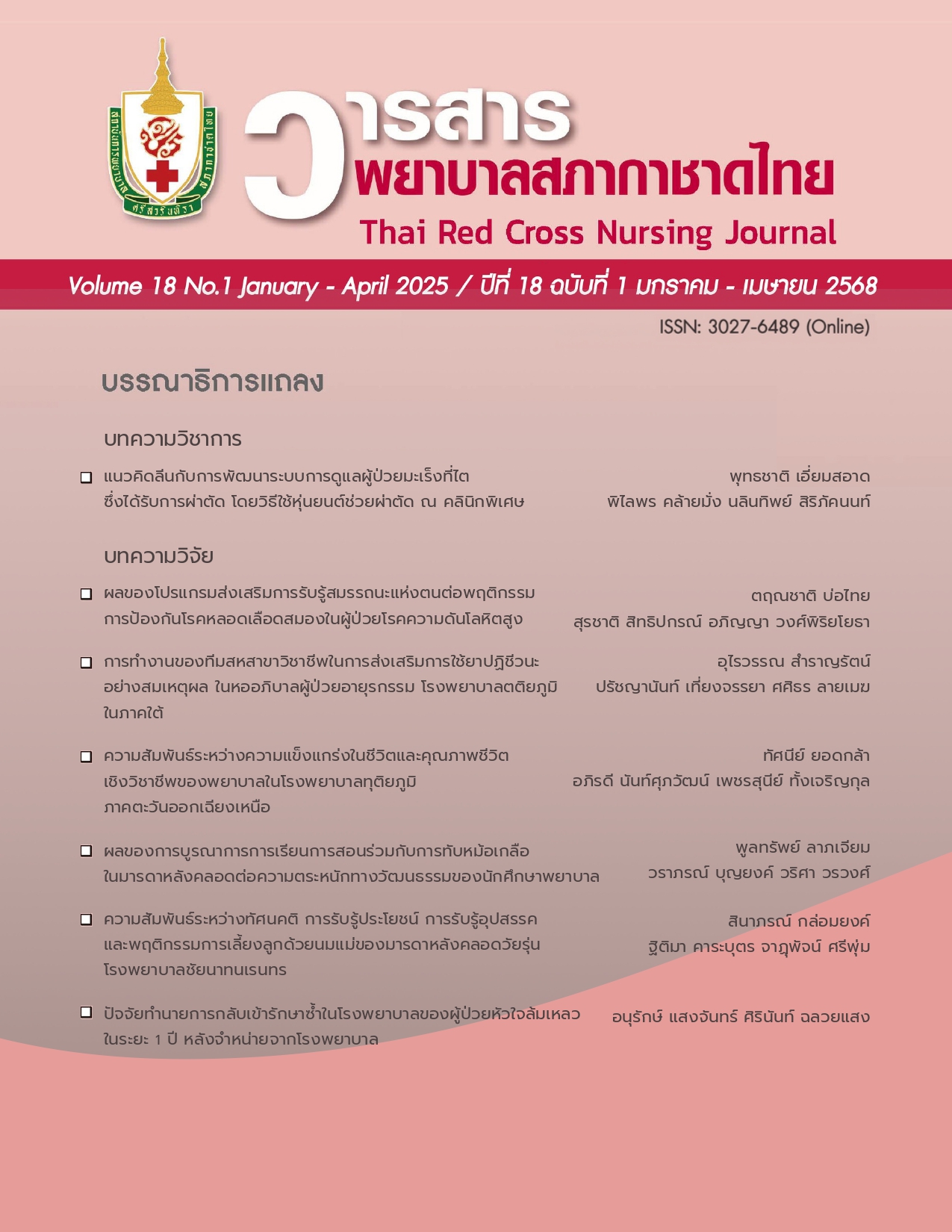
Factors Predicting Hospital Readmission within One Year among Patients with Heart Failure after Hospital Discharge
DOI:
https://doi.org/10.64767/trcn.2025.272070Keywords:
heart failure, family involvement, health literacyAbstract
This study investigates the predictive relationship of various factors associated with hospital readmission within one year among patients with heart failure. The participants were 130 patients with heart failure treated at the outpatient department of a general hospital in Udon Thani province from January to April 2024. The research tools included personal information, medical history, a health literacy assessment (Cronbach's alpha = .94), and a family support scale (content accuracy = 0.90, Cronbach's alpha = .95). Data analysis was performed using descriptive statistics and binary logistic regression.
The results show that the incidence of hospital readmission within one year for patients with heart failure was 45.40% (n = 59). Age, health literacy, and family support were significant predictors of hospital readmission, accounting for 69.20% of the variance. Patients aged 49-59 and 59-69 were six times more likely to be readmitted than those aged 69-79 (OR 6.68 ; 95%CI 1.67-26.71, p < 0.05 and OR 6.28; 95%CI 1.88-21.03, p < 0.05, respectively). Patients with moderate health literacy were more than four times more likely to be readmitted to the hospital compared to those with very good health literacy (OR 4.05; 95% CI 1.20-13.90,
p < 0.05). Additionally, patients with moderate family support were more than three times more likely to be readmitted to the hospital compared to those with high family support (OR 3.40 ; 95% CI 1.18-9.74, p < 0.05).
The study suggests that further research should focus on reducing readmission rates by developing programs that consider age, health knowledge, and family support.
Downloads
References
Groenewegen A, Rutten FH, Mosterd A, Hoes AW. Epidemiology of heart failure. Eur J Heart Fail 2020;22(8):1342-56. DOI: https://doi.org/10.1002/ejhf.1858
Bozkurt B, Ahmad T, Alexander KM, Baker WL, Bosak K, Breathett K, et al. Heart failure epidemiology and outcomes statistics: a report of the Heart Failure Society of America. J Card Fail 2023;29(10):1412-51. DOI: https://doi.org/10.1016/j.cardfail.2023.07.006
Health Data Center. HDC-Report [database on the Internet]. 2024 [cited 2024 Jun 4]. Available from: https://hdc.moph.go.th/center/public/standard-report-detail/e2a5a66dd74fa1252fcf786674f05f02 (in Thai)
Wanichang K. Mortality and re-hospitalization in chronic heart failure in Mahasarakham hospital. Mahasarakham Hospital Journal 2022;19(3):15-27. (in Thai)
Foroutan F, Rayner DG, Ross HJ, Ehler T, Srivastava A, Shin S, et al. Global comparison of readmission rates for patients with heart failure. J Am Coll Cardiol 2023;82(5):430-44. DOI: https://doi.org/10.1016/j.jacc.2023.05.040
Lertpongpakpoom S, Phonphet C, Suwanno J. Predictors of readmission after one-year hospital discharge with acute decompensated heart failure. Thai J Cardio-Thorac Nurs 2019;30(2):126-40. (in Thai)
Longlalerng W. Love your heart program. TUH Journal Online 2020;5(3):61-70. (in Thai)
Chamberlain RS, Sond J, Mahendraraj K, Lau CS, Siracuse BL. Determining 30-day readmission risk for heart failure patients: the readmission after heart failure scale. Int J Gen Med 2018;11:127-41. DOI: https://doi.org/10.2147/IJGM.S150676
Li H, Hastings MH, Rhee J, Trager LE, Roh JD, Rosenzweig A. Targeting age-related pathways in heart failure. Circ Res 2020;126(4):533-51. DOI: https://doi.org/10.1161/CIRCRESAHA.119.315889
Fabbri M, Murad MH, Wennberg AM, Turcano P, Erwin PJ, Alahdab F, et al. Health literacy and outcomes among patients with heart failure: A systematic review and meta-analysis. JACC Heart Fail 2020;8(6):451-60. DOI: https://doi.org/10.1016/j.jchf.2019.11.007
Noori A, Shokoohi M, Baneshi MR, Naderi N, Bakhshandeh H, Haghdoost AA. Impact of socio-economic status on the hospital readmission of congestive heart failure patients: a prospective cohort study. Int J Health Policy Manag 2014;3(5):251-57. DOI: https://doi.org/10.15171/ijhpm.2014.94
Deek H, Chang S, Newton PJ, Noureddine S, Inglis SC, Arab GA, et al. An evaluation of involving family caregivers in the self-care of heart failure patients on hospital readmission: randomised controlled trial (the family study). Int J Nurs Stud 2017;75:101-1. DOI: https://doi.org/10.1016/j.ijnurstu.2017.07.015
Glans M, Kragh Ekstam A, Jakobsson U, Bondesson Å, Midlöv P. Risk factors for hospital readmission in older adults within 30 days of discharge–a comparative retrospective study. BMC Geriatr 2020;20(1):467. DOI: https://doi.org/10.1186/s12877-020-01867-3
Thawa N, Tunyarak H. Factors Associated with quality of life among working age people in PakPhun Community, Nakhon Si Thammarat Province. Journal of Health Science 2023;32(1):31-42. (in Thai)
Sangsinsorn P. A study of factors related to health behavior of people at risk of diabetes and hypertension in Phichit Province. Phichit Public Health Research and Academic Journal 2021;2(2):43-54. (in Thai)
Nielsen-Bohlman L, Panzer AM, Kindig DA, editors. Health literacy: a prescription to end confusion [Internet]. Washington: The National Academies Press; 2004. [cited 2024 Jun 21]. DOI: https://doi.org/10.17226/10883
Wu JR, Holmes GM, DeWalt DA, Macabasco-O'Connell A, Bibbins-Domingo K, Ruo B, et al. Low literacy is associated with increased risk of hospitalization and death among individuals with heart failure. J Gen Intern Med 2013;28(9):1174-80. DOI: https://doi.org/10.1007/s11606-013-2394-4
Shahid R, Shoker M, Chu LM, Frehlick R, Ward H, Pahwa P. Impact of low health literacy on patients’ health outcomes: a multicenter cohort study. BMC Health Serv Res 2022;22(1):1148. DOI: https://doi.org/10.1186/s12913-022-08527-9
Riegel B, Moser DK, Anker SD, Lawrence JB, Dunbar SB, Dracup K, et al. State of the science: promoting self-care in persons with heart failure: a scientific statement from the American Heart Association. Circulation 2009;120(12):1141-63. DOI: https://doi.org/10.1161/CIRCULATIONAHA.109.192628
Krejcie RV, Morgan DW. Determining sample size for research activities. Educ Psychol Meas 1970;30(3):607-10. DOI: https://doi.org/10.1177/001316447003000308
Intarakamhang U. Creating and developing of Thailand health literacy scales [database on the Internet]. [cited 2024 Jun 21]. Available from: http://bsris.swu.ac.th/upload/268335.pdf (in Thai)
Osborn RH, Batterham RW, Elsworth GR, Hawkins M, Buchbinder R. The grounded psychometric development and initial validation of the health literacy questionnaire (HLQ). BMC Public Health 2013;13:658. DOI: https://doi.org/10.1186/1471-2458-13-658
House JS, Kahn RL, McLeod JD, Williams D. Measures and concepts of social support. In: Cohen S, Syme SL, editors. Social support and health. Orlando: Academic Press; 1985. p. 83-108.
Son YJ, Won MH. Gender differences in the impact of health literacy on hospital readmission among older heart failure patients: a prospective cohort study. J Adv Nurs 2020;76(6):1345–54. DOI: https://doi.org/10.1111/jan.14328
Shahriari M, Ahmadi M, Babaee S, Mehrabi T, Sadeghi M. Effects of a family support program on self-care behaviors in patients with congestive heart failure. Iran J Nurs Midwifery Res 2013;18(2):152-7.
Downloads
Published
How to Cite
Issue
Section
License
Copyright (c) 2025 Srisavarindhira Thai Red Cross Institute of Nursing

This work is licensed under a Creative Commons Attribution-NonCommercial-NoDerivatives 4.0 International License.
เนื้อหาบทความหรือข้อคิดเห็นต่างๆ ในวารสารพยาบาลสภากาชาดไทยนี้ เป็นความคิดเห็นของผู้เขียนบทความ ไม่ใช่ความเห็นของกองบรรณาธิการ หรือสถาบันการพยาบาลศรีสวรินทิรา สภากาชาดไทย


