
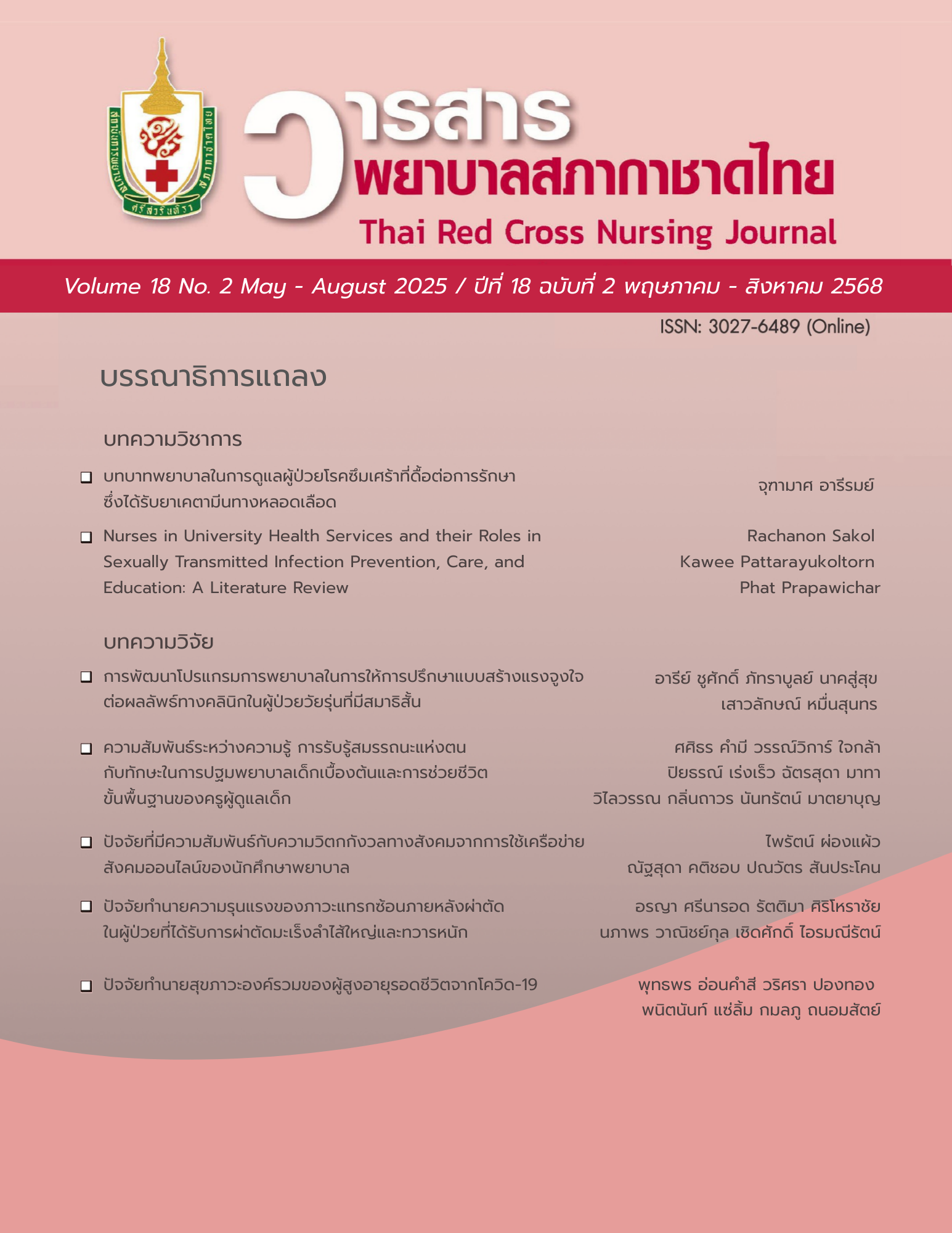
การพัฒนาโปรแกรมการพยาบาลในการให้การปรึกษาแบบสร้างแรงจูงใจ ต่อผลลัพธ์ทางคลินิกในผู้ป่วยวัยรุ่นที่มีสมาธิสั้น
DOI:
https://doi.org/10.64767/trcn.2025.272690คำสำคัญ:
โปรแกรมการพยาบาล, การปรึกษาแบบสร้างแรงจูงใจ, ความร่วมมือในการใช้ยา, สมาธิสั้น, วัยรุ่นบทคัดย่อ
การวิจัยนี้มีวัตถุประสงค์เพื่อพัฒนาและศึกษาผลของโปรแกรมการพยาบาลในการให้การปรึกษาแบบสร้างแรงจูงใจต่อผลลัพธ์ทางคลินิกในผู้ป่วยวัยรุ่นที่มีสมาธิสั้นใช้กระบวนการพัฒนาโปรแกรมของไมเจลและคณะ 5 ระยะ ได้แก่ 1) การกำหนดปัญหา 2) การสำรวจความต้องการเนื้อหาและกิจกรรมที่ต้องการพัฒนาโปรแกรม 3) การออกแบบโปรแกรมการทดลอง 4) การตรวจสอบความตรง การประเมินความเป็นไปได้ และการยอมรับโปรแกรม และ 5) การทดสอบผลลัพธ์ของโปรแกรม กลุ่มตัวอย่าง ประกอบด้วยผู้ป่วยวัยรุ่นที่ได้รับการวินิจฉัยว่าเป็นโรคสมาธิสั้น จำนวน 62 ราย และผู้ปกครอง แบ่งเป็นกลุ่มทดลองและกลุ่มควบคุม กลุ่มละ 31 ราย ด้วยการสุ่มอย่างง่าย เครื่องมือที่ใช้ในการวิจัย ได้แก่ โปรแกรมการพยาบาลในการ ให้การปรึกษาแบบสร้างแรงจูงใจ (ความตรงเชิงเนื้อหา CVI = 0.84) แบบประเมินความร่วมมือในการใช้ยา และแบบประเมินพฤติกรรมสมาธิสั้น (ค่าความเชื่อมั่น = 0.76, 0.82 ตามลำดับ) เก็บรวบรวมข้อมูลก่อนและภายหลังได้รับโปรแกรม วิเคราะห์ข้อมูลด้วยสถิติ Wilcoxon Signed Ranks Test และ Mann-Whitney U-test
ผลการวิจัย 1) การพัฒนาโปรแกรมการพยาบาลในการให้การปรึกษาแบบสร้างแรงจูงใจต่อผลลัพธ์ทางคลินิกในผู้ป่วยวัยรุ่นที่มีสมาธิสั้น เกิดจากการสำรวจปัญหาและการทบทวนวรรณกรรม ประกอบด้วย 7 กิจกรรม 2) กลุ่มทดลองภายหลังได้รับโปรแกรม มีคะแนนความร่วมมือในการใช้ยามากกว่าก่อนเข้าร่วมโปรแกรมและพฤติกรรมสมาธิสั้นลดลง อย่างมีนัยสำคัญทางสถิติ (p < .001) 3) คะแนนความร่วมมือในการใช้ยา และพฤติกรรมสมาธิสั้นของผู้ป่วยวัยรุ่นที่มีสมาธิสั้นระหว่างกลุ่มทดลองและกลุ่มควบคุม โดยใช้ Mann-Whitney U-test พบว่าไม่แตกต่างกัน อย่างมีนัยสำคัญทางสถิติ (p > .05) ในทั้งสองตัวแปร สรุปได้ว่าโปรแกรมการพยาบาลในการให้การปรึกษาแบบสร้างแรงจูงใจสามารถช่วยส่งเสริมความร่วมมือในการใช้ยาและลดพฤติกรรมสมาธิสั้นในกลุ่มวัยรุ่นสมาธิสั้นได้อย่างมีประสิทธิภาพในระดับรายบุคคล แม้ยังไม่พบความแตกต่างเมื่อเปรียบเทียบกับกลุ่มควบคุม จึงควรมีการศึกษาต่อเนื่องในกลุ่มตัวอย่างขนาดใหญ่ และในระยะเวลาติดตามผลที่ยาวนานขึ้น เพื่อยืนยันผลลัพธ์ในกลุ่มประชากร
Downloads
เอกสารอ้างอิง
Ayano G, Demelash S, Gizachew Y, Tsegay L, Alati R. The global prevalence of attention deficit hyperactivity disorder in children and adolescents: an umbrella review of meta-analyses. J Affect Disord 2023:339:860-6. DOI: https://doi.org/10.1016/j.jad.2023.07.071
Cénat JM, Kokou Kpolou CK, Blais Rochette C, Morse C, Vandette MP, Dalexis RD, et al. Prevalence of ADHD among black youth compared to white, Latino and Asian youth: a meta analysis. J Clin Child Adolesc Psychol 2024;53(3):373-88. DOI: https://doi.org/10.1080/15374416.2022.2051524
Visanuyothin T, Pavasuthipaisit C, Wachiradilok P, Arunruang P, Buranasuksakul T. The prevalence of attention deficit/hyperactivity disorder in Thailand. Journal of Mental Health of Thailand 2013;21(2):66-75. (in Thai)
Department of Mental Health. Incidence and prevalence of attention deficit hyperactivity disorder (ADHD) in Thai children aged 6-15 years, fiscal years 2023–2024 (January–November): Health Data Center (HDC) [Internet]. Nonthaburi: Department of Mental Health Knowledge Repository; 2024 [cited 2025 Apr 8]. Available from: https://dmh-elibrary.org/items/show/1802
Salari N, Ghasemi H, Abdoli N, Rahmani A, Shiri MH, Hashemian AH, et al. The global prevalence of ADHD in children and adolescents: a systematic review and meta-analysis. Ital J Pediatr 2023;49(1):48. DOI: https://doi.org/10.1186/s13052-023-01456-1
Austgulen A, Skram NKG, Haavik J, Lundervold AJ. Risk factors of suicidal spectrum behaviors in adults and adolescents with attention deficit/hyperactivity disorder – a systematic review. BMC Psychiatry 2023;23(1):612. DOI: https://doi.org/10.1186/s12888-023-05099-8
Powell V, Riglin L, Hammerton G, Eyre O, Martin J, Anney R, et al. What explains the link between childhood ADHD and adolescent depression? Investigating the role of peer relationships and academic attainment. Eur Child Adolesc Psychiatry 2020;29(11):1581-91. DOI: https://doi.org/10.1007/s00787-019-01463-w
Upadhyay N, Chen H, Mgbere O, Bhatara VS, Aparasu RR. The impact of pharmacotherapy on substance use in adolescents with attention deficit/hyperactivity disorder: variations across subtypes. Subst Use Misuse 2017;52(10):1266-74. DOI: https://doi.org/10.1080/10826084.2016.1273955
Polanczyk GV, Salum GA, Sugaya LS, Caye A, Rohde LA. Annual research review: a meta analysis of the worldwide prevalence of mental disorders in children and adolescents. J Child Psychol Psychiatry 2015;56(3):345-65. DOI: https://doi.org/10.1111/jcpp.12381
Alghamdi T, Helou M, Jeyaseelan L, Sultan MA. Stress level of parents of children diagnosed with attention deficit/hyperactivity disorder (ADHD) in Dubai, United Arab Emirates. Emirates Med J 2023;4(2): e170323214707. DOI: https://doi.org/10.2174/04666230317110616
Cortese S, Adamo N, Del Giovane C, Mohr Jensen C, Hayes AJ, Carucci S, et al. Comparative efficacy and tolerability of medications for attention-deficit hyperactivity disorder in children, adolescents, and adults: a systematic review and network meta-analysis. Lancet Psychiatry 2018;5(9):727-38. DOI: https://doi.org/10.1016/S2215-0366(18)30269-4
Johnson M, Åsberg Johnels J, Östlund S, Cedergren K, Omanovic Z, Hjalmarsson K, et al. Long term medication for ADHD and development of cognitive functions in children and adolescents. J Psychiatr Res 2021;142:204-9. DOI: https://doi.org/10.1016/j.jpsychires.2021.07.055
Peterson BS, Trampush J, Maglione M, Bolshakova M, Rozelle M, Miles J, et al. Treatments for ADHD in children and adolescents: a systematic review. Pediatrics 2024;153(4):e2024065787. DOI: https://doi.org/10.1542/peds.2024-065787
Sibley MH, Kuriyan AB, Evans SW, Waxmonsky JG, Smith BH. Pharmacological and psychosocial treatments for adolescents with ADHD: an updated systematic review of the literature. Clin Psychol Rev 2014;34(3):218-32. DOI: https://doi.org/10.1016/j.cpr.2014.02.001
Ching C, Eslick GD, Poulton AS. Evaluation of methylphenidate safety and maximum-dose titration rationale in attention-deficit/hyperactivity disorder: a meta-analysis. JAMA Pediatr 2019;173(7):630-9. DOI: https://doi.org/10.1001/jamapediatrics.2019.0905
Rashid MA, Lovick S, Llanwarne NR. Medication taking experiences in attention deficit hyperactivity disorder: a systematic review. Fam Pract 2018;35(2):142-50. DOI: https://doi.org/10.1093/fampra/cmx088
Sibley MH, Graziano PA, Coxe SJ, Bickman L, Martin P. Effectiveness of motivational interviewing enhanced behavior therapy for adolescents with attention deficit/hyperactivity disorder: a randomized community based trial. J Am Acad Child Adolesc Psychiatry 2021;60(6):745-56. DOI: https://doi.org/10.1016/j.jaac.2020.07.907
Kamimura-Nishimura KI, Brinkman WB, Froehlich TE. Strategies for improving ADHD medication adherence. Curr psychiatr 2019;18(8):25-38.
Rosenau PT, Dietrich A, van den Hoofdakker BJ, Hoekstra PJ. ADHD medication adherence reduces risk of committing minor offenses in adolescents. J Child Psychol Psychiatry 2024;65(11):1478-85. DOI: https://doi.org/10.1111/jcpp.13997
Sibley MH, Graziano PA, Coxe S, Page TF, Martin P. Three year effects of motivational interviewing enhanced behavior therapy for adolescents with attention deficit/hyperactivity disorder: a randomized community based trial. J Am Acad Child Adolesc Psychiatry 2024:S0890-8567(24)01948-8.
Palacio A, Garay D, Langer B, Taylor J, Wood BA, Tamariz L. Motivational interviewing improves medication adherence: a systematic review and meta analysis. J Gen Intern Med 2016;31(8):929–40. DOI: https://doi.org/10.1007/s11606-016-3685-3
Van Meijel B, Gamel C, van Swieten-Duijfjes B, Grypdonck MHF. The development of evidence based nursing interventions: methodological considerations. J Adv Nurs 2004;48(1):84-92. DOI: https://doi.org/10.1111/j.1365-2648.2004.03171.x
Miller WR, Rollnick S. Motivational interviewing: helping people change. 3rd ed. New York: Guilford Press; 2013.
Raksawong N, Buala S, Mueansunthon S. The effect of motivational interviewing on medication adherence of patients and families in the use of ADHD medication. In: Dechkong T, editor. Proceedings of 23rd Annual International Mental Health Conference 2024; 2024 Jul 30-31, Aug 1; Bangkok, Thailand. Nonthaburi: Department of Mental Health, Ministry of Public Health; 2024. p.125. (in Thai)
American Psychiatric Association. Diagnostic and statistical manual of mental disorders. 5th ed., text rev. Arlington, VA: American Psychiatric Publishing; 2022. DOI: https://doi.org/10.1176/appi.books.9780890425787
Krejcie RV, Morgan DW. Determining sample size for research activities. Educ Psychol Meas 1970;30(3):607-10. DOI: https://doi.org/10.1177/001316447003000308
Polit DF, Beck CT. Nursing research: generating and assessing evidence for nursing practice. 11th ed. Philadelphia: Wolters Kluwer; 2021.
Miller WR, Rollnick S. Motivational interviewing: preparing people to change addictive behavior. New York: Guilford Press; 1991.
Morisky DE, Ang A, Krousel Wood M, Ward HJ. Predictive validity of a medication adherence measure in an outpatient setting. J Clin Hypertens (Greenwich) 2008;10(5):348-54. DOI: https://doi.org/10.1111/j.1751-7176.2008.07572.x
Sakthong P, Chabunthom R, Charoenvisuthiwongs R. Psychometric properties of the Thai version of the 8 item morisky medication adherence scale in patients with type 2 diabetes. Ann Pharmacother 2009;43(5):950-7. DOI: https://doi.org/10.1345/aph.1L453
Swanson J, Lerner M, March J, Gresham FM. Assessment and intervention for attention deficit/hyperactivity disorder in the schools: lessons from the MTA study. Pediatr Clin North Am 1999;46(5):993-1009. DOI: https://doi.org/10.1016/S0031-3955(05)70168-1
Pityaratstian N, Booranasuksakul T, Juengsiragulwit D, Benyakorn S. ADHD screening properties of the Thai version of Swanson, Nolan, and Pelham IV scale (SNAP IV) and Strengths and Difficulties Questionnaire (SDQ). J Psychiatr Assoc Thailand 2014;59(2):97-110. (in Thai)
Boontavee S, Sethabouppha H, Thamthai K. Effect of the motivational interviewing program with parental participation on game addiction behaviors of adolescents with attention deficit hyperactivity disorders. J Psychiatr Nurs Ment Health 2024;38(1):1-14. (in Thai)
Miller WR, Rollnick S. Motivational interviewing: helping people change and grow. 4th ed. New York: Guilford Press; 2023.
Khan MU, Aslani P. Exploring factors influencing medication adherence from initiation to discontinuation in parents and adolescents with attention deficit hyperactivity disorder. Clin Pediatr (Phila) 2020;59(3):285-96. DOI: https://doi.org/10.1177/0009922819900973
Charach A, Ickowicz A, Schachar R. Stimulant treatment over five years: adherence, effectiveness, and adverse effects. J Am Acad Child Adolesc Psychiatry 2004;43(5):559-67. DOI: https://doi.org/10.1097/00004583-200405000-00009
Gau SS, Shen HY, Soong WT, Gau CS. An open-label, randomized, active-controlled equivalent trial of osmotic release oral system methylphenidate in children with attention-deficit/hyperactivity disorder in Taiwan. J Child Adolesc Psychopharmacol 2006;16(4):441-55. DOI: https://doi.org/10.1089/cap.2006.16.441
Barkley RA, Fischer M, Smallish L, Fletcher K. The persistence of attention-deficit/hyperactivity disorder into young adulthood as a function of reporting source and definition of disorder. J Abnorm Psychol 2002;111(2):279-89. DOI: https://doi.org/10.1037//0021-843X.111.2.279
ดาวน์โหลด
เผยแพร่แล้ว
รูปแบบการอ้างอิง
ฉบับ
ประเภทบทความ
สัญญาอนุญาต
ลิขสิทธิ์ (c) 2025 สถาบันการพยาบาลศรีสวรินทิรา สภากาชาดไทย

อนุญาตภายใต้เงื่อนไข Creative Commons Attribution-NonCommercial-NoDerivatives 4.0 International License.
เนื้อหาบทความหรือข้อคิดเห็นต่างๆ ในวารสารพยาบาลสภากาชาดไทยนี้ เป็นความคิดเห็นของผู้เขียนบทความ ไม่ใช่ความเห็นของกองบรรณาธิการ หรือสถาบันการพยาบาลศรีสวรินทิรา สภากาชาดไทย


